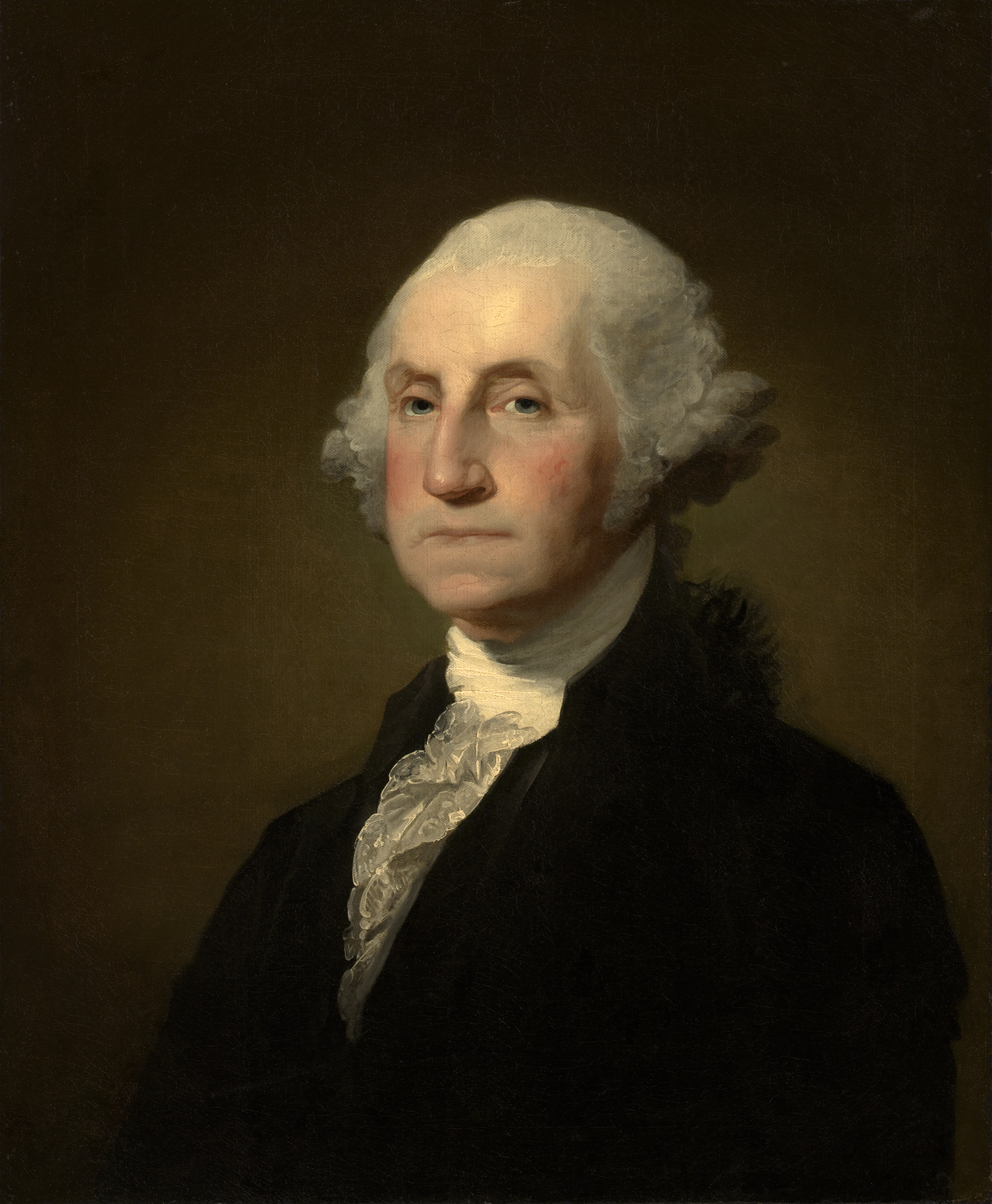
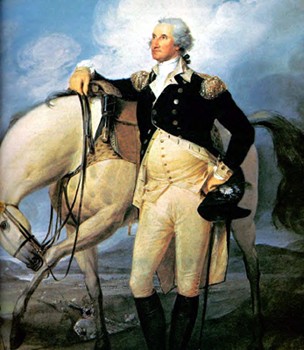
Thanksgiving celebrations since the time of the Pilgrims and Puritans had been celebrated throughout the American colonies. They were always a time of religious reflection thanking God for that year's blessings. There was no set date for thankgiving celebrations but they would be declared by local leaders or colony governors in response to some event. Throughout the American Revolutionary War, the Continental Congress appointed one or more days of thanksgiving every year. The first formal declaration was made by the Congress in 1777.
As President of the United States, George Washington declared the first federal Thanksgiving Day with the following proclamation:
"Whereas it is the duty of all Nations to acknowledge the providence of Almighty God, to obey his will, to be grateful for his benefits, and humbly to implore his protection and favor, and whereas both Houses of Congress have by their joint Committee requested me "to recommend to the People of the United States a day of public thanksgiving and prayer to be observed by acknowledging with grateful hearts the many signal favors of Almighty God especially by affording them an opportunity peaceably to establish a form of government for their safety and happiness. Now therefore I do recommend and assign Thursday the 26th day of November next to be devoted by the People of these States to the service of that great and glorious Being, who is the beneficent Author of all the good that was, that is, or that will be. That we may then all unite in rendering unto him our sincere and humble thanks, for his kind care and protection of the People of this Country previous to their becoming a Nation, for the signal and manifold mercies, and the favorable interpositions of his providence, which we experienced in the course and conclusion of the late war, for the great degree of tranquility, union, and plenty, which we have since enjoyed, for the peaceable and rational manner, in which we have been enabled to establish constitutions of government for our safety and happiness, and particularly the national One now lately instituted, for the civil and religious liberty with which we are blessed; and the means we have of acquiring and diffusing useful knowledge; and in general for all the great and various favors which he hath been pleased to confer upon us. And also that we may then unite in most humbly offering our prayers and supplications to the great Lord and Ruler of Nations and beseech him to pardon our national and other transgressions, to enable us all, whether in public or private stations, to perform our several and relative duties properly and punctually, to render our national government a blessing to all the people, by constantly being a Government of wise, just, and constitutional laws, discreetly and faithfully executed and obeyed, to protect and guide all Sovereigns and Nations (especially such as have shown kindness unto us) and to bless them with good government, peace, and concord. To promote the knowledge and practice of true religion and virtue, and the encrease* of science among them and Us, and generally to grant unto all Mankind such a degree of temporal prosperity as he alone knows to be best. Given under my hand at the City of New York the third day of October in the year of our Lord 1789."
*an older spelling of “increase”
He would again proclaim a day of Thanksgiving in 1795 as would many of the presidents except Thomas Jefferson. James Madison would renew the tradition that has been followed ever since.
Even though US Presidents proclaimed a Day of Thanksgiving (though not every year), it was still not an official federal holiday. During the American Civil War, Abraham Lincoln, with the influence of Sarah Josepha Hale, decided to create a national Thanksgiving Day that would be celebrated on the last Thursday of November.
In 1939, President Franklin D. Roosevelt broke with tradition and declared the fourth Thursday of November as Thanksgiving. There were 5 Thursdays that year. In 1940 he declared the third Thursday (there were 4 Thursdays that November). His stated goal was to help improve the profits of the Christmas shopping season because of the Great Depression and since it was considered indecent at the time to advertise Christmas items before Thanksgiving. So, finally in 1941, the Congress passed an act declaring that Thanksgiving Day would always be on the fourth Thursday of November.
World War I – known at the time as “The Great War” - officially ended when the Treaty of Versailles was signed on June 28, 1919, in the Palace of Versailles outside the town of Versailles, France. However, fighting ceased seven months earlier when an armistice, or temporary cessation of hostilities, between the Allied nations and Germany went into effect on the eleventh hour of the eleventh day of the eleventh month. For that reason, November 11, 1918, is generally regarded as the end of “the war to end all wars.”
Soldiers of the 353rd Infantry near a church at Stenay, Meuse in France, wait for the end of hostilities. This photo was taken at 10:58 a.m., on November 11, 1918, two minutes before the armistice ending World War I went into effect
In November 1919, President Wilson proclaimed November 11 as the first commemoration of Armistice Day with the following words: "To us in America, the reflections of Armistice Day will be filled with solemn pride in the heroism of those who died in the country’s service and with gratitude for the victory, both because of the thing from which it has freed us and because of the opportunity it has given America to show her sympathy with peace and justice in the councils of the nations…"
The original concept for the celebration was for a day observed with parades and public meetings and a brief suspension of business beginning at 11:00 a.m.
The United States Congress officially recognized the end of World War I when it passed a concurrent resolution on June 4, 1926, with these words:
Whereas the 11th of November 1918, marked the cessation of the most destructive, sanguinary, and far reaching war in human annals and the resumption by the people of the United States of peaceful relations with other nations, which we hope may never again be severed, and
Whereas it is fitting that the recurring anniversary of this date should be commemorated with thanksgiving and prayer and exercises designed to perpetuate peace through good will and mutual understanding between nations; and
Whereas the legislatures of twenty-seven of our States have already declared November 11 to be a legal holiday: Therefore be it Resolved by the Senate (the House of Representatives concurring), that the President of the United States is requested to issue a proclamation calling upon the officials to display the flag of the United States on all Government buildings on November 11 and inviting the people of the United States to observe the day in schools and churches, or other suitable places, with appropriate ceremonies of friendly relations with all other peoples.
An Act (52 Stat. 351; 5 U. S. Code, Sec. 87a) approved May 13, 1938, made the 11th of November in each year a legal holiday—a day to be dedicated to the cause of world peace and to be thereafter celebrated and known as "Armistice Day." Armistice Day was primarily a day set aside to honor veterans of World War I, but in 1954, after World War II had required the greatest mobilization of soldiers, sailors, Marines and airmen in the Nation’s history; after American forces had fought aggression in Korea, the 83rd Congress, at the urging of the veterans service organizations, amended the Act of 1938 by striking out the word "Armistice" and inserting in its place the word "Veterans." With the approval of this legislation (Public Law 380) on June 1, 1954, November 11th became a day to honor American veterans of all wars.
Later that same year, on October 8th, President Dwight D. Eisenhower issued the first "Veterans Day Proclamation" which stated: "In order to insure proper and widespread observance of this anniversary, all veterans, all veterans' organizations, and the entire citizenry will wish to join hands in the common purpose. Toward this end, I am designating the Administrator of Veterans' Affairs as Chairman of a Veterans Day National Committee, which shall include such other persons as the Chairman may select, and which will coordinate at the national level necessary planning for the observance. I am also requesting the heads of all departments and agencies of the Executive branch of the Government to assist the National Committee in every way possible."
President Eisenhower signing HR7786, changing Armistice Day to Veterans Day. From left: Alvin J. King, Wayne Richards, Arthur J. Connell, John T. Nation, Edward Rees, Richard L. Trombla, Howard W. Watts
In 1958, the White House advised VA's General Counsel that the 1954 designation of the VA Administrator as Chairman of the Veterans Day National Committee applied to all subsequent VA Administrators. Since March 1989 when VA was elevated to a cabinet level department, the Secretary of Veterans Affairs has served as the committee's chairman.
The Uniform Holiday Bill (Public Law 90-363 (82 Stat. 250)) was signed on June 28, 1968, and was intended to ensure three-day weekends for Federal employees by celebrating four national holidays on Mondays: Washington's Birthday, Memorial Day, Veterans Day, and Columbus Day. It was thought that these extended weekends would encourage travel, recreational and cultural activities and stimulate greater industrial and commercial production. Many states did not agree with this decision and continued to celebrate the holidays on their original dates.
The first Veterans Day under the new law was observed with much confusion on October 25, 1971. It was quite apparent that the commemoration of this day was a matter of historic and patriotic significance to a great number of our citizens, and so on September 20th, 1975, President Gerald R. Ford signed Public Law 94-97 (89 Stat. 479), which returned the annual observance of Veterans Day to its original date of November 11, beginning in 1978. This action supported the desires of the overwhelming majority of state legislatures, all major veterans service organizations and the American people.
Veterans Day continues to be observed on November 11, regardless of what day of the week on which it falls. The restoration of the observance of Veterans Day to November 11 not only preserves the historical significance of the date, but helps focus attention on the important purpose of Veterans Day: A celebration to honor America's veterans for their patriotism, love of country, and willingness to serve and sacrifice for the common good.
By Rick McKee from the Augusta Chronicle in Augusta, Georgia on 02 July 2010.
It is a sheer pleasure teaching English to someone who really wants to learn it! This adjective is used to give emphasis to a noun to give it a greater amount of degree. It has the meaning of ‘extreme.’
Later on, the caricature of Kagan asks Larry King, the interviewer, to grant her a point of personal privilege. If you grant something, like a request, you accord or allow them something.
‘A point of personal privilege’ is a very formal, parliamentary expression usually asked for when a member what to speak out to defend his personal rights, reputation or conduct.
On this day in 1831, James Abram Garfield was born in Moreland Hills, Ohio. He would become the 20th President of the United States and would have the second shortest presidency in the history of the country with only 199 days in office.
James A. Garfield was a major general in the US Army during the Civil War and later became a member of the US House of Representatives. In fact, Garfield is the only sitting member of the House to have been elected President of the United States.
Garfield’s life was changed at the Republican National Convention of 1880. Just before, in January of that year, Garfield had been elected by the Ohio legislature to become US Senator for the state of Ohio starting in March of 1881. Senator-elect Garfield went to the convention supporting Secretary of the Treasury John Sherman for the Republican nomination. In all, there were 14 nominations for the party’s nomination (this predates the modern primary system). The top three candidates were former President Ulysses S. Grant, James G. Blaine and John Sherman. Grant, who was president from 1869 to 1877 was seeking a third term in office.
After 35 ballots, none of the candidates obtained the required number of votes to capture the party’s nomination. Sherman and Blaine along with their delegates decided to look elsewhere and threw their support to a ‘dark horse,’ James A. Garfield. In political terms, a dark horse is someone who is little known and rises to prominence, much like current President Barack Obama. On the 36 ballot, Garfield, who didn’t even go the Republican Convention seeking the nomination, was elected with 93 more votes than Grant. Finally, the convention chose Chester A. Arthur as Garfield’s vice presidential running mate ending the longest Republican Convention in history. Ironically, Sherman, whom Garfield went to the convention to support, was chosen to be the senator for Ohio in the place of Garfield.
In the general election of 1880, the Republican Garfield-Arthur ticket won 214 votes in the Electoral College against the Democratic Hancock-English ticket’s 155 votes. In the popular vote, Garfield and Arthur received only 1,898 more votes. The smallest popular vote majority in the history of US presidential elections. President Garfield and Vice President Arthur were sworn into office on March 4, 1881.
On July 2, 1881 Garfield was on his way to deliver a speech and was shot twice while walking through a train station in Washington D.C. by Charles J. Guiteau who was disgruntled for not being able to obtain a federal post. One bullet only grazed the President’s arm and the other was believed to have lodged itself in the spine. Garfield survived but was bedridden in the White House as he became increasingly ill from infection. The doctors were unable to locate the bullet and Alexander Graham Bell, the inventor of the telephone, devised a metal detector to locate the bullet. Unfortunately the metal-framed bed in which the President lay caused the detector to not function correctly. Such beds were so rare, they had no idea that it was the cause of the metal detector’s deviation.
President Garfield’s infection worsened which weakened his heart. He had constant fevers and severe pains. On September 9, he was moved to the New Jersey shore hoping that the fresh air would help aid the President in his recovery. Unfortunately, on September 19, President Garfield suffered either a massive heart attack or an aneurysm due to blood poisoning and pneumonia from infection. Garfield became the second American president to have been assassinated after President Lincoln. On the same day, Vice President Chester A. Arthur was sworn in as the 21st President of the United States.
Other interesting facts about the 20th President of the United States (taken from Wikipedia) :
Garfield was a minister and an elder for the Church of Christ (Christian Church), making him the first—and to date, only—member of the clergy to serve as President. He is also claimed as a member of the Disciples of Christ, as the different branches did not split until the 20th century. Garfield preached his first sermon in Poestenkill, New York.
Garfield is the only person in U.S. history to be a Representative, Senator-elect, and President-elect at the same time. To date, he is the only Representative to be directly elected President of the United States.
In 1876, Garfield discovered a novel proof of the Pythagorean Theorem using a trapezoid while serving as a member of the House of Representatives.
Garfield was the first ambidextrous president. It was said that one could ask him a question in English and he could simultaneously write the answer in Latin with one hand, and Ancient Greek with the other.
Garfield was a descendant of Mayflower passenger John Billington through his son Francis, another Mayflower passenger.John Billington was convicted of murder at Plymouth Mass. 1630.
As a follow-up to yesterday’s post commemorating the birthday of America’s 2nd First Lady, Abigail Adams, I am posting a 20 minute video on the making of the 2008 HBO television mini-series John Adams. I cannot praise enough this historically accurate television series.
On this day in 1744, Abigail Adams (née Smith) was born in town of Weymouth in the colony of Massachusetts. Of all the First Ladies of the United States, she is the one I most admire. She is most remembered thanks to her letters with her husband, John Adams, the first Vice President and the second President of the United States. She was the mother of the sixth President of the United States, John Quincy Adams. She was the first Second Lady of the United States. When her husband John Adams succeeded George Washington as President of the United States, Abigail became the second First Lady and the first to live in the White House.
The letters written between Abigail and John Adams well document their marriage relationship and exposes one of the greatest love stories in American history! The letters shed light on their emotional attachment and their mutual intellectual respect.
Abigail’s father, was a minister in the Congregational Church who preached the importance of reason and morality. Her mother was from the Quincy family, a very influential political family in the Massachusetts Colony. Although she did not receive a formal education due to frail health, her mother taught her and her sisters to read and write. She was also well versed in English and French literature. Thanks to her open-mindedness and idea’s on women’s rights and government, Abigail would become one of the most erudite First Ladies in American history. She would also be one of the most influential and politically active First Ladies. Her political opponents referred to her as “Mrs. President.”
She was also the first First Lady to live in the White House. In 1800, near the end of his term, the President and the First Lady moved into the President’s House, as it was known at the time, while it was still under construction by slave labor, a practice that both she and her husband abhorred!
President Adams lost his bid for re-election in 1800 to then Vice President Thomas Jefferson. Upon Jefferson’s inauguration, the Adams retired back to their home in Quincy, Massachusetts. During her time back in Quincy she closely followed the political career of her son, John Quincy Adams, and renewed correspondence with Thomas Jefferson, their one-time close friend and later political enemy. Thanks to this renewed correspondence, Abigail rekindled the close friendship that the Adams had with Thomas Jefferson.
On October 28, 1818, Abigail Adams died rom typhoid fever and unfortunately never had the pleasure of seeing her son, John Quincy Adams, elected the 6th President of the United States. She was just shy of her 74th birthday. Her last words to her husband were, "Do not grieve, my friend, my dearest friend. I am ready to go. And John, it will not be long."
To learn more about this great American First Lady, go to:
Watch excerpts from the 2008 HBO miniseries “John Adams” with scenes depicting Abigail Adams played by Laura Linney and John Adams played by Paul Giamatti:
The 2008 HBO series was based on the Pulitzer Prize winning biography John Adams by David McCullough. I read this book and I highly recommend it and the miniseries!!
You can buy the book and the series in DVD or Blu ray at Amazon !
Click on the front page to have a larger image. To visit The Globe and Mail homepage, go to: http://www.theglobeandmail.com/
- Bono and his company raised the roof and took Toronto by storm with a dazzlingspectacle. If you raise the roof you make a lot of noise or you’re complaining very noisily. U2 also took the city by storm. In other words, they were a huge success! The reason was that U2 gave a dazzling or extremely impressive spectacle. It’s very close to the French meaning and means an exciting and impressive public event. Depending on how you use the term, a spectacle can also refer to an embarrassing event. Last week for example, rapper Kayne West made a spectacle of himself when he went on stage during the MTV Video Music Awards completely drunk.
- Canadian Prime Minister of the Conservative Party is finding unlikely support from the center-left party, New Democratic Party (NDP), and from the independence party, Bloc québécois! The Liberals in Parliament are calling for a censure which could lead to new elections; however the two parties that previously scorned Harper are now keeping his government afloat, possibly avoiding elections. If you scorn someone, you treat that person as if they don’t deserve approval or respect. If you keep a boat afloat, you prevent it from sinking. Here, the unexpected support will keep Harper’s government in charge. Prime Minister Harper is in a difficult situation because he has warned the nation against socialist economic policies and now two parties that support such policies have promised to support him in a confidence vote. Nonetheless, the Conservative Party is ahead in the polls.
- A fiery (fougueux/enflammé) debate is raging in the United States due to the media and more importantly due to comments made by Democratic stalwart, former President Jimmy Carter. If an argument or debate rages, it is causing a lot of anger. In the first sentence, we have the debate pictured like a fire that is burning out of control. In the headline, Carter is described as a Democrat stalwart which means he is in a position to speak with strong authority for his party. He claims that what lies beneath the backlash to President Obama’s healthcare reform is racism! In other words, Carter asserts that racism is the real ‘hidden’ reason for the angry and negative reaction to Obama’s policies. He claims this racism is bubbling to the surface. He is picturing racism, in this common expression, as being like a bubble at the bottom of a hot liquid that rises to the surface when the temperature gets hot enough.
F.D.R. threw keggers and J.F.K. was a Heineken man, while Theodore Roosevelt didn't touch the stuff.
Wall Street Journal / FOXNews.com
Saturday, August 01, 2009
The most pressing question of the week was what brands of brew would be quaffed at the White House "beer summit," the presidential peer-mediation between the Harvard prof and the Cambridge cop. Some foodie followers were dismayed to hear that President Obama chose to drink Bud Light, which some dismiss as the very symbol of corporate, mass-produced, flavorless beer-like product.
No one makes a fuss over what brand of coffee is dripping in the White House kitchen. But the quality and nationality of alcoholic drinks bring out high passions.
This is a rather recent obsession. French wines were commonplace at 1600 Pennsylvania up until Lyndon Johnson made drinking American a matter of national pride. He banished the old parlez-vous mouthwash, not only in the president's house, but also at every embassy and government function. The main effect of this was that for years the only fizzy wine in the White House was New York "champagne."
Johnson was rebelling against the worldly chic of the Kennedy years, when Dom Perignon was the house wine. John Kennedy not only liked bubbly, he was a man for Daiquiris and could be found to discuss nuclear deterrence strategy over gin and tonics. But his standard refreshment was beer, and his tastes did not run to the domestic stuff. J.F.K. was a Heineken man.
Oh for the days when there would have been a beer that the president served without a lot of fussyfuss over who wanted exactly what.
Say what you will about the advisability of Thursday's "beer summit," but one thing was clear: It was the most momentous moment for White House suds in three-quarters of a century.
The last time the question of presidential beer was considered quite so newsworthy came in spring of 1933, when President Franklin D. Roosevelt acted to make 3.2 beer legal, setting the stage for the elimination of Prohibition altogether. At the stroke of midnight, April 7, beer started flowing, and within minutes a shiny new truck from Washington's Abner-Drury Brewery was hurtling down a rain-slick Pennsylvania Ave, led by an escort of motorcycle cops. Inside the truck were two cases of freshly brewed beer; outside was a banner proclaiming, "President Roosevelt, the first real beer is yours!" Other beer makers were quick to follow suit. No dummy, F.D.R. had the bottles distributed to the thirsty gentlemen of the press.
Theodore Roosevelt, by contrast, did not drink beer. We know this because we have his testimony, under oath: "I do not drink beer," T.R. told the jury in the little burg of Ishpeming, Mich., nearly a century ago.
There have been teetotalers in office, but the great presidential beer villain, of course, was Woodrow Wilson who, during World War I, signed a law shutting down the nation's breweries.
The US Constitution provides for the removal from office of the president, vice president and other “officers” of the United States (e.g. federal judges, justices of the Supreme Court, etc.). The first step of removal is impeachment.
According to the US Constitution, article of impeachment must first be voted on by the House of Representatives. The sole power to impeach is given to the House and may only be done for “treason, bribery, or other high crimes and misdemeanors.” Once the House of Representatives votes and approves articles of impeachment, the accused is officially impeached. However, this is only the first step in removal from office.
Next, the US Senate, functioning like a court, tries the accused. Members of the House who represent the prosecution and present the charges in this trial are called “managers.” The senators function as the jury. The accused will be defended by his own lawyers. Before the senators deliberate, they must take an oath swearing to perform their duties honestly and with due diligence.
After hearing the charges, the Senate will deliberate in private and will vote to either convict or acquit. In order to convict and remove from office, a two-thirds majority is required. If convicted, the judgment is filed with the Secretary of State and the official is immediately removed from office.
During the impeachment process of a president, the US Constitution requires the Chief Justice of the United States (Supreme Court) to preside over the impeachment trial, however in the case of the vice president or other official, the Constitution is silent. In most cases, either the president pro tempore or vice president (constitutionally he is President of the Senate) will preside.
Only two presidents have been impeached: President Andrew Johnson in 1868 and President William Clinton in December of 1998. Both were acquitted and not removed from office.
Only 18 federal officials have been impeached in US history including the recently impeached Judge Samuel B. Kent. Before Kent, President Clinton was the last impeached official. For a complete list of federal officials impeached and results of impeachment, go to the link below.
Impeachment can also occur at a state level according to the rules laid out by the constitutions of the individual states. Governor Rod Blagojevich of Illinois was impeached on charges of corruption and misconduct by the Illinois House of Representatives on January 14, 2009 and the Illinois Senate voted unanimously on January 29, 2009 to remove the governor from office and to bar him from ever running for public office again in the state of Illinois.
In this first lecture in a series touching on how the U.S. Presidency changed during the 20th century, noted historian Robert Dalek begins with his take on Theodore Roosevelt.
The Constitution of the United States was ratified by the states in June 1788. In February of the following year the new nation's Electoral College selected George Washington to be its first President. On April 16, 1789 Washington began the journey from his home at Mount Vernon to New York City, then the nation's capital, where he would be inaugurated. Washington was reluctant to leave the serenity of his home and uncertain about his new position. His journal entry for that day noted:
"About 10 o'clock I bade adieu to Mount Vernon, to private life, and to domestic felicity, and with a mind oppressed with more anxious and painful sensations than I have words to express, set out for New York in company with Mr. Thompson, and Colonel Humphries, with the best dispositions to render service to my country in obedience to its call, but with less hope of answering its expectations."
His journey to New York City took seven days and was transformed into a triumphal procession by the crowds and local officials who greeted the new President along the way. Celebrations erupted at numerous towns along his route including Alexandria, Baltimore, Wilmington, Philadelphia and Trenton. Washington arrived at Elizabeth Town, NJ on April 23 where a ceremonial barge awaited to take him across the river to Manhattan.
Entrance into the City
Rudolph Von Dorsten was the Secretary of the Dutch Legation in New York City and describes Washington's entrance into the city:
"President George Washington made his entry into New York on Thursday, April 23d. On the previous day a barge left this city. The barge was built expressly by the citizens of New York, and was rowed by thirteen pilots, all dressed in white. A committee of three Senators and five Representatives on behalf of Congress, and three of the first officers on behalf of New York, went to Elizabethtown in New Jersey, to welcome the President, and to await his arrival there. His Excellency was also accompanied by some well-equipped sloops and by a multitude of small craft with citizens of New Jersey and New York on board.
A Spanish royal packet-boat, happening to be anchored at the entrance of the harbor, at sight of the barge, on board of which was the President, fired a signal-shot, whereupon that vessel was dressed at once with the flags of all nations. When the presidential barge passed, the Spanish vessel saluted his Excellency by firing thirteen guns, which was repeated by the Battery, and again thirteen guns were fired by the fort when the President landed.
His Excellency was received by Governor George Clinton, the mayor of the city and other officers, and, after a procession had formed, consisting of some companies of uniformed citizens and the merchants and other citizens of the city, the President walked with his escort and, Governor Clinton at his side, to the house prepared by Congress for his use."
Taking the Oath of Office
Washington remained at his New York residence for a week while the House and the Senate ironed out their differences over how the formal inauguration should be conducted. Finally, on April 30, Washington was escorted to Federal Hall on Wall Street and into the Senate Chamber. Washington, Vice President John Adams, the Senators and Representatives stepped out of the chamber onto a balcony overlooking the street filled with a cheering crowd. As there were as yet no Supreme Court Justices, the Oath of Office was administered by Chancellor Robert R. Livingstone - New York's highest ranking judge. After taking the oath, Washington and the others returned to the Senate Chamber where the new President gave a short speech.
William Maclay was a farmer, a lawyer and one of Pennsylvania's Senators. He kept a diary of his experiences. We pick up his story as Washington arrives at the Senate Chamber:
"The President advanced between the Senate and Representatives, bowing to each. He was placed in the chair by the Vice-President; the Senate with their president on the right, the Speaker and the Representatives on his left. The Vice-President rose and addressed a short sentence to him. The import of it was that he should now take the oath of office as President. He seemed to have forgot half what he was to say, for he made a dead pause and stood for some time, to appearance, in a vacant mood. He finished with a formal bow, and the President was conducted out of the middle window into the gallery, and the oath was administered by the Chancellor. Notice that the business done was communicated to the crowd by proclamation, etc., who gave three cheers, and repeated it on the President bowing to them.
As the company returned into the Senate chamber, the President took the, chair and the Senators and Representatives, their seats. He rose, and all arose also, and addressed them. This great man was agitated and embarrassed more than ever he was by the leveled cannon or pointed musket. He trembled, and several times could scarce make out to read, though it must be supposed he had often read it before.
He put part of the fingers of his left hand into the side of what I think the tailors call the fail of the breeches (corresponding to the modern side-pocket), changing the paper into his left (right) hand. After some time he then did the same with some of the fingers of his right hand.
When he came to the words all the world, he made a flourish with his right hand, which left rather an ungainly impression. I sincerely, for my part, wished all set ceremony in the hands of the dancing-masters, and that this first of men had read off his address in the plainest manner, without ever taking his eyes from the paper, for I felt hurt that he was not first in everything.
He was dressed in deep brown, with metal buttons, with an eagle on them, white stockings, a. bag, and sword."
References: Van Dorsten's account was first published in Clarence Bowen (ed.) The History of the Centennial Celebration of the Inauguration of George Washington as First President of the United States (1892) republished in Paul Angle (ed.) The American Reader (1958); Senator Maclay's account appears in Bowling, Kenneth, Helen Vent (eds.) The Diary of William Maclay (1988); Jackson, Donald (ed) The Diaries of George Washington (1976-1979); Schecter, Stephen L. and Richard Bernstein (eds.) Well Begun: Chronicles of the Early National Period (1989).
Today is the birthday of President Thomas Jefferson, the third President of the United States, born in 1743. Mr. Jefferson was also the principal author of the Declaration of Independence and one of the most influential Founding Fathers. His presidency is most noted for the Louisiana Purchase from France in 1803 and the Lewis and Clark Expedition sent to explore this newly acquired territory.
To learn more about President Thomas Jefferson clink on the links below:
Today, the third Monday of February is a federal holiday in the United States. Traditionally known as Washington’s Birthday, there was a movement in the 1980s to change the name to Presidents’ Day. The holiday was established in 1880 and celebrated on the actual date of the first president’s day of birth: 22 February. In 1971, the Uniform Monday Holiday Act, signed into law in 1968, went into effect moving several federal holidays to Mondays in order to create 3-day weekends for federal employees. A movement in the 1980s began to push a name change to Presidents’ Day in order to honor another great American president who was also born in February, Abraham Lincoln. Several of the States already recognized President Lincoln’s birthday, such his home state of Illinois. Other States such as Massachusetts had already changed the name of Washington’s Birthday to Presidents’ Day in order to honor all US presidents from that state: John Adams, John Quincy Adams, Calvin Coolidge and John F. Kennedy. In Virginia, this day is legally recognized as “George Washington Day.”
Even though the official name of this holiday is still “Washington’s Birthday,” it has commonly been called by many Americans as Presidents’ Day. Many schools around the country use the days preceding this holiday to educate students about all US presidents with emphasize on Washington and Lincoln.
To learn more about this US federal holiday, read the Wikipedia article Washington’s Birthday.
Below is a video from the recent television miniseries, ‘John Adams,’ with an accurate representation of George Washington taking the oath of office as the first US President!
Celestial choir! enthron'd in realms of light, Columbia's scenes of glorious toils I write. While freedom's cause her anxious breast alarms, She flashes dreadful in refulgent arms. See mother earth her offspring's fate bemoan, And nations gaze at scenes before unknown! See the bright beams of heaven's revolving light Involved in sorrows and veil of night! The goddess comes, she moves divinely fair, Olive and laurel bind her golden hair: Wherever shines this native of the skies, Unnumber'd charms and recent graces rise. Muse! bow propitious while my pen relates How pour her armies through a thousand gates, As when Eolus heaven's fair face deforms, Enwrapp'd in tempest and a night of storms; Astonish'd ocean feels the wild uproar, The refluent surges beat the sounding shore; Or thick as leaves in Autumn's golden reign, Such, and so many, moves the warrior's train. In bright array they seek the work of war, Where high unfurl'd the ensign waves in air. Shall I to Washington their praise recite? Enough thou know'st them in the fields of fight. Thee, first in peace and honours,—we demand The grace and glory of thy martial band. Fam'd for thy valour, for thy virtues more, Hear every tongue thy guardian aid implore! One century scarce perform'd its destined round, When Gallic powers Columbia's fury found; And so may you, whoever dares disgrace The land of freedom's heaven-defended race! Fix'd are the eyes of the nations on the scales, For in their hopes Columbia's arm prevails. Anon Britannia droops the pensive head, While round increase the rising hills of dead. Ah! cruel blindness to Columbia's state! Lament thy thirst of boundless power too late. Proceed, great chief, with virtue on thy side,40 Thy ev'ry action let the goddess guide. A crown, a mansion, and a throne that shine, With gold unfading, WASHINGTON! be thine.
This poem was written by a young slave girl from Boston, Phyllis Wheatley. You can learn more about her on Wednesday when there will be a post dedicated to the great African-American poet.
Phillis Wheatley’s poem “To His Excellency General Washington” is as unique as the poet herself. The poem was sent to George Washington, the newly appointed Commander-in-Chief of the Armies of North America, in October of 1775, well before American Independence was declared in 1776. Washington, as busy as he was with organizing the colonies to take on the British, sent a letter back to Wheatley thanking her for the poem and inviting her to visit him if she ever came to Cambridge, Massachusetts. The two did meet in March of 1776, seven years before the war was finished and true independence was declared. Washington was roundly lauded in poems and prose after the successful conclusion of the Revolutionary War in 1783, but Wheatley’s poem was written when the war’s outcome was very uncertain, the British being the obvious favorites to win. It can be said that Wheatley was the groundbreaker in beginning the Washington legend as the “father of our country,” yet she stands as a groundbreaker in even more important ways. In 1773, two years before this poem was written, Phillis Wheatley, a twenty-year-old slave, published her collection of poems entitled Poems on Various Subjects, Religious and Moral, the first book of poetry published by an African American, and only the second book by a woman in what would become the United States. Considering that Ms. Wheatley was bought at a slave auction in 1761, not able to read or write and incapable of speaking English, her book of poems is truly astounding. She was revered in many countries. Benjamin Franklin offered his services to her, as did many other high-ranking men in America. In April of 1776, the author and political philosopher Thomas Paine published Wheatley’s poem to Washington in The Pennsylvania Magazine. The central theme of this poem is “freedom’s cause,” the colonies’ struggle for freedom from England, which General Washington was assigned to lead. Like many other residents of Boston, Wheatley’s feelings for the British regime turned from obedient admiration to mild admonition, and finally, to support of the revolution. The poem anticipates the future for the new republic, and praises the efforts of its military leader and first president.
To learn more about his poem, go to the Study Guide.
How They Measured Up The smallest President was James Madison (Presidential term 1809-17). The fourth President, Madison stood 5 feet, 4 inches (163 centimeters) tall and weighed less than 100 pounds (45 kilograms). The tallest President was Abraham Lincoln (1861-65). He stood 6 feet, 4 inches (193 centimeters) tall. The heaviest President was William Howard Taft (1909-13), who sometimes tipped the scales at more than 300 pounds (136 kilograms) during his tenure. After he became stuck in the White House bathtub, Taft ordered a new one installed. The replacement was big enough to hold four grown men of average size. The oldest President ever elected was Ronald Reagan (1981-89). The 40th President took office at the age of 69. The youngest elected President was John F. Kennedy (1961-63), who reached the White House at 43. But the youngest President to ever serve was Theodore Roosevelt (1901-09), who was elected Vice President on a ticket with President William McKinley. In September 1901 a deranged anarchist shot McKinley twice in Buffalo, New York, and Roosevelt assumed the top office at 42.
At Play Benjamin Harrison (1889-93), the 23nd President, was the first President to attend a baseball game. He saw the Cincinnati Reds beat the Washington Senators 7 to 4 on June 6, 1892. William Taft started the tradition of the Presidential "first pitch" of baseball season. The event took place on April 4, 1910, during an opening day game between the Washington Senators and the Philadelphia Athletics. Since Taft's first pitch, every President but one has opened at least one baseball season during their tenure. The exception: Jimmy Carter (1977-1981). John Quincy Adams (1825-29), the sixth President, customarily took a nude early morning swim in the Potomac River. George Washington (1789-1797), Thomas Jefferson (1801-09), and John Adams (1797-1801) were all avid collectors and players of marbles.
Assassination and Death Four sitting Presidents have been assassinated while in office: Abraham Lincoln, James Abram Garfield (1881), William McKinley (1897-1901), and John F. Kennedy (1961-63). Six other Presidents were luckier and survived their assassination attempts: Andrew Jackson (1829-37), Theodore Roosevelt (1901-09), Franklin Roosevelt (1933-45), Harry Truman (1945-53), Gerald Ford (1974-77), and Ronald Reagan (1981-89). Other Presidents have died while in office: • William Henry Harrison (1841), the ninth President, died of pneumonia one month to the day after making—in the snow—the longest U.S. presidential inauguration speech on record. • Zachary Taylor (1849-50), the 12th President, died in 1850 of an inflamed stomach and intestines just 16 months after he took office. • Warren Harding (1921-23), who presided over a scandal-plagued administration, died suddenly on August 2, 1923. Medical records suggest Harding battled high blood pressure and died of a heart attack. But rumors at the time claimed Harding either took his own life or was poisoned by his wife, who sought to end Harding's notorious philandering. John Adams (1797-1801), the second President, and Thomas Jefferson (1801-09), the third President, both died on July 4, 1826. Calvin Coolidge (1923-29), the 30th President, was born on July 4, 1872.
Geography The first President born a U.S. citizen was Martin Van Buren (1837-41). Van Buren was delivered on December 5, 1782, making him the first President born after the Declaration of Independence was signed. Virginia is the birthplace of the greatest number of Presidents. It boasts eight. Thirty-one states have never claimed a native son as President. Teddy Roosevelt was the first President to travel abroad while in office; he visited the Panama Canal in 1906. In 1943 Franklin Roosevelt made the first Presidential flight. Richard Nixon was the first President to visit all 50 states. Bill Clinton set a record for the most trips abroad: 133.
Elections and Politics George W. Bush, the 43rd and current President, lost the popular vote to Al Gore in 2000. Bush is the fourth President to attain the highest office in the U.S. without the backing of the majority of the people. He shares the distinction with John Quincy Adams, Rutherford B. Hayes (1877-81), and Benjamin Harrison. James Monroe (1817-25), the fifth President, received every Electoral College vote except one. The holdout: a New Hampshire delegate who wanted to preserve the legacy of George Washington, the first and only President elected unanimously by the Electoral College. Gerald Ford (1974-77) was the only President to serve who was not elected by U.S. voters either as President or Vice President. In 1973 then-President Richard Nixon (1969-74) appointed Ford Vice President after former Vice President Spiro Agnew resigned. When Nixon resigned from the White House on August 9, 1974 (the only President to do so), Ford became President. Bill Clinton (1993-2001), the 42nd President, was the second President to be impeached. In 1998 Clinton was impeached by the U.S. House of Representatives but acquitted by the Senate. Andrew Johnson was impeached by the U.S. House of Representatives in 1868, but he was also later acquitted by the Senate. George W. Bush is the second President to follow in the footsteps of his father. George Herbert Walker Bush was the 41st President. John Quincy Adams (1825-29), the sixth President, was the son of John Adams (1797-1801), the second President.
 HAPPY THANKSGIVING!!





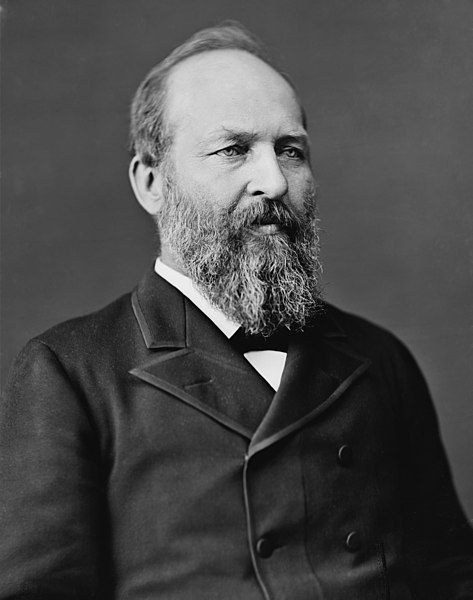 James A. Garfield was a major general in the US Army during the Civil War and later became a member of the US House of Representatives. In fact, Garfield is the only sitting member of the House to have been elected President of the United States.
  On July 2, 1881 Garfield was on his way to deliver a speech and was shot twice while walking through a train station in Washington D.C. by Charles J. Guiteau who was disgruntled for not being able to obtain a federal post. One bullet only grazed the President’s arm and the other was believed to have lodged itself in the spine. Garfield survived but was bedridden in the White House as he became increasingly ill from infection. The doctors were unable to locate the bullet and Alexander Graham Bell, the inventor of the telephone, devised a metal detector to locate the bullet. Unfortunately the metal-framed bed in which the President lay caused the detector to not function correctly. Such beds were so rare, they had no idea that it was the cause of the metal detector’s deviation.

 and the second President of the United States. She was the mother of the sixth President of the United States, John Quincy Adams. She was the first Second Lady of the United States. When her husband John Adams succeeded George Washington as President of the United States, Abigail became the second First Lady and the first to live in the White House.
 The 2008 HBO series was based on the Pulitzer Prize winning biography John Adams by David McCullough. I read this book and I highly recommend it and the miniseries!!
 The most pressing question of the week was what brands of brew would be
  The last time the question of presidential beer was considered quite so

 Author: Robert Dallek

 William Maclay was a farmer, a lawyer and one of Pennsylvania's Senators. He kept a diary of his experiences. We pick up his story as Washington arrives at the Senate Chamber: