Showing posts with label Civil War. Show all posts

26 November 2009

Thanksgiving in America : Featured Podcast – What Thanksgiving Day Means to People in the US (VOA News – Special English)

http://www.voanews.com/specialenglish/2009-11-22-voa2.cfm

Sharing some favorite memories, mixed with cold reality about the effects of the economic downturn.

Download MP3 HERE

Transcript of radio broadcast: 22 November 2009

VOICE ONE:

Thanksgiving meal

Welcome to THIS IS AMERICA. I'm Faith Lapidus. This Thursday is a day for families and friends to share a special holiday meal and think about what they are thankful for. This week on our program, we ask some people to share their favorite memories of Thanksgiving Day.

(MUSIC)

VOICE ONE:

Special English reporters June Simms and Dana Demange talked to people about the holiday. 

JIM OLDHAM: "My name is Jim Oldham and I'm from Nashville, Tennessee. I remember my father drove a bus and my mother was a waitress, and so we often didn't get to have Thanksgiving together. And I remember when I was about twelve, her work and his work permitted us all to do that. And we had brothers and sisters, and the traditional turkey and all the trimmings. We always had pumpkin pie, and if we were really lucky, a little bit of whipped cream on top. And it was just a wonderful day."

ANN GEIGER: "I'm Ann Geiger from Tucson, Arizona. Thanksgiving is special for our family because like so many families our adult children live around the country. And we usually get at least part of them together for Thanksgiving."

REPORTER: "And what is one of your fondest Thanksgiving Day memories?"

ANN GEIGER: "Oh, I think a recent Thanksgiving when my son and I had a turkey cook-off. He brined his turkey and I didn't brine mine. And we decided which one was the best."

REPORTER: "Who won?"

ANN GEIGER: "He did."

VOICE ONE:

Brining is a way to prepare meat in a salt solution, whether for a competitive "cook-off" or just any meal. Traditionally the meat served on Thanksgiving is turkey. The bird is usually served with side dishes including a mixture known either as stuffing or dressing.

Many families also bring out their finest table settings -- the "good china" -- for Thanksgiving.

JOEL UPTON: "My name is Joel Upton. I'm from Livingston, Tennessee. Thanksgiving at my family was always a time when brothers and sisters, aunts and uncles, cousins, we all got together. And someone would bring different dishes. Someone would bring the sweet potatoes. Someone would bring the meat. Someone would bring the dressing. And we would all sort of combine the efforts to have a family Thanksgiving dinner and bring out the good china for that particular event.

And Thanksgiving also, in my early days when I was a child, the kids would all get to play, maybe we hadn't seen each other for a while. The men would always watch a football game on TV. And Thanksgiving was just a really, really special time. And, of course, we had in mind the Pilgrims and what it was all about too. But it was a family time."

VOICE ONE:

Thanksgiving

The Pilgrims first arrived in America in sixteen twenty. They were separatists from the Church of England and other settlers. The ship that brought the first group was the Mayflower.

An exploring party landed at Plymouth, in what became the Commonwealth of Massachusetts. The state is named after an American Indian tribe -- a recognition of the groups that came long before the Pilgrims.

The first Pilgrims established a village. Those who survived the first difficult years held harvest festivals and religious celebrations of thanksgiving. These events formed the basis of the holiday that Americans now celebrate.

But there are no official "rules" for a Thanksgiving meal. Some people like to find ways to do things a little differently.

BUTCH HUNSINGER: "Butch Hunsinger from Williamsport, Pennsylvania."

REPORTER: "The bird. What are you going to do differently this year?"

BUTCH HUNSINGER: "Try to shoot it myself, instead of go to the store to buy it. Go to the family cabin, and hunt on the family land and try to call in a turkey and fire away."

REPORTER: "And who's the better shot in the family?"

BUTCH: "Oh my son, by far."

REPORTER: "What about your worst Thanksgiving memory?"

BUTCH: "Worst…[Laughter] The worst was also the funnest, 'cause I got up early Thanksgiving day and we went to the Burwick Marathon, but it's a nine-mile road race. Just a crusher." [Laughter]

HUGUETTE MBELLA: "Hi, my name is Huguette Mbella. And I was born in Cameroon and grew up in France. And I live now in the United States in Washington, D.C. The whole concept of Thanksgiving was a little bit bizarre. In France, the main celebration is Christmas, not Thanksgiving."

REPORTER: "Can you think of one of your most fond Thanksgiving memories?"

HUGUETTE MBELLA: "I would say my first one. It was in New York. Suddenly the turkey comes on the table, and I was amazed by the size. It was huge! The first thing that came to my mind was actually that's a lot of food!"

ELIZABETH BRINKMAN: "My name is Elizabeth Brinkman and I'm from Cleveland, Ohio. It was always a day that my mother did all the cooking. And we had turkey and I got to chop the vegetables for the dressing. And we got out the good china."

GORDON GEIGER: "Gordon Geiger from Tucson, Arizona. We used to get together at my parents' house and all of my relatives would come over and we'd have a big dinner. And after dinner we would watch football games on the television.

I think it's probably really the most important holiday in the United States because it is a day that is not tied to a particular religion. It is not tied as much to commercial activities. It's more a reflection of the fact that we've had a good life and we appreciate it."

(MUSIC)

VOICE ONE:

This Thanksgiving, Americans can be thankful that the Great Recession may be over. But the job market faces a long recovery.  Unemployment is now above ten percent. And if the underemployed are added, the rate is seventeen and a half percent. The underemployed are people no longer searching for work or only able to find part time jobs.

Last week, the United States Department of Agriculture released its "household food security" report for two thousand eight. The study found that families in seventeen million households had difficulty getting enough food at times during the year. That was almost fifteen percent -- up from eleven percent in two thousand seven. It was the highest level since the current surveys began in nineteen ninety-five.

The Agriculture Department says poverty is the main cause of food insecurity and hunger in the United States.

President Obama, in a statement, called the report unsettling. Especially troubling, he said, is that there were more than five hundred thousand families in which a child experienced hunger multiple times during the year.

He said the first task is to renew job growth, but added that his administration is taking other steps to prevent hunger. These include an increase in aid for people in the government's nutrition assistance program, commonly known as food stamps.

(MUSIC)

VOICE ONE:

The Continental Congress wrote the first national Thanksgiving proclamation in seventeen seventy-seven, during the Revolutionary War. George Washington issued the first presidential Thanksgiving proclamation in seventeen eighty-nine. Here is part of what he wrote.

READER:

Whereas it is the duty of all nations to acknowledge the providence of almighty God, to obey his will, to be grateful for his benefits, and humbly to implore his protection and favor -- and whereas both houses of Congress have by their joint committee requested me "to recommend to the people of the United States a day of public thanksgiving and prayer to be observed by acknowledging with grateful hearts the many signal favors of Almighty God, especially by affording them an opportunity peaceably to establish a form of government for their safety and happiness."

Now therefore I do recommend and assign Thursday the twenty-sixth day of November next to be devoted by the people of these states to the service of that great and glorious being, who is the beneficent author of all the good that was, that is, or that will be ...

VOICE ONE:

Sarah Josepha Hale was a magazine editor and writer who campaigned for a Thanksgiving holiday. That way, there would be "two great American national festivals," she said, the other being Independence Day on the Fourth of July.

In September of eighteen sixty-three, Sarah Josepha Hale appealed to President Abraham Lincoln. Lincoln had made proclamations in the spring of eighteen sixty-two and sixty-three. But these gave thanks for victories in battle during the Civil War.

Then came another proclamation on October third, eighteen sixty-three. It gave more general thanks for the blessings of the year. This is part of what it said:

READER:

In the midst of a civil war of unequaled magnitude and severity, which has sometimes seemed to foreign states to invite and to provoke their aggression, peace has been preserved with all nations, order has been maintained, the laws have been respected and obeyed, and harmony has prevailed everywhere, except in the theater of military conflict, while that theater has been greatly contracted by the advancing armies and navies of the Union.

Needful diversions of wealth and of strength from the fields of peaceful industry to the national defense have not arrested the plow, the shuttle, or the ship; the ax has enlarged the borders of our settlements, and the mines, as well of iron and coal as of the precious metals, have yielded even more abundantly than heretofore. ...

I do therefore invite my fellow-citizens in every part of the United States, and also those who are at sea and those who are sojourning in foreign lands, to set apart and observe the last Thursday of November next as a day of thanksgiving and praise to our beneficent Father who dwelleth in the heavens.

VOICE ONE:

Lincoln's proclamation began a tradition. Presidents have issued Thanksgiving proclamations every year since eighteen sixty-three. All can be found on the Web site of the Pilgrim Hall Museum in Plymouth.

In nineteen forty-one, Franklin Roosevelt was president. Roosevelt approved a resolution by Congress. It established, by law, the fourth Thursday in November as Thanksgiving Day.

(MUSIC)

Our program was produced by Caty Weaver. I'm Faith Lapidus.  Join us again next week for THIS IS AMERICA in VOA Special English.

06 November 2009

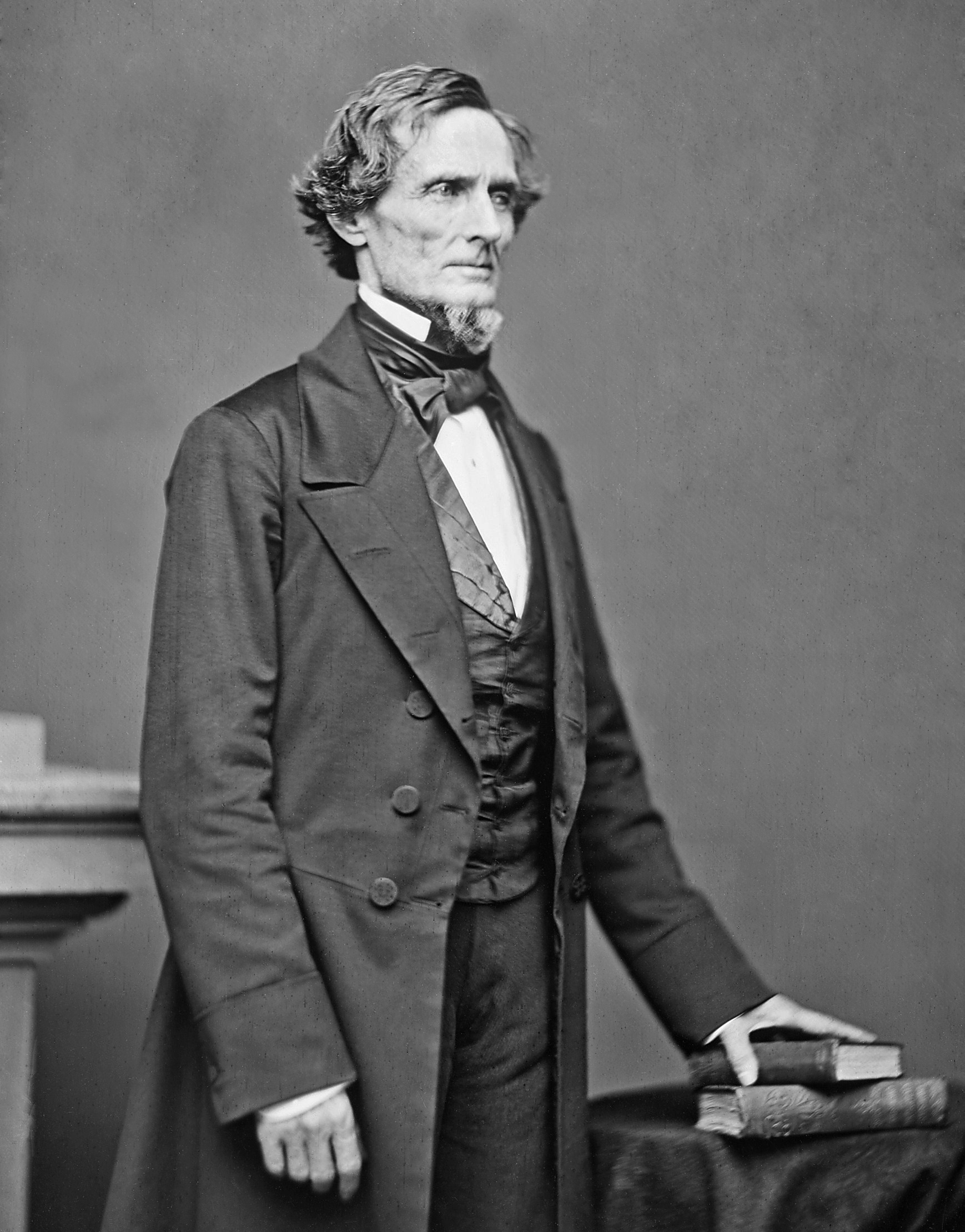
Culture Spot : On This Day . . . 6 November - Jefferson Davis, President of the Confederate States of America

On this day in 1861, Jefferson Davis was elected President of the Confederate States of America. Here’s an extract taken from Wikipedia:

Jefferson Finis Davis (June 3, 1808 – December 6, 1889) was an American politician who served as President of the Confederate States of America for its entire history, 1861 to 1865, during the American Civil War.

A West Point graduate, Davis fought in the Mexican-American War as a colonel of a volunteer regiment, and was the United States Secretary of War under Franklin Pierce. Both before and after his time in the Pierce Administration, he served as a U.S. Senator from Mississippi. As a senator he argued against secession but believed each state was sovereign and had an unquestionable right to secede from the Union.

Davis resigned from the Senate in January 1861, after receiving word that Mississippi had seceded from the Union. The following month, he was provisionally appointed President of the Confederate States of America. He was elected to a six-year term that November. During his presidency, Davis was not able to find a strategy to defeat the more industrially developed Union.

After Davis was captured May 10, 1865, he was charged with treason, though not tried, and stripped of his eligibility to run for public office. This limitation was posthumously removed by order of Congress and President Jimmy Carter in 1978, 89 years after his death. While not disgraced, he was displaced in Southern affection after the war by its leading general, Robert E. Lee.

23 February 2009

Culture Spot: The Buffalo Soldiers (Video)

African-American soldiers have fought in American wars since colonial days. 180,000 Black soldiers served in the Civil War. The Buffalo Soldiers of the late 1800s took their name from the Native Americans..


Buffalo Soldiers
envoyé par josephboen

to abolish


abolir

to be up to a challenge


pouvoir relever un défi / le challenge

curly


frisé

to remind


rappeler

tenacity


la détermination, la ténacité

cornered


piégé

to affix


attacher

a will


une volonté, une détermination

a chief warrant officer


un adjudant-chef

to devote oneself to


se consacrer à

through


à travers, par

to contend with


affronter

purpose


le but

to disdain


mépriser, dédaigner

a lesser rank


un rang de moindre importance

pride


une fierté

to swell up


enfler

to prove


démontrer, prouver

worth


la valeur

Learn more about Buffalo Soldiers at BuffaloSoldiers.com

General George Armstrong Custer

12 February 2009

VOA News - The Complex Story of Abraham Lincoln and How He Saved the Union

NOTE! This comes directly from Voice of America Special English. Posted in honor of Lincoln’s Birthday!!

The Complex Story of Abraham Lincoln and How He Saved the Union

America's 16th president, born 200 years ago this Thursday, opposed slavery and led a civil war that ended it. Yet he originally thought slave-holding southern states should be left alone. Transcript of radio broadcast:
09 February 2009

MP3  - Download (MP3)audio clip  (to save, right-click with your mouse)
MP3 - Listen to (MP3)audio clip

VOICE ONE:

Welcome to THIS IS AMERICA in VOA Special English. I'm Steve Ember.

VOICE TWO:

And I'm Barbara Klein. This week on our program, we remember President Abraham Lincoln. This Thursday is the two hundredth anniversary of his birth.

(MUSIC)

VOICE ONE:

Abraham Lincoln

Abraham Lincoln

Abraham Lincoln is the only president in American history to lead a nation divided by civil war.

At the heart of the issues that divided the South from the North was slavery. Southern states withdrew from the Union because they saw a threat to their way of life. Their agricultural economy depended on the labor of slaves originally brought from Africa. The states thought the federal government would free the slaves.

South Carolina was the first to leave. It did so shortly after Lincoln's election in November of eighteen sixty. Six other states followed by the time he took office in March of eighteen sixty-one. In his inaugural speech, Lincoln begged southern states not to leave the Union.

READER:

We are not enemies, but friends. We must not be enemies. Though passion may have strained, it must not break our bonds of affection.

VOICE TWO:

Abraham Lincoln did not receive a majority of the popular vote in the eighteen sixty election. But he won enough electoral votes to become president.

A Confederate soldier killed in battle at Gettysburg, Pennsylvania, photographed by Alexander Gardner in July 1863

A Confederate soldier killed at Gettysburg, Pennsylvania, photographed by Alexander Gardner in July 1863

Lincoln fought to keep the Union together. He led a civil war in which more than six hundred thousand Americans were killed. And, in leading that war, he took the first steps that would destroy the institution of slavery.

(MUSIC: "Battle Hymn of the Republic")

VOICE ONE:

Most whites did not consider blacks -- or negroes, as they called them -- to be their equal. Lincoln was no different. But he believed that slavery was wrong.

Yet he thought that slavery would die out naturally over time -- and that outsiders should not force southerners to end slavery. He explained his position many times in speeches, debates and letters, including this one written in eighteen fifty-eight:

READER:

I have made it equally plain that I think the negro is included in the word "men" used in the Declaration of Independence.

I believe the declaration that "all men are created equal" is the great fundamental principle upon which our free institutions rest; that negro slavery is violative of that principle; but that, by our frame of government, that principle has not been made one of legal obligation; that by our frame of government, the states which have slavery are to retain it, or surrender it at their own pleasure; and that all others — individuals, free states and national government — are constitutionally bound to leave them alone about it.

VOICE TWO:

Mary Todd Lincoln

Mary Todd Lincoln

But Lincoln changed his mind. Some historians think the death of his eleven-year-old son Willie had an influence. The president and his wife, Mary Todd Lincoln, had four children, all sons. Three got sick and died. Only one lived past the age of eighteen.

Tom Schwartz is the Illinois state historian and an expert on Abraham Lincoln. He says the president began to think seriously about the meaning of life after Willie died in eighteen sixty-two. Lincoln never joined a church, but he believed in a supreme being who created every person with a purpose in life.

After his son's death, Lincoln decided that one of his purposes was to be an emancipator -- to begin the process of freeing the slaves. A few months later, he wrote the Emancipation Proclamation.

VOICE ONE:

Many people think the Emancipation Proclamation freed the slaves. It did not. It only declared slaves in the Confederacy to be free. In other words, only slaves in the southern states that did not recognize Lincoln as president.

Lincoln read the first draft of the document to his cabinet in July of eighteen sixty-two, five months after Willie's death. 

A new stage play has been written about those five months in Lincoln's life. "The Heavens Are Hung In Black" by James Still is the first play being presented in the newly redecorated Ford's Theatre in Washington, D.C. That is the same theater where President Lincoln was shot in eighteen sixty-five.

VOICE TWO:

"First Reading of the Emancipation Proclamation of President Lincoln" by Francis Bicknell Carpenter

Historians say that by writing the Emancipation Proclamation, Lincoln established a moral purpose for the war. No longer was the purpose simply to bring the southern states back into the Union. Now his declaration made freeing the slaves a long-term goal of the conflict.

It put the Confederate states in the position of fighting for slavery -- even though most of the soldiers were too poor to own slaves. And it increased the military strength of the Union by making it possible for free blacks to serve in the northern army.

VOICE ONE:

Political opponents and the press criticized actions taken by President Lincoln.

The First Amendment to the Constitution guarantees free speech and a free press. Yet Lincoln briefly closed some newspapers.

Another action that he took was to suspend the right of habeas corpus. Habeas corpus is a legal term for the right to have a judge decide if a person is being detained lawfully. The request is made to the court in a written document called a writ.

The Constitution, in setting limits on Congress, says in Article One: "The privilege of the Writ of Habeas Corpus shall not be suspended, unless when in Cases of Rebellion or Invasion the public Safety may require it."

VOICE TWO:

Suspending habeas corpus means that a prisoner can be held without trial for as long as the government wants.

Abraham Lincoln or his cabinet officers suspended that right several times. They believed they were acting within the Constitution.

VOICE ONE:

President Lincoln knew that he would be criticized for issuing such orders without waiting for congressional approval. Yet he himself was not sure what powers he had in many situations. American history could offer no guide. After all, the country had never before had a civil war.

Lincoln made his orders temporary. And he made sure the country held its next presidential election as planned in eighteen sixty-four, when he was re-elected.

(MUSIC)

VOICE TWO:

Abraham LincolnAbraham Lincoln was born into a poor family in Kentucky. He grew up in Indiana and later moved to Illinois. He loved to learn. He was a self-taught lawyer who served for eight years as an Illinois state representative.

But he also suffered from depression all his life. Doctors at that time called it melancholia. He wrote letters about killing himself and saying that he was the "most miserable man alive."

Lincoln was a tall man with a long face, long arms and large hands. Political opponents called him names like "gorilla." Many said he was unqualified to be president because of his limited experience in national government. Lincoln had served only two years in Congress before his election to the White House.

VOICE ONE:

Yet Abraham Lincoln is often called America's greatest president. He is remembered as the man who saved the Union and re-invented it at the same time.

By including blacks, Lincoln expanded "the borders of freedom," says historian Tom Schwartz. Lincoln himself said his purpose was to provide "an open field and a fair chance in life." He succeeded in beginning that process, though black Americans did not gain full civil rights until the nineteen sixties.

VOICE TWO:

Abraham Lincoln was the first presidential candidate of the modern Republican Party. He included political opponents in his cabinet, which is unusual. Doris Kearns Goodwin wrote about this in her two thousand five book "Team of Rivals: The Political Genius of Abraham Lincoln."

But some historians suggest that the inclusion of opponents may not have been as smart an idea as Lincoln had hoped. In fact, they say that in some cases it may have created more problems than it solved.    

VOICE ONE:

John Wilkes Booth

John Wilkes Booth

But Lincoln was the leading force behind the Thirteenth Amendment which officially ended slavery in the United States. It became law in December of eighteen sixty-five.

By then, Lincoln was dead. On April fourteenth, eighty sixty-five, Southern sympathizer and actor John Wilkes Booth shot Lincoln in Ford's Theatre. It happened five days after the South surrendered and the Civil War ended.

VOICE TWO:

Not surprisingly, America's sixteenth president is a hero of another former Illinois lawmaker. Barack Obama has spoken repeatedly of Lincoln's influence in making it possible for the country to have its first African-American president.  

President Obama will return to Illinois to celebrate Abraham Lincoln's two hundredth birthday at a big dinner in Springfield this Thursday.

(MUSIC)

VOICE ONE:

Our program was written by Nancy Steinbach and produced by Mario Ritter. I'm Steve Ember.

VOICE TWO:

And I'm Barbara Klein. Doug Johnson was our reader. Join us again next week for THIS IS AMERICA in VOA Special English.

VOA News - The Complex Story of Abraham Lincoln and How He Saved the Union

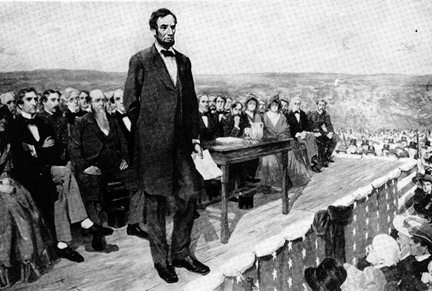
The Gettysburg Address by President Lincoln– November 19, 1863

This is one of the most important speeches in US history! When I was a boy, we had to memorize this speech in school. Thankfully it isn’t very long. This speech was given at the dedication of the Soldiers’ National Cemetery in Gettysburg, Pennsylvania, four and a half months after the bloodiest battle of the Civil War took place on the same site.


Four score and seven years ago our fathers brought forth on this continent a new nation, conceived in Liberty, and dedicated to the proposition that all men are created equal.

Now we are engaged in a great civil war, testing whether that nation, or any nation, so conceived and so dedicated, can long endure. We are met on a great battle-field of that war. We have come to dedicate a portion of that field, as a final resting place for those who here gave their lives that that nation might live. It is altogether fitting and proper that we should do this.

But, in a larger sense, we can not dedicate—we can not consecrate—we can not hallow—this ground. The brave men, living and dead, who struggled here, have consecrated it, far above our poor power to add or detract. The world will little note, nor long remember what we say here, but it can never forget what they did here. It is for us the living, rather, to be dedicated here to the unfinished work which they who fought here have thus far so nobly advanced. It is rather for us to be here dedicated to the great task remaining before us—that from these honored dead we take increased devotion to that cause for which they gave the last full measure of devotion—that we here highly resolve that these dead shall not have died in vain—that this nation, under God, shall have a new birth of freedom—and that government of the people, by the people, for the people, shall not perish from the earth.

score vingt
to bring forth (literary) produire, introduire
whether si
resting place un lieu de repos
altogether complètement
fitting qui convient
to hallow consacrer
to struggle lutter
to detract diminuer
rather plutôt
thus far jusqu'à présent
nobly noblement, grandement
task la tâche
to resolve décider
to perish périr
 

To learn more about this document and Gettysburg visit the following links:

Soldiers’ National Cemetery at Gettysburg

Animated history of the Battle of Gettysburg

The Brothers War: The Battle of Gettysburg

Gettysburg Visitor Information

The Battle of Gettysburg at Wikipedia

Gettysburg Address at Wikipedia

Gettysburg Address at Cornell University

The Emancipation Proclamation by Pres. Lincoln – January 1, 1863

In honor of both the bicentennial of Lincoln’s birth and Black History Month

Taken directly from the National Archives

The Emancipation Proclamation

President Abraham Lincoln issued the Emancipation Proclamation on January 1, 1863, as the nation approached its third year of bloody civil war. The proclamation declared "that all persons held as slaves" within the rebellious states "are, and henceforward shall be free."

Despite this expansive wording, the Emancipation Proclamation was limited in many ways. It applied only to states that had seceded from the Union, leaving slavery untouched in the loyal border states. It also expressly exempted parts of the Confederacy that had already come under Northern control. Most important, the freedom it promised depended upon Union military victory.

Although the Emancipation Proclamation did not immediately free a single slave, it fundamentally transformed the character of the war. After January 1, 1863, every advance of federal troops expanded the domain of freedom. Moreover, the Proclamation announced the acceptance of black men into the Union Army and Navy, enabling the liberated to become liberators. By the end of the war, almost 200,000 black soldiers and sailors had fought for the Union and freedom.

From the first days of the Civil War, slaves had acted to secure their own liberty. The Emancipation Proclamation confirmed their insistence that the war for the Union must become a war for freedom. It added moral force to the Union cause and strengthened the Union both militarily and politically. As a milestone along the road to slavery's final destruction, the Emancipation Proclamation has assumed a place among the great documents of human freedom.

The document was bound with other proclamations in a large volume preserved for many years by the Department of State. When it was prepared for binding, it was reinforced with strips along the center folds and then mounted on a still larger sheet of heavy paper. Written in red ink on the upper right-hand corner of this large sheet is the number of the Proclamation, 95, given to it by the Department of State long after it was signed. With other records, the volume containing the Emancipation Proclamation was transferred in 1936 from the Department of State to the National Archives of the United States.

The original of the Emancipation Proclamation of January 1, 1863, is in the National Archives in Washington, DC. With the text covering five pages the document was originally tied with narrow red and blue ribbons, which were attached to the signature page by a wafered impression of the seal of the United States. Most of the ribbon remains; parts of the seal are still decipherable, but other parts have worn off.

to issue délivrer,émettre
rebellious rebelle, révolté
henceforward dorénavant
wording la formulation
to secede faire sécession
to expand élargir, étendre
moreover de plus
enabling permettant
a milestone une étape importante
bound relié
binding la reliure
strip une bande
fold le pli
wafered comme une gauffre
decipherable déchiffrable
worn off effacé

The Emancipation Proclamation
January 1, 1863

A Transcription

By the President of the United States of America:

A Proclamation.

Whereas, on the twenty-second day of September, in the year of our Lord one thousand eight hundred and sixty-two, a proclamation was issued by the President of the United States, containing, among other things, the following, to wit:

"That on the first day of January, in the year of our Lord one thousand eight hundred and sixty-three, all persons held as slaves within any State or designated part of a State, the people whereof shall then be in rebellion against the United States, shall be then, thenceforward, and forever free; and the Executive Government of the United States, including the military and naval authority thereof, will recognize and maintain the freedom of such persons, and will do no act or acts to repress such persons, or any of them, in any efforts they may make for their actual freedom.

"That the Executive will, on the first day of January aforesaid, by proclamation, designate the States and parts of States, if any, in which the people thereof, respectively, shall then be in rebellion against the United States; and the fact that any State, or the people thereof, shall on that day be, in good faith, represented in the Congress of the United States by members chosen thereto at elections wherein a majority of the qualified voters of such State shall have participated, shall, in the absence of strong countervailing testimony, be deemed conclusive evidence that such State, and the people thereof, are not then in rebellion against the United States."

Now, therefore I, Abraham Lincoln, President of the United States, by virtue of the power in me vested as Commander-in-Chief, of the Army and Navy of the United States in time of actual armed rebellion against the authority and government of the United States, and as a fit and necessary war measure for suppressing said rebellion, do, on this first day of January, in the year of our Lord one thousand eight hundred and sixty-three, and in accordance with my purpose so to do publicly proclaimed for the full period of one hundred days, from the day first above mentioned, order and designate as the States and parts of States wherein the people thereof respectively, are this day in rebellion against the United States, the following, to wit:

Arkansas, Texas, Louisiana, (except the Parishes of St. Bernard, Plaquemines, Jefferson, St. John, St. Charles, St. James Ascension, Assumption, Terrebonne, Lafourche, St. Mary, St. Martin, and Orleans, including the City of New Orleans) Mississippi, Alabama, Florida, Georgia, South Carolina, North Carolina, and Virginia, (except the forty-eight counties designated as West Virginia, and also the counties of Berkley, Accomac, Northampton, Elizabeth City, York, Princess Ann, and Norfolk, including the cities of Norfolk and Portsmouth[)], and which excepted parts, are for the present, left precisely as if this proclamation were not issued.

And by virtue of the power, and for the purpose aforesaid, I do order and declare that all persons held as slaves within said designated States, and parts of States, are, and henceforward shall be free; and that the Executive government of the United States, including the military and naval authorities thereof, will recognize and maintain the freedom of said persons.

And I hereby enjoin upon the people so declared to be free to abstain from all violence, unless in necessary self-defence; and I recommend to them that, in all cases when allowed, they labor faithfully for reasonable wages.

And I further declare and make known, that such persons of suitable condition, will be received into the armed service of the United States to garrison forts, positions, stations, and other places, and to man vessels of all sorts in said service.

And upon this act, sincerely believed to be an act of justice, warranted by the Constitution, upon military necessity, I invoke the considerate judgment of mankind, and the gracious favor of Almighty God.

In witness whereof, I have hereunto set my hand and caused the seal of the United States to be affixed.

Done at the City of Washington, this first day of January, in the year of our Lord one thousand eight hundred and sixty three, and of the Independence of the United States of America the eighty-seventh.

By the President: ABRAHAM LINCOLN
WILLIAM H. SEWARD, Secretary of State.

whereas attendu que
to wit (phrase) à savoir
whereof de quoi, dont
aforesaid susdit
thereto y
wherein dans lequel, où
countervailing contrebalançant
deemed considéré, jugé, estimé
vested acquis
fit propre
in accordance with conformément à
henceforward dorénavant
hereby par la présente
to labor travailler
wages une salaire
to garrison placer une garnison dans, tenir garnison dans, être en garnison à
to man armer
vessel un vaisseau
warranted garanti
hereunto de ceci

Abraham Lincoln's White House 1861-1865 during U.S. Civil War.

This is a very nice site on the Lincoln years in the White House.

Mr. Lincolns White House Banner

Abraham Lincoln's White House 1861-1865 during U.S. Civil War.

11 February 2009

Culture Spot: Harriet Tubman (Video Lesson)

As part of Black History Month, here is the story of slavery abolitionist Harriet Tubman. She was born into slavery in Maryland but eventually escaped to Pennsylvania. She returned to Maryland secretly several times in order to rescue her family out of bondage. Over time she led dozens of other slaves out and never lost one earning her the name “Moses.'’ When the Civil War broke out, she worked for the Union army as a cook, a nurse and then as a spy. At the end of the war, she worked hard for the women’s suffrage movement. To learn more about this great American woman, read about her at the following links:

Wikipedia - Harriet_Tubman

Harriet Tubman: Online Resources

Harriet, the Moses of Her People by Sarah H. Bradford (a on-line book to download)

Scenes in the Life of Harriet Tubman

Bound For The Promised Land: Harriet Tubman, Portrait of an American Hero

Now follow the link below to watch a very good MSN video about Harriet Tubman and print out the worksheet below to answer the comprehension questions.

Profile of Harriet Tubman

Profile of Harriet Tubman

10 February 2009

Free Audio Book to Download: Narrative of the Life of Frederick Douglass, An American Slave

As part of celebrating Black History Month, download the FREE audio book below written by one of America’s greatest abolitionists and statesmen. He is a prominent figure in African-American history and his literary work is a masterpiece! I have read this book and I very highly recommend it! Most of this post comes from FreeAudio.org

Narrative of the Life of Frederick Douglass, An American Slave By Frederick Douglass

First published in 1845, the Narrative of the life of Frederick Douglass became Frederick Douglass’s most well known work. It is as the name implies, his autobiography.

Frederick Douglass was born a slave and underwent horrendous treatment at the hands of his ‘owners’. He later escaped to the north and became an outspoken abolitionist. Not only did he have a great life story to tell, his skill in telling it has long been admired. Douglass traveled throughout Europe lecturing about slavery.

After publication, the Narrative of the life of Frederick Douglass quickly became a best seller and within three years there were over 11,000 copies published in the United States had been reprinted nine times and had been translated into two languages (Dutch and French). The book was so well written that some argued that an ex-slave could not be as articulate as Frederick Douglass demonstrated himself to be. Of course, Douglass did write the book and it stands today as a monument to the human spirit and what may be achieved with hard work - no matter where in society somebody may begin.

Frederick Douglass had to leave the United States and flee to Ireland for a period after the books publication and its immediate success for some believed that Douglass’s ex-owner Hugh Auld might try to get his ‘property’ returned. After two years, he was able to return to the United States after his freedom was purchased for $710 from Auld.

If you are interested in learning about the life of a great man who rose above his birth as a slave and became one of the greatest literary figures in American history, the Narrative of the Life of Frederick Douglass is the book to read.

Download Links: (right-click to save MP3 file)

Narrative of the Life of Frederick Douglass, Part 1 : Approximately 13MB Narrative of the Life of Frederick Douglass, Part 2 : Approximately 12MB Narrative of the Life of Frederick Douglass, Part 3 : Approximately 13MB

.Zip Archive -- Divided into Three Minutes Track

FreeAudio.org -- Free Audio Books on Liberty and Freedom

You can read the book at: Narrative of the Life of Frederick Douglass at Project Gutenberg (plain text and HTML).

The Narrative of the Life of Frederick Douglass at Wikipedia

Frederick Douglass at Wikipedia

Frederick Douglas National Historic Site The Washington, DC home of Frederick Douglass

Mr. Lincoln's White House: Frederick Douglass