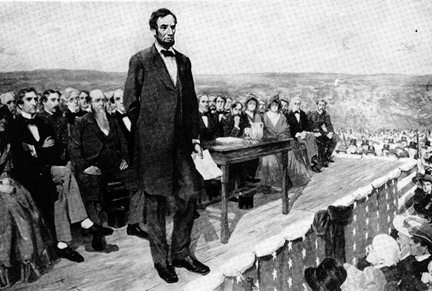
This is one of the most important speeches in US history! When I was a boy, we had to memorize this speech in school. Thankfully it isn’t very long. This speech was given at the dedication of the Soldiers’ National Cemetery in Gettysburg, Pennsylvania, four and a half months after the bloodiest battle of the Civil War took place on the same site.
Four score and seven years ago our fathers brought forth on this continent a new nation, conceived in Liberty, and dedicated to the proposition that all men are created equal.
Now we are engaged in a great civil war, testing whether that nation, or any nation, so conceived and so dedicated, can long endure. We are met on a great battle-field of that war. We have come to dedicate a portion of that field, as a final resting place for those who here gave their lives that that nation might live. It is altogether fitting and proper that we should do this.
But, in a larger sense, we can not dedicate—we can not consecrate—we can not hallow—this ground. The brave men, living and dead, who struggled here, have consecrated it, far above our poor power to add or detract. The world will little note, nor long remember what we say here, but it can never forget what they did here. It is for us the living, rather, to be dedicated here to the unfinished work which they who fought here have thus far so nobly advanced. It is rather for us to be here dedicated to the great task remaining before us—that from these honored dead we take increased devotion to that cause for which they gave the last full measure of devotion—that we here highly resolve that these dead shall not have died in vain—that this nation, under God, shall have a new birth of freedom—and that government of the people, by the people, for the people, shall not perish from the earth.
score
vingt
to bring forth (literary)
produire, introduire
whether
si
resting place
un lieu de repos
altogether
complètement
fitting
qui convient
to hallow
consacrer
to struggle
lutter
to detract
diminuer
rather
plutôt
thus far
jusqu'à présent
nobly
noblement, grandement
task
la tâche
to resolve
décider
to perish
périr
To learn more about this document and Gettysburg visit the following links:
President Abraham Lincoln issued the Emancipation Proclamation on January 1, 1863, as the nation approached its third year of bloody civil war. The proclamation declared "that all persons held as slaves" within the rebellious states "are, and henceforward shall be free."
Despite this expansive wording, the Emancipation Proclamation was limited in many ways. It applied only to states that had seceded from the Union, leaving slavery untouched in the loyal border states. It also expressly exempted parts of the Confederacy that had already come under Northern control. Most important, the freedom it promised depended upon Union military victory.
Although the Emancipation Proclamation did not immediately free a single slave, it fundamentally transformed the character of the war. After January 1, 1863, every advance of federal troops expanded the domain of freedom. Moreover, the Proclamation announced the acceptance of black men into the Union Army and Navy, enabling the liberated to become liberators. By the end of the war, almost 200,000 black soldiers and sailors had fought for the Union and freedom.
From the first days of the Civil War, slaves had acted to secure their own liberty. The Emancipation Proclamation confirmed their insistence that the war for the Union must become a war for freedom. It added moral force to the Union cause and strengthened the Union both militarily and politically. As a milestone along the road to slavery's final destruction, the Emancipation Proclamation has assumed a place among the great documents of human freedom.
The document was bound with other proclamations in a large volume preserved for many years by the Department of State. When it was prepared for binding, it was reinforced with strips along the center folds and then mounted on a still larger sheet of heavy paper. Written in red ink on the upper right-hand corner of this large sheet is the number of the Proclamation, 95, given to it by the Department of State long after it was signed. With other records, the volume containing the Emancipation Proclamation was transferred in 1936 from the Department of State to the National Archives of the United States.
The original of the Emancipation Proclamation of January 1, 1863, is in the National Archives in Washington, DC. With the text covering five pages the document was originally tied with narrow red and blue ribbons, which were attached to the signature page by a wafered impression of the seal of the United States. Most of the ribbon remains; parts of the seal are still decipherable, but other parts have worn off.
to issue
délivrer,émettre
rebellious
rebelle, révolté
henceforward
dorénavant
wording
la formulation
to secede
faire sécession
to expand
élargir, étendre
moreover
de plus
enabling
permettant
a milestone
une étape importante
bound
relié
binding
la reliure
strip
une bande
fold
le pli
wafered
comme une gauffre
decipherable
déchiffrable
worn off
effacé
The Emancipation Proclamation January 1, 1863
A Transcription
By the President of the United States of America:
A Proclamation.
Whereas, on the twenty-second day of September, in the year of our Lord one thousand eight hundred and sixty-two, a proclamation was issued by the President of the United States, containing, among other things, the following, to wit:
"That on the first day of January, in the year of our Lord one thousand eight hundred and sixty-three, all persons held as slaves within any State or designated part of a State, the people whereof shall then be in rebellion against the United States, shall be then, thenceforward, and forever free; and the Executive Government of the United States, including the military and naval authority thereof, will recognize and maintain the freedom of such persons, and will do no act or acts to repress such persons, or any of them, in any efforts they may make for their actual freedom.
"That the Executive will, on the first day of January aforesaid, by proclamation, designate the States and parts of States, if any, in which the people thereof, respectively, shall then be in rebellion against the United States; and the fact that any State, or the people thereof, shall on that day be, in good faith, represented in the Congress of the United States by members chosen thereto at elections wherein a majority of the qualified voters of such State shall have participated, shall, in the absence of strong countervailing testimony, be deemed conclusive evidence that such State, and the people thereof, are not then in rebellion against the United States."
Now, therefore I, Abraham Lincoln, President of the United States, by virtue of the power in me vested as Commander-in-Chief, of the Army and Navy of the United States in time of actual armed rebellion against the authority and government of the United States, and as a fit and necessary war measure for suppressing said rebellion, do, on this first day of January, in the year of our Lord one thousand eight hundred and sixty-three, and in accordance with my purpose so to do publicly proclaimed for the full period of one hundred days, from the day first above mentioned, order and designate as the States and parts of States wherein the people thereof respectively, are this day in rebellion against the United States, the following, to wit:
Arkansas, Texas, Louisiana, (except the Parishes of St. Bernard, Plaquemines, Jefferson, St. John, St. Charles, St. James Ascension, Assumption, Terrebonne, Lafourche, St. Mary, St. Martin, and Orleans, including the City of New Orleans) Mississippi, Alabama, Florida, Georgia, South Carolina, North Carolina, and Virginia, (except the forty-eight counties designated as West Virginia, and also the counties of Berkley, Accomac, Northampton, Elizabeth City, York, Princess Ann, and Norfolk, including the cities of Norfolk and Portsmouth[)], and which excepted parts, are for the present, left precisely as if this proclamation were not issued.
And by virtue of the power, and for the purpose aforesaid, I do order and declare that all persons held as slaves within said designated States, and parts of States, are, and henceforward shall be free; and that the Executive government of the United States, including the military and naval authorities thereof, will recognize and maintain the freedom of said persons.
And I hereby enjoin upon the people so declared to be free to abstain from all violence, unless in necessary self-defence; and I recommend to them that, in all cases when allowed, they labor faithfully for reasonable wages.
And I further declare and make known, that such persons of suitable condition, will be received into the armed service of the United States to garrison forts, positions, stations, and other places, and to man vessels of all sorts in said service.
And upon this act, sincerely believed to be an act of justice, warranted by the Constitution, upon military necessity, I invoke the considerate judgment of mankind, and the gracious favor of Almighty God.
In witness whereof, I have hereunto set my hand and caused the seal of the United States to be affixed.
Done at the City of Washington, this first day of January, in the year of our Lord one thousand eight hundred and sixty three, and of the Independence of the United States of America the eighty-seventh.
By the President: ABRAHAM LINCOLN WILLIAM H. SEWARD, Secretary of State.
whereas
attendu que
to wit (phrase)
à savoir
whereof
de quoi, dont
aforesaid
susdit
thereto
y
wherein
dans lequel, où
countervailing
contrebalançant
deemed
considéré, jugé, estimé
vested
acquis
fit
propre
in accordance with
conformément à
henceforward
dorénavant
hereby
par la présente
to labor
travailler
wages
une salaire
to garrison
placer une garnison dans, tenir garnison dans, être en garnison à
 This is one of the most important speeches in US history! When I was a boy, we had to memorize this speech in school. Thankfully it isn’t very long. This speech was given at the dedication of the Soldiers’ National Cemetery in Gettysburg, Pennsylvania, four and a half months after the bloodiest battle of the Civil War took place on the same site.


 President Abraham Lincoln issued the