
To read the article go to: http://www.boston.com/bostonglobe/ideas/articles/2010/12/26/the_belsnickler_cometh/?page=1
To read the article go to: http://www.boston.com/bostonglobe/ideas/articles/2010/12/26/the_belsnickler_cometh/?page=1
 HAPPY THANKSGIVING!!
 "Whereas it is the duty of all Nations to acknowledge the providence of Almighty God, to obey his will, to be grateful for his benefits, and humbly to implore his protection and favor, and whereas both Houses of Congress have by their joint Committee requested me "to recommend to the People of the United States a day of public thanksgiving and prayer to be observed by acknowledging with grateful hearts the many signal favors of Almighty God especially by affording them an opportunity peaceably to establish a form of government for their safety and happiness. Now therefore I do recommend and assign Thursday the 26th day of November next to be devoted by the People of these States to the service of that great and glorious Being, who is the beneficent Author of all the good that was, that is, or that will be. That we may then all unite in rendering unto him our sincere and humble thanks, for his kind care and protection of the People of this Country previous to their becoming a Nation, for the signal and manifold mercies, and the favorable interpositions of his providence, which we experienced in the course and conclusion of the late war, for the great degree of tranquility, union, and plenty, which we have since enjoyed, for the peaceable and rational manner, in which we have been enabled to establish constitutions of government for our safety and happiness, and particularly the national One now lately instituted, for the civil and religious liberty with which we are blessed; and the means we have of acquiring and diffusing useful knowledge; and in general for all the great and various favors which he hath been pleased to confer upon us. And also that we may then unite in most humbly offering our prayers and supplications to the great Lord and Ruler of Nations and beseech him to pardon our national and other transgressions, to enable us all, whether in public or private stations, to perform our several and relative duties properly and punctually, to render our national government a blessing to all the people, by constantly being a Government of wise, just, and constitutional laws, discreetly and faithfully executed and obeyed, to protect and guide all Sovereigns and Nations (especially such as have shown kindness unto us) and to bless them with good government, peace, and concord. To promote the knowledge and practice of true religion and virtue, and the encrease* of science among them and Us, and generally to grant unto all Mankind such a degree of temporal prosperity as he alone knows to be best. Given under my hand at the City of New York the third day of October in the year of our Lord 1789."
*an older spelling of “increase”
Other Links and Articles:
Presidential Proclamation – Thanksgiving Day (released on November 24, 2010 by President Obama)
Thanksgiving Features Native American Foods (VOA News article) & Video
President Obama Pardons Thanksgiving Turkey (VOA News article) & Audio
Watch video of President Obama pardoning the 2010 White House turkey in this unusual White House tradition! Download Video : MP4 (66 MB)


See also President Bush’s 2008 Thanksgiving Proclamation
Political cartoon by Rick McKee of the The Augusta Chronicle in Georgia and published on 21 November 2010.
Clear-cutting is the act of cutting down all the trees in an area. The deforestation of the Brazilian rain jungle is caused by clear-cutting.
If you set up a new business, you start and put it in place. The cartoonist is criticizing how the government set up by the Founding Fathers has been turned into a massive, oversized one.
The government, as most of our Western governments, have run up massive debts! If you run up a bill or a debt, you owe someone a lot of money. With the arrival of winter, we run up our gas bills as we heat our homes more and more.
The cartoonist also criticizes the moral state of the country. He believes that Americans have embraced immorality of every kind. If you embrace a new belief, an idea or a new way of life, you accept it completely.
According to the cartoonist, the embrace of immorality has led the country to devolve into godless socialism. Devolve is the opposite of evolve and has the meaning of deteriorating and degenerating. The cartoonist also expresses the global opinion of Americans concerning socialism as being godless. A form of governance that is considered to be immoral and atheistical by a large part of the American citizenry.
After a harsh winter, the Pilgrims had their first formal contact with the indigenous when on March 16, 1621 an Native American walked boldly into the middle of Plymouth Colony and declared in English, "Welcome, Englishmen!" He also asked if they had any beer! His name was Samoset, a subordinate chief of the Abenaki tribe in Maine, and he was was visiting Chief Massasoit of the Wampanoags. Samoset had learned English from English fishermen that came to fish off the coast of Maine. From Samoset, the colonists learned about the plague that had wiped out the Indians where they had established Plymouth Colony. After spending the night in the settlement, he came back two days later with Tisquantum, better known today as Squanto.
 For the Pilgrims, Tisquantum (or Squanto) was a Godsend. He helped them to recover from the harsh winter teaching them how to plant crops in the New World and where to best catch fish and eels. Around October of 1621 after a fruitful harvest thanks to the help of the Wampanoags, they held "The First Thanksgiving." The colonists didn't refer to this celebration as Thanksgiving because it was more of a harvest festival. For Puritans, thanksgiving was a day of prayer and worship, not revelry. The first real thankgiving was in 1623 with the arrival of new supplies and colonists from England. What Americans really celebrate today is rooted in the European harvest festival tradition.
  The Pilgrims had brought with them a shallop they had dismantled to fit onboard the Mayflower. It had also been damaged during the crossing and so its reparation and reassembling delayed exploration of the coast for two weeks. Finally exploration began under the leadership of Myles Standish, a soldier the Pilgrims met in Leiden and hired to assist them, and Christopher Jones, the Mayflower's master. They found an area of land deserted of all human life with vestiges of old buildings and recently cultivated fields. Artificial mounds which turned out to be Native American graves were discovered and in which they found baskets of maize which they took intending it for planting.
 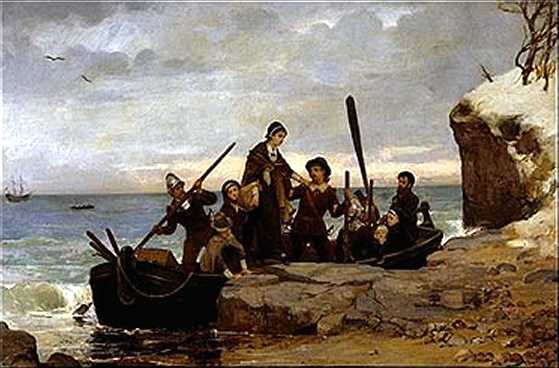 arrived in the area which would become the settlement of Plymouth. They cleared the remains of the village Patuxet which had belonged to the Wampanoag people and whose residents were wiped out by a plague three years earlier. Construction began immediately and the first common house of the Pilgrims was completed on January 19th.
 On Thursday, November 26 this month, American families all across the United States will get together around the table to enjoy the traditional Thanksgiving dinner and 
 the Separatists decided that they needed to leave Holland for a couple of reasons. First their children were starting to adopt Dutch customs and habits they believed to be ungodly. Thirdly, the political situation risked becoming unstable and they feared how a Spanish Holland would treat them. Last of all, they believed that missionary work compelled them to spread the Gospel. A debate arose on where they should go, finally they decided that the territory north of the Virginia Colony which would be called New England was the best place for them to go.
 Learn more about the Puritans HERE
Learn more about the Pilgrims in Leiden HERE

History of Veterans Day
World War I – known at the time as “The Great War” - officially ended when the Treaty of Versailles was signed on June 28, 1919, in the Palace of Versailles outside the town of Versailles, France. However, fighting ceased seven months earlier when an armistice, or temporary cessation of hostilities, between the Allied nations and Germany went into effect on the eleventh hour of the eleventh day of the eleventh month. For that reason, November 11, 1918, is generally regarded as the end of “the war to end all wars.”
Soldiers of the 353rd Infantry near a church at Stenay, Meuse in France, wait for the end of hostilities. This photo was taken at 10:58 a.m., on November 11, 1918, two minutes before the armistice ending World War I went into effect
In November 1919, President Wilson proclaimed November 11 as the first commemoration of Armistice Day with the following words: "To us in America, the reflections of Armistice Day will be filled with solemn pride in the heroism of those who died in the country’s service and with gratitude for the victory, both because of the thing from which it has freed us and because of the opportunity it has given America to show her sympathy with peace and justice in the councils of the nations…"
The original concept for the celebration was for a day observed with parades and public meetings and a brief suspension of business beginning at 11:00 a.m.
The United States Congress officially recognized the end of World War I when it passed a concurrent resolution on June 4, 1926, with these words:
Whereas the 11th of November 1918, marked the cessation of the most destructive, sanguinary, and far reaching war in human annals and the resumption by the people of the United States of peaceful relations with other nations, which we hope may never again be severed, and
Whereas it is fitting that the recurring anniversary of this date should be commemorated with thanksgiving and prayer and exercises designed to perpetuate peace through good will and mutual understanding between nations; and
Whereas the legislatures of twenty-seven of our States have already declared November 11 to be a legal holiday: Therefore be it Resolved by the Senate (the House of Representatives concurring), that the President of the United States is requested to issue a proclamation calling upon the officials to display the flag of the United States on all Government buildings on November 11 and inviting the people of the United States to observe the day in schools and churches, or other suitable places, with appropriate ceremonies of friendly relations with all other peoples.
An Act (52 Stat. 351; 5 U. S. Code, Sec. 87a) approved May 13, 1938, made the 11th of November in each year a legal holiday—a day to be dedicated to the cause of world peace and to be thereafter celebrated and known as "Armistice Day." Armistice Day was primarily a day set aside to honor veterans of World War I, but in 1954, after World War II had required the greatest mobilization of soldiers, sailors, Marines and airmen in the Nation’s history; after American forces had fought aggression in Korea, the 83rd Congress, at the urging of the veterans service organizations, amended the Act of 1938 by striking out the word "Armistice" and inserting in its place the word "Veterans." With the approval of this legislation (Public Law 380) on June 1, 1954, November 11th became a day to honor American veterans of all wars.
Later that same year, on October 8th, President Dwight D. Eisenhower issued the first "Veterans Day Proclamation" which stated: "In order to insure proper and widespread observance of this anniversary, all veterans, all veterans' organizations, and the entire citizenry will wish to join hands in the common purpose. Toward this end, I am designating the Administrator of Veterans' Affairs as Chairman of a Veterans Day National Committee, which shall include such other persons as the Chairman may select, and which will coordinate at the national level necessary planning for the observance. I am also requesting the heads of all departments and agencies of the Executive branch of the Government to assist the National Committee in every way possible."
President Eisenhower signing HR7786, changing Armistice Day to Veterans Day. From left: Alvin J. King, Wayne Richards, Arthur J. Connell, John T. Nation, Edward Rees, Richard L. Trombla, Howard W. Watts
On that same day, President Eisenhower sent a letter to the Honorable Harvey V. Higley, Administrator of Veterans' Affairs (VA), designating him as Chairman of the Veterans Day National Committee.
In 1958, the White House advised VA's General Counsel that the 1954 designation of the VA Administrator as Chairman of the Veterans Day National Committee applied to all subsequent VA Administrators. Since March 1989 when VA was elevated to a cabinet level department, the Secretary of Veterans Affairs has served as the committee's chairman.
The Uniform Holiday Bill (Public Law 90-363 (82 Stat. 250)) was signed on June 28, 1968, and was intended to ensure three-day weekends for Federal employees by celebrating four national holidays on Mondays: Washington's Birthday, Memorial Day, Veterans Day, and Columbus Day. It was thought that these extended weekends would encourage travel, recreational and cultural activities and stimulate greater industrial and commercial production. Many states did not agree with this decision and continued to celebrate the holidays on their original dates.
The first Veterans Day under the new law was observed with much confusion on October 25, 1971. It was quite apparent that the commemoration of this day was a matter of historic and patriotic significance to a great number of our citizens, and so on September 20th, 1975, President Gerald R. Ford signed Public Law 94-97 (89 Stat. 479), which returned the annual observance of Veterans Day to its original date of November 11, beginning in 1978. This action supported the desires of the overwhelming majority of state legislatures, all major veterans service organizations and the American people.
Veterans Day continues to be observed on November 11, regardless of what day of the week on which it falls. The restoration of the observance of Veterans Day to November 11 not only preserves the historical significance of the date, but helps focus attention on the important purpose of Veterans Day: A celebration to honor America's veterans for their patriotism, love of country, and willingness to serve and sacrifice for the common good.
http://www1.voanews.com/learningenglish/home/american-life/people/Independence-Day-97620419.html

Or download MP3 (Right-click or option-click and save link)
DOUG JOHNSON: Welcome to American Mosaic in VOA Special English.
(MUSIC)
I’m Doug Johnson.
Today we tell about Independence Day in the United States. This Fourth of July will mark America’s two hundred and thirty-fourth birthday.
We also answer a listener question about a famous American general.
And we hear a poem about the American flag by country singer Johnny Cash.
(MUSIC)
Independence Day
DOUG JOHNSON: The Fourth of July marks the anniversary of America’s Declaration of Independence from Britain. During the summer of seventeen seventy-six, American colonists were deeply divided. Almost one in three was loyal to Britain. Yet most were increasingly angry about what they considered unfair treatment by the British government. By June, fighting had already taken place between colonial forces and Britain. The idea of independence was spreading.
Delegates from the thirteen colonies gathered in Philadelphia, Pennsylvania. The Continental Congress decided that a document declaring separation from Britain should be declared. Thomas Jefferson led a committee chosen to write it.
**(TO READ MORE, CLICK ON THE LINK ABOVE)**
http://www.voanews.com/specialenglish/2009-11-22-voa2.cfm
Sharing some favorite memories, mixed with cold reality about the effects of the economic downturn.
Download MP3 HERE
Transcript of radio broadcast: 22 November 2009
VOICE ONE:
Welcome to THIS IS AMERICA. I'm Faith Lapidus. This Thursday is a day for families and friends to share a special holiday meal and think about what they are thankful for. This week on our program, we ask some people to share their favorite memories of Thanksgiving Day.
(MUSIC)
VOICE ONE:
Special English reporters June Simms and Dana Demange talked to people about the holiday.
JIM OLDHAM: "My name is Jim Oldham and I'm from Nashville, Tennessee. I remember my father drove a bus and my mother was a waitress, and so we often didn't get to have Thanksgiving together. And I remember when I was about twelve, her work and his work permitted us all to do that. And we had brothers and sisters, and the traditional turkey and all the trimmings. We always had pumpkin pie, and if we were really lucky, a little bit of whipped cream on top. And it was just a wonderful day."
ANN GEIGER: "I'm Ann Geiger from Tucson, Arizona. Thanksgiving is special for our family because like so many families our adult children live around the country. And we usually get at least part of them together for Thanksgiving."
REPORTER: "And what is one of your fondest Thanksgiving Day memories?"
ANN GEIGER: "Oh, I think a recent Thanksgiving when my son and I had a turkey cook-off. He brined his turkey and I didn't brine mine. And we decided which one was the best."
REPORTER: "Who won?"
ANN GEIGER: "He did."
VOICE ONE:
Brining is a way to prepare meat in a salt solution, whether for a competitive "cook-off" or just any meal. Traditionally the meat served on Thanksgiving is turkey. The bird is usually served with side dishes including a mixture known either as stuffing or dressing.
Many families also bring out their finest table settings -- the "good china" -- for Thanksgiving.
JOEL UPTON: "My name is Joel Upton. I'm from Livingston, Tennessee. Thanksgiving at my family was always a time when brothers and sisters, aunts and uncles, cousins, we all got together. And someone would bring different dishes. Someone would bring the sweet potatoes. Someone would bring the meat. Someone would bring the dressing. And we would all sort of combine the efforts to have a family Thanksgiving dinner and bring out the good china for that particular event.
And Thanksgiving also, in my early days when I was a child, the kids would all get to play, maybe we hadn't seen each other for a while. The men would always watch a football game on TV. And Thanksgiving was just a really, really special time. And, of course, we had in mind the Pilgrims and what it was all about too. But it was a family time."
VOICE ONE:
The Pilgrims first arrived in America in sixteen twenty. They were separatists from the Church of England and other settlers. The ship that brought the first group was the Mayflower.
An exploring party landed at Plymouth, in what became the Commonwealth of Massachusetts. The state is named after an American Indian tribe -- a recognition of the groups that came long before the Pilgrims.
The first Pilgrims established a village. Those who survived the first difficult years held harvest festivals and religious celebrations of thanksgiving. These events formed the basis of the holiday that Americans now celebrate.
But there are no official "rules" for a Thanksgiving meal. Some people like to find ways to do things a little differently.
BUTCH HUNSINGER: "Butch Hunsinger from Williamsport, Pennsylvania."
REPORTER: "The bird. What are you going to do differently this year?"
BUTCH HUNSINGER: "Try to shoot it myself, instead of go to the store to buy it. Go to the family cabin, and hunt on the family land and try to call in a turkey and fire away."
REPORTER: "And who's the better shot in the family?"
BUTCH: "Oh my son, by far."
REPORTER: "What about your worst Thanksgiving memory?"
BUTCH: "Worst…[Laughter] The worst was also the funnest, 'cause I got up early Thanksgiving day and we went to the Burwick Marathon, but it's a nine-mile road race. Just a crusher." [Laughter]
HUGUETTE MBELLA: "Hi, my name is Huguette Mbella. And I was born in Cameroon and grew up in France. And I live now in the United States in Washington, D.C. The whole concept of Thanksgiving was a little bit bizarre. In France, the main celebration is Christmas, not Thanksgiving."
REPORTER: "Can you think of one of your most fond Thanksgiving memories?"
HUGUETTE MBELLA: "I would say my first one. It was in New York. Suddenly the turkey comes on the table, and I was amazed by the size. It was huge! The first thing that came to my mind was actually that's a lot of food!"
ELIZABETH BRINKMAN: "My name is Elizabeth Brinkman and I'm from Cleveland, Ohio. It was always a day that my mother did all the cooking. And we had turkey and I got to chop the vegetables for the dressing. And we got out the good china."
GORDON GEIGER: "Gordon Geiger from Tucson, Arizona. We used to get together at my parents' house and all of my relatives would come over and we'd have a big dinner. And after dinner we would watch football games on the television.
I think it's probably really the most important holiday in the United States because it is a day that is not tied to a particular religion. It is not tied as much to commercial activities. It's more a reflection of the fact that we've had a good life and we appreciate it."
(MUSIC)
VOICE ONE:
This Thanksgiving, Americans can be thankful that the Great Recession may be over. But the job market faces a long recovery. Unemployment is now above ten percent. And if the underemployed are added, the rate is seventeen and a half percent. The underemployed are people no longer searching for work or only able to find part time jobs.
Last week, the United States Department of Agriculture released its "household food security" report for two thousand eight. The study found that families in seventeen million households had difficulty getting enough food at times during the year. That was almost fifteen percent -- up from eleven percent in two thousand seven. It was the highest level since the current surveys began in nineteen ninety-five.
The Agriculture Department says poverty is the main cause of food insecurity and hunger in the United States.
President Obama, in a statement, called the report unsettling. Especially troubling, he said, is that there were more than five hundred thousand families in which a child experienced hunger multiple times during the year.
He said the first task is to renew job growth, but added that his administration is taking other steps to prevent hunger. These include an increase in aid for people in the government's nutrition assistance program, commonly known as food stamps.
(MUSIC)
VOICE ONE:
The Continental Congress wrote the first national Thanksgiving proclamation in seventeen seventy-seven, during the Revolutionary War. George Washington issued the first presidential Thanksgiving proclamation in seventeen eighty-nine. Here is part of what he wrote.
READER:
Whereas it is the duty of all nations to acknowledge the providence of almighty God, to obey his will, to be grateful for his benefits, and humbly to implore his protection and favor -- and whereas both houses of Congress have by their joint committee requested me "to recommend to the people of the United States a day of public thanksgiving and prayer to be observed by acknowledging with grateful hearts the many signal favors of Almighty God, especially by affording them an opportunity peaceably to establish a form of government for their safety and happiness."
Now therefore I do recommend and assign Thursday the twenty-sixth day of November next to be devoted by the people of these states to the service of that great and glorious being, who is the beneficent author of all the good that was, that is, or that will be ...
VOICE ONE:
Sarah Josepha Hale was a magazine editor and writer who campaigned for a Thanksgiving holiday. That way, there would be "two great American national festivals," she said, the other being Independence Day on the Fourth of July.
In September of eighteen sixty-three, Sarah Josepha Hale appealed to President Abraham Lincoln. Lincoln had made proclamations in the spring of eighteen sixty-two and sixty-three. But these gave thanks for victories in battle during the Civil War.
Then came another proclamation on October third, eighteen sixty-three. It gave more general thanks for the blessings of the year. This is part of what it said:
READER:
In the midst of a civil war of unequaled magnitude and severity, which has sometimes seemed to foreign states to invite and to provoke their aggression, peace has been preserved with all nations, order has been maintained, the laws have been respected and obeyed, and harmony has prevailed everywhere, except in the theater of military conflict, while that theater has been greatly contracted by the advancing armies and navies of the Union.
Needful diversions of wealth and of strength from the fields of peaceful industry to the national defense have not arrested the plow, the shuttle, or the ship; the ax has enlarged the borders of our settlements, and the mines, as well of iron and coal as of the precious metals, have yielded even more abundantly than heretofore. ...
I do therefore invite my fellow-citizens in every part of the United States, and also those who are at sea and those who are sojourning in foreign lands, to set apart and observe the last Thursday of November next as a day of thanksgiving and praise to our beneficent Father who dwelleth in the heavens.
VOICE ONE:
Lincoln's proclamation began a tradition. Presidents have issued Thanksgiving proclamations every year since eighteen sixty-three. All can be found on the Web site of the Pilgrim Hall Museum in Plymouth.
In nineteen forty-one, Franklin Roosevelt was president. Roosevelt approved a resolution by Congress. It established, by law, the fourth Thursday in November as Thanksgiving Day.
(MUSIC)
Our program was produced by Caty Weaver. I'm Faith Lapidus. Join us again next week for THIS IS AMERICA in VOA Special English.

to beg - to ask for help, an opportunity, etc. in a way that shows you want it very much
seldom – rarely, not often

“As we express our gratitude, we must never forget that the highest appreciation is not to utter words, but to live by them.” John Fitzgerald Kennedy, 35th President of the United States
| to express – exprimer |
| gratitude – la reconnaissance |
| to utter – prononcer |

| to set aside – réserver pour |
| to diet – faire régime |

| unchallengeable – incontestable |
| goo – une substance gluante |
| overtone – une connotation |
| delectable – délicieux |
| board – le repas, le couvert |
| uneatable – non comestible |

Trimmings is a strange word in English. In comes from the verb to trim meaning to ornament or decorate. For example, at Christmas we say to trim the tree. This means to decorate the Christmas tree. Trimmings is used to talk about all the the extra parts added to a meal to make it traditional or more interesting. This word is usually used for the festive meals of Thanksgiving or Christmas. In the United States, some of the trimmings you might find gracing the Thanksgiving table along with the turkey are stuffing (une farce), sweet potatoes (des patates douces), various types of casseroles (des gratins), mashed potatoes (une purée), cranberry sauce or relish, pumpkin pie, apple pie, and other various desserts.
For some American Thanksgiving recipes, go to:
Allrecipes.com - Thankgiving recipes homepage
Holidays.net - Thanksgiving recipes
Foodnetwork.com (Food TV) - Thankgiving and Turkey recipes
Reposted from last year
This is the month when Americans will celebrate Thanksgiving. As you know, a roast turkey traditionally graces our Thanksgiving tables. In honor of this month, let's look at a some slang and idioms that use the word 'turkey!' You might hear someone called a turkey which isn't a very nice thing to say about someone. If you called someone 'a turkey,' it's because you think that person is an idiot, fool or a moron. A film or a theatrical production might be referred to as a turkey if it turns out that the film or play is a complete failure. In the business world, turkeys are investments or securities that failed to yield the profit expected. They also refer to any failed business deal. A turkey is also a sports term in bowling meaning three consecutive strikes. If you need to speak quite openly and frankly with someone, you would talk turkey. Do you have any annoying addictions such as smoking cigarettes? Well, if one day you decided to stop abruptly without taking one more cigarette, we would say that you went or stopped cold turkey. It's very hard to do for most people!
To renege on something, you decide not to do something that you promised to do. In the cartoon, Babs states that we reneged on every single treaty. In other words, she’s accusing earlier Americans of not honoring the treaties they signed with the native peoples.
As a result, Babs states that Native American culture was decimated and that they were forced into poverty onto squalid reservations. If something is squalid, we say that it is dirty and unpleasant. It can also imply unpleasant conditions because it involves dishonest, illegal or immoral behavior. Many people who live in government housing projects (les cités) live in squalid living conditions.

November 11 is known as Veterans’ Day in the United States and is observed to honor the service of all US military veterans living or dead.
U.S. President Woodrow Wilson first proclaimed Armistice Day in on November 11, 1919. After World War II, there was a push to expand Armistice Day to include all veterans. On May 26, 1954 President Eisenhower signed into law an act that expanded Armistice Day to include all veterans. On November 8 of that same year, Congress amended the law by simply changing the name to Veterans’ Day.
However, if November 11 falls on a Saturday or a Sunday, the official observance will be held on Monday in order to have a three-day weekend.
 To describe work or a job that you find to be boring and very unpleasant, you would say it is a drudgery (une besogne)! If the job is tedious and requires you to collect a lot of information, to research or to move around a lot, you would say that your job requires a lot of legwork. Another way to describe very difficult and boring work which isn't very important is described as grunt work in American English and donkeywork in British English. If the boring job is done by someone of low social status, we say that it is a joe job, in other words, anyone can do it.
 Now look up for yourselves the words work and job at http://www.macmillandictionary.com/ to expand your vocabulary. At the site, you’ll find lots of usages and expressions that use both words. I’m not going to do all the work for you! LOL!
In this podcast from www.eslpod.com, you learn about some cultural and societal aspects of the United States. In this podcast dated from September 2006, you’ll learn about Labor Day in the United States and American charitable organizations. To listen to or download this MP3 lesson, go to: ESL Café 49
Today’s post is taken directly from Wikipedia.
Labor Day is a United States federal holiday observed on the first Monday in September (September 7 in 2009).
The holiday originated Canada out of labor disputes ("Nine-Hour Movement") first in Hamilton then Toronto Ontario in the 1870's, which resulted in a Trade Union Act which legalized and protected union activity in 1872. The parades held in support of the Nine-Hour Movement and the printers' strike led to an annual celebration in Canada. In 1882 American labor leader Peter J. McGuire witnessed one of these labor festivals in Toronto. Inspired, he returned to New York and organized the first American "labor day" on September 5 of the same year.
Labor Day has been celebrated on the first Monday in September in the United States since the 1880s. In the aftermath of the deaths of a number of workers at the hands of the US military and US Marshals during the 1894 Pullman Strike, President Grover Cleveland put reconciliation with Labor as a top political priority. Fearing further conflict, legislation making Labor Day a national holiday was rushed through Congress unanimously and signed into law a mere six days after the end of the strike. Cleveland was also concerned that aligning a US labor holiday with existing international May Day celebrations would stir up negative emotions linked to the Haymarket Affair. All 50 U.S. states have made Labor Day a state holiday.
The form for the celebration of Labor Day was outlined in the first proposal of the holiday: A street parade to exhibit to the public "the strength and esprit de corps of the trade and labor organizations," followed by a festival for the workers and their families. This became the pattern for Labor Day celebrations. Speeches by prominent men and women were introduced later, as more emphasis was placed upon the economic and civil significance of the holiday. Still later, by a resolution of the American Federation of Labor convention of 1909, the Sunday preceding Labor Day was adopted as Labor Sunday and dedicated to the spiritual and educational aspects of the labor movement.
Traditionally, Labor Day is celebrated by most Americans as the symbolic end of the summer. The holiday is often regarded as a day of rest and parades. Speeches or political demonstrations are more low-key than May 1 Labor Day celebrations in most countries, although events held by labor organizations often feature political themes and appearances by candidates for office, especially in election years. Forms of celebration include picnics, barbecues, fireworks displays, water sports, and public art events. Families with school-age children take it as the last chance to travel before the end of summer. Some teenagers and young adults view it as the last weekend for parties before returning to school. However, of late, schools have begun well before Labor Day, as early as July 24 in many urban districts, including major southern cities in the United States such as Atlanta, Miami, and Los Angeles. In addition, Labor Day marks the beginning of the NFL and college football seasons. The NCAA usually plays their first games the week before Labor Day, with the NFL traditionally playing their first game the Thursday following Labor Day. (Wikipedia : http://en.wikipedia.org/wiki/Labor_Day)
An American Heritage Archives Series
By John Adams’s calculation, America’s “great anniversary Festival” should fall on July 2.
John Adams was certain the second of July would be celebrated “by succeeding generations, as the great anniversary Festival.” Writing to his wife Abigail on July 3, 1776, the day after the Continental Congress had voted momentously for independence from Great Britain, Adams said of July 2:
“It ought to be commemorated, as the Day of Deliverance by solemn Acts of Devotion to God Almighty. It ought to be solemnized with Pomp and Parade, with Shews, Games, Sports, Guns, Bells, Bonfires and Illuminations from one End of this Continent to the other from this Time forward forever more.”
America’s independence has indeed always been observed with such festivities, but Adams was wrong about the day. It was the adoption two days later of the Declaration of Independence, the document explaining the reasons for the separation from Great Britain, that Americans chose to celebrate. The Declaration, which was widely distributed throughout the new nation in broadside form, was of course dated July 4, 1776.
One year to that day the very first commemorations were held in some of the major cities of the thirteen states, Philadelphia among them. That city may have been the cradle of liberty, but its citizens were by no means united in the patriot cause (as became all too evident later in 1777 when British troops occupied it). A grand round of parades, banquets, and fireworks was prepared, but Philadelphia’s Executive Council, fearing violence, urgently requested all constables and watchmen to be on patrol that evening, and called up two hundred militiamen “to direct in preserving the peace”—and, no doubt, to protect captured Hessian musicians who were to perform.
What especially worried the city fathers was the “illumination” attending the Fourth of July observance. At sunset, patriots planned to light candles and lanterns inside and outside their homes. Tory houses would be conspicuous by their darkness. With that in mind, the Executive Council recommended “moderation & forbearance towards persons who might not illuminate.”
How did that first Fourth go? One journal, Dunlap’s Penn Packet, recorded the event:
“Last Friday the 4th of July, being the anniversary of the Independence of the United States of America, was celebrated in this City with demonstrations of joy and festivity. About noon all the armed ships and gallies in the river were drawn up before the City, dressed in the gayest manner, with the colours of the United States and streamers displayed. At one o’clock, the yards being properly manned, they began the celebration of the day by a discharge of thirteen cannon from each of the ships, and one from each of the thirteen gallies, in honor of the thirteen United States.
“In the afternoon an elegant dinner was prepared for Congress, to which were invited the President and Supreme Executive Council, and Speaker of the Assembly of this State, the general officers and colonels of the army, and strangers of eminence, and the Members of the Several Continental Boards in Town. The Hessian band of music, taken in Trenton the 26th of December last, attended and heightened the festivity with some fine performances suited to the joyous occasion, while a corps of British deserters, taken into the service of the continent by the State of Georgia, being drawn up before the door, filled up the intervals with Feux De Joie. After dinner a number of toasts were drank, all breathing independence, and a generous love of liberty, and commemorating the memories of those brave and worthy patriots who gallantly exposed their lives, and fell gloriously in defence of freedom and the righteous cause of their country.
“Each toast was followed by a discharge of artillery and small arms, and a suitable piece of music by the Hessian Band.
“The glorious fourth of July was reiterated three times, accompanied with triple discharges of cannon and small arms, and loud huzzas that resounded from street to street through the city. Towards evening several troops of horse, a corps of artillery, and a brigade of North Carolina forces, which was in town on its way to join the Grand Army, were drawn up in Second Street, and reviewed by Congress and the General Officers. The evening was closed with the ringing of bells, and at night there was a grand exhibition of fireworks (which began and concluded with thirteen rockets) on the Commons, and the City was beautifully illuminated. Everything was conducted with the greatest order and decorum, and the face of joy and gladness was universal.
“Thus may the Fourth of July, that glorious and ever memorable day, be celebrated through America, by the Sons of Freedom, from age to age till time shall be no more. Amen, and Amen.”


