http://www.voanews.com/specialenglish/2009-11-22-voa2.cfm
Sharing some favorite memories, mixed with cold reality about the effects of the economic downturn.
Download MP3 HERE
Transcript of radio broadcast: 22 November 2009
VOICE ONE:

Welcome to THIS IS AMERICA. I'm Faith Lapidus. This Thursday is a day for families and friends to share a special holiday meal and think about what they are thankful for. This week on our program, we ask some people to share their favorite memories of Thanksgiving Day.
(MUSIC)
VOICE ONE:
Special English reporters June Simms and Dana Demange talked to people about the holiday.
JIM OLDHAM: "My name is Jim Oldham and I'm from Nashville, Tennessee. I remember my father drove a bus and my mother was a waitress, and so we often didn't get to have Thanksgiving together. And I remember when I was about twelve, her work and his work permitted us all to do that. And we had brothers and sisters, and the traditional turkey and all the trimmings. We always had pumpkin pie, and if we were really lucky, a little bit of whipped cream on top. And it was just a wonderful day."
ANN GEIGER: "I'm Ann Geiger from Tucson, Arizona. Thanksgiving is special for our family because like so many families our adult children live around the country. And we usually get at least part of them together for Thanksgiving."
REPORTER: "And what is one of your fondest Thanksgiving Day memories?"
ANN GEIGER: "Oh, I think a recent Thanksgiving when my son and I had a turkey cook-off. He brined his turkey and I didn't brine mine. And we decided which one was the best."
REPORTER: "Who won?"
ANN GEIGER: "He did."
VOICE ONE:
Brining is a way to prepare meat in a salt solution, whether for a competitive "cook-off" or just any meal. Traditionally the meat served on Thanksgiving is turkey. The bird is usually served with side dishes including a mixture known either as stuffing or dressing.
Many families also bring out their finest table settings -- the "good china" -- for Thanksgiving.
JOEL UPTON: "My name is Joel Upton. I'm from Livingston, Tennessee. Thanksgiving at my family was always a time when brothers and sisters, aunts and uncles, cousins, we all got together. And someone would bring different dishes. Someone would bring the sweet potatoes. Someone would bring the meat. Someone would bring the dressing. And we would all sort of combine the efforts to have a family Thanksgiving dinner and bring out the good china for that particular event.
And Thanksgiving also, in my early days when I was a child, the kids would all get to play, maybe we hadn't seen each other for a while. The men would always watch a football game on TV. And Thanksgiving was just a really, really special time. And, of course, we had in mind the Pilgrims and what it was all about too. But it was a family time."
VOICE ONE:

The Pilgrims first arrived in America in sixteen twenty. They were separatists from the Church of England and other settlers. The ship that brought the first group was the Mayflower.
An exploring party landed at Plymouth, in what became the Commonwealth of Massachusetts. The state is named after an American Indian tribe -- a recognition of the groups that came long before the Pilgrims.
The first Pilgrims established a village. Those who survived the first difficult years held harvest festivals and religious celebrations of thanksgiving. These events formed the basis of the holiday that Americans now celebrate.
But there are no official "rules" for a Thanksgiving meal. Some people like to find ways to do things a little differently.
BUTCH HUNSINGER: "Butch Hunsinger from Williamsport, Pennsylvania."
REPORTER: "The bird. What are you going to do differently this year?"
BUTCH HUNSINGER: "Try to shoot it myself, instead of go to the store to buy it. Go to the family cabin, and hunt on the family land and try to call in a turkey and fire away."
REPORTER: "And who's the better shot in the family?"
BUTCH: "Oh my son, by far."
REPORTER: "What about your worst Thanksgiving memory?"
BUTCH: "Worst…[Laughter] The worst was also the funnest, 'cause I got up early Thanksgiving day and we went to the Burwick Marathon, but it's a nine-mile road race. Just a crusher." [Laughter]
HUGUETTE MBELLA: "Hi, my name is Huguette Mbella. And I was born in Cameroon and grew up in France. And I live now in the United States in Washington, D.C. The whole concept of Thanksgiving was a little bit bizarre. In France, the main celebration is Christmas, not Thanksgiving."
REPORTER: "Can you think of one of your most fond Thanksgiving memories?"
HUGUETTE MBELLA: "I would say my first one. It was in New York. Suddenly the turkey comes on the table, and I was amazed by the size. It was huge! The first thing that came to my mind was actually that's a lot of food!"
ELIZABETH BRINKMAN: "My name is Elizabeth Brinkman and I'm from Cleveland, Ohio. It was always a day that my mother did all the cooking. And we had turkey and I got to chop the vegetables for the dressing. And we got out the good china."
GORDON GEIGER: "Gordon Geiger from Tucson, Arizona. We used to get together at my parents' house and all of my relatives would come over and we'd have a big dinner. And after dinner we would watch football games on the television.
I think it's probably really the most important holiday in the United States because it is a day that is not tied to a particular religion. It is not tied as much to commercial activities. It's more a reflection of the fact that we've had a good life and we appreciate it."
(MUSIC)
VOICE ONE:
This Thanksgiving, Americans can be thankful that the Great Recession may be over. But the job market faces a long recovery. Unemployment is now above ten percent. And if the underemployed are added, the rate is seventeen and a half percent. The underemployed are people no longer searching for work or only able to find part time jobs.
Last week, the United States Department of Agriculture released its "household food security" report for two thousand eight. The study found that families in seventeen million households had difficulty getting enough food at times during the year. That was almost fifteen percent -- up from eleven percent in two thousand seven. It was the highest level since the current surveys began in nineteen ninety-five.
The Agriculture Department says poverty is the main cause of food insecurity and hunger in the United States.
President Obama, in a statement, called the report unsettling. Especially troubling, he said, is that there were more than five hundred thousand families in which a child experienced hunger multiple times during the year.
He said the first task is to renew job growth, but added that his administration is taking other steps to prevent hunger. These include an increase in aid for people in the government's nutrition assistance program, commonly known as food stamps.
(MUSIC)
VOICE ONE:
The Continental Congress wrote the first national Thanksgiving proclamation in seventeen seventy-seven, during the Revolutionary War. George Washington issued the first presidential Thanksgiving proclamation in seventeen eighty-nine. Here is part of what he wrote.
READER:
Whereas it is the duty of all nations to acknowledge the providence of almighty God, to obey his will, to be grateful for his benefits, and humbly to implore his protection and favor -- and whereas both houses of Congress have by their joint committee requested me "to recommend to the people of the United States a day of public thanksgiving and prayer to be observed by acknowledging with grateful hearts the many signal favors of Almighty God, especially by affording them an opportunity peaceably to establish a form of government for their safety and happiness."
Now therefore I do recommend and assign Thursday the twenty-sixth day of November next to be devoted by the people of these states to the service of that great and glorious being, who is the beneficent author of all the good that was, that is, or that will be ...
VOICE ONE:
Sarah Josepha Hale was a magazine editor and writer who campaigned for a Thanksgiving holiday. That way, there would be "two great American national festivals," she said, the other being Independence Day on the Fourth of July.
In September of eighteen sixty-three, Sarah Josepha Hale appealed to President Abraham Lincoln. Lincoln had made proclamations in the spring of eighteen sixty-two and sixty-three. But these gave thanks for victories in battle during the Civil War.
Then came another proclamation on October third, eighteen sixty-three. It gave more general thanks for the blessings of the year. This is part of what it said:
READER:
In the midst of a civil war of unequaled magnitude and severity, which has sometimes seemed to foreign states to invite and to provoke their aggression, peace has been preserved with all nations, order has been maintained, the laws have been respected and obeyed, and harmony has prevailed everywhere, except in the theater of military conflict, while that theater has been greatly contracted by the advancing armies and navies of the Union.
Needful diversions of wealth and of strength from the fields of peaceful industry to the national defense have not arrested the plow, the shuttle, or the ship; the ax has enlarged the borders of our settlements, and the mines, as well of iron and coal as of the precious metals, have yielded even more abundantly than heretofore. ...
I do therefore invite my fellow-citizens in every part of the United States, and also those who are at sea and those who are sojourning in foreign lands, to set apart and observe the last Thursday of November next as a day of thanksgiving and praise to our beneficent Father who dwelleth in the heavens.
VOICE ONE:
Lincoln's proclamation began a tradition. Presidents have issued Thanksgiving proclamations every year since eighteen sixty-three. All can be found on the Web site of the Pilgrim Hall Museum in Plymouth.
In nineteen forty-one, Franklin Roosevelt was president. Roosevelt approved a resolution by Congress. It established, by law, the fourth Thursday in November as Thanksgiving Day.
(MUSIC)
Our program was produced by Caty Weaver. I'm Faith Lapidus. Join us again next week for THIS IS AMERICA in VOA Special English.
 For the Pilgrims, Tisquantum (or Squanto) was a Godsend. He helped them to recover from the harsh winter teaching them how to plant crops in the New World and where to best catch fish and eels. Around October of 1621 after a fruitful harvest thanks to the help of the Wampanoags, they held "The First Thanksgiving." The colonists didn't refer to this celebration as Thanksgiving because it was more of a harvest festival. For Puritans, thanksgiving was a day of prayer and worship, not revelry. The first real thankgiving was in 1623 with the arrival of new supplies and colonists from England. What Americans really celebrate today is rooted in the European harvest festival tradition.


 The Pilgrims had brought with them a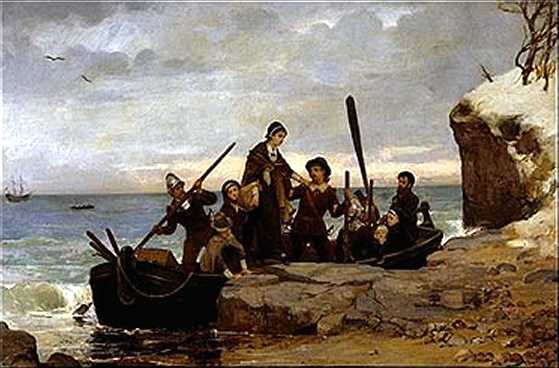


 African-American soldiers have fought in American wars since colonial days. 180,000 Black soldiers served in the Civil War. The Buffalo Soldiers of the late 1800s took their name from the Native Americans..