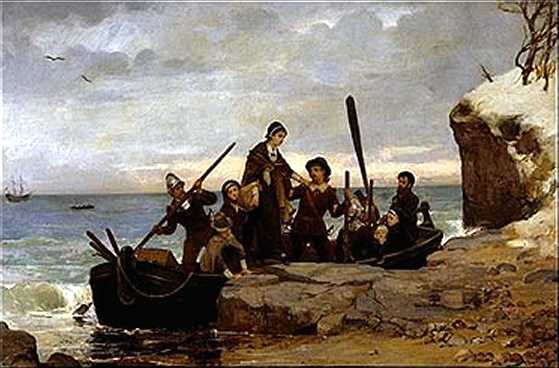
After a harsh winter, the Pilgrims had their first formal contact with the indigenous when on March 16, 1621 an Native American walked boldly into the middle of Plymouth Colony and declared in English, "Welcome, Englishmen!" He also asked if they had any beer! His name was Samoset, a subordinate chief of the Abenaki tribe in Maine, and he was was visiting Chief Massasoit of the Wampanoags. Samoset had learned English from English fishermen that came to fish off the coast of Maine. From Samoset, the colonists learned about the plague that had wiped out the Indians where they had established Plymouth Colony. After spending the night in the settlement, he came back two days later with Tisquantum, better known today as Squanto.
23 November 2010
Thanksgiving in America : The Story of Thanksgiving, Part 4 (Reposted from 23 November 2009)
21 November 2010
Thanksgiving in America : The Story of Thanksgiving, Part 3 (Reposted from 20 November 2009)
19 November 2010
Thanksgiving In America : The Story of Thanksgiving, Part 2 (Repost from 17 November 2009)
13 November 2010
Thanksgiving in America : The Story of Thanksgiving, Part 1 (Repost from 13 November 2009)
On Thursday, November 26 this month, American families all across the United States will get together around the table to enjoy the traditional Thanksgiving dinner and give thanks for the year's blessings. Even though its roots can be traced back to the European harvest festivals, this American holiday has deep religious roots from the Puritan tradition. However, Thanksgiving is not based on any one denomination allowing Americans of all faiths to celebrate. This is the first post in a series that will tell the Thanksgiving story.
Learn more about the Puritans HERE
Learn more about the Pilgrims in Leiden HERE
11 November 2010
11 November - Remembrance Day in the United Kingdom
(from http://www.woodlands-junior.kent.sch.uk/customs/Remembrance.html)
November is the time of the year when the British wear a red poppy in memory of those who sacrificed their lives for us during wars.
The eleventh hour of the eleventh day of the eleventh month marks the signing of the Armistice, on 11th November 1918, to signal the end of World War One.
At 11 am on 11 November 1918 the guns of the Western Front fell silent after more than four years continuous warfare.
What is Remembrance Day?
Remembrance Day is on 11 November. It is a special day set aside to remember all those men and women who were killed during the two World Wars and other conflicts. At one time the day was known as Armistice Day and was renamed Remembrance Day after the Second World War.
Remembrance Sunday is held on the second Sunday in November, which is usually the Sunday nearest to 11 November. Special services are held at war memorials and churches all over Britain.
A national ceremony takes place at the Cenotaph in Whitehall, London. The Queen lays the first wreath at the Cenotaph.
Wreaths are layed beside war memorials by companies, clubs and societies. People also leave small wooden crosses by the memorials in remembrance of a family member who died in war.
The 'Last Post'
The "Last Post" is traditionally played to introduce the two minute silence in Remembrance Day ceremonies. It is usually ' played on a bugle. (In military life, 'The Last Post' marks the end of the day and the final farewell.)
Listen to the ‘Last Post’
The sounding of "Reveille" (or, more commonly, "The Rouse"), ends the two minute silence, followed by the recitation of the "Ode of Remembrance."
Listen to ‘Reveille’
"They Shall not grow old" ("Ode of Remembrance." )
A poem called 'For the Fallen' is often read aloud during the ceremony.
For the Fallen
By Laurence Binyon
|
|
|
|
|
|
|
Poppy Day
Remembrance Day is also known as Poppy Day, because it is traditional to wear an artificial poppy. They are sold by the Royal British Legion, a charity dedicated to helping war veterans.
Two minute silence
At 11am on each Remembrance Sunday a two minute silence is observed at war memorials and other public spaces across the UK.
05 November 2010
On This Day : 05 November 2010 – Guy Fawkes and Bonfire Night
Slide your cursor over the words in bold to find their French translation.
Taken from : http://www.bonfirenight.net/index.php
In 1605, thirteen young men planned to blow up
the Houses of Parliament. Among them was
Guy Fawkes, Britain's most notorious traitor.
After Queen Elizabeth I died in 1603, English Catholics who had been persecuted under her rule had hoped that her successor, James I, would be more tolerant of their religion. James I had, after all, had a Catholic mother. Unfortunately, James did not turn out to be more tolerant than Elizabeth and a number of young men, 13 to be exact, decided that violent action was the answer.
A small group took shape, under the leadership of Robert Catesby. Catesby felt that violent action was warranted. Indeed, the thing to do was to blow up the Houses of Parliament. In doing so, they would kill the King, maybe even the Prince of Wales, and the Members of Parliament who were making life difficult for the Catholics. Today these conspirators would be known as extremists, or terrorists.
To carry out their plan, the conspirators got hold of 36 barrels of gunpowder - and stored them in a cellar, just under the House of Lords.
But as the group worked on the plot , it became clear that innocent people would be hurt or killed in the attack, including some people who even fought for more rights for Catholics. Some of the plotters started having second thoughts. One of the group members even sent an anonymous letter warning his friend, Lord Monteagle, to stay away from the Parliament on November 5th. Was the letter real?
The warning letter reached the King, and the King's forces made plans to stop the conspirators.
Guy Fawkes, who was in the cellar of the parliament with the 36 barrels of gunpowder when the authorities stormed it in the early hours of November 5th, was caught, tortured and executed.
It's unclear if the conspirators would ever have been able to pull off their plan to blow up the Parliament even if they had not been betrayed. Some have suggested that the gunpowder itself was so old as to be useless. Since Guy Fawkes and the other conspirators got caught before trying to ignite the powder, we'll never know for certain.
Even for the period which was notoriously unstable, the Gunpowder Plot struck a very profound chord for the people of England. In fact, even today, the reigning monarch only enters the Parliament once a year, on what is called "the State Opening of Parliament". Prior to the Opening, and according to custom, the Yeomen of the Guard search the cellars of the Palace of Westminster. Nowadays, the Queen and Parliament still observe this tradition.
On the very night that the Gunpowder Plot was foiled, on November 5th, 1605, bonfires were set alight to celebrate the safety of the King. Since then, November 5th has become known as Bonfire Night. The event is commemorated every year with fireworks and burning effigies of Guy Fawkes on a bonfire.
Some of the English have been known to wonder, in a tongue in cheek kind of way, whether they are celebrating Fawkes' execution or honoring his attempt to do away with the government.
For 400 years, bonfires have burned
on November 5th to mark the failed Gunpowder Plot.
The tradition of Guy Fawkes-related bonfires actually began the very same year as the failed coup. The Plot was foiled in the night between the 4th and 5th of November 1605. Already on the 5th, agitated Londoners who knew little more than that their King had been saved, joyfully lit bonfires in thanksgiving. As years progressed, however, the ritual became more elaborate.
Soon, people began placing effigies onto bonfires, and fireworks were added to the celebrations. Effigies of Guy Fawkes, and sometimes those of the Pope, graced the pyres. Still today, some communities throw dummies of both Guy Fawkes and the Pope on the bonfire (and even those of a contemporary politician or two), although the gesture is seen by most as a quirky tradition, rather than an expression of hostility towards the Pope.
Preparations for Bonfire Night celebrations include making a dummy of Guy Fawkes, which is called "the Guy". Some children even keep up an old tradition of walking in the streets, carrying "the Guy" they have just made, and beg passersby for "a penny for the Guy." The kids use the money to buy fireworks for the evening festivities.
On the night itself, Guy is placed on top of the bonfire, which is then set alight; and fireworks displays fill the sky.
The extent of the celebrations and the size of the bonfire varies from one community to the next. Lewes, in the South East of England, is famous for its Bonfire Night festivities and consistently attracts thousands of people each year to participate.
Bonfire Night is not only celebrated in Britain. The tradition crossed the oceans and established itself in the British colonies during the centuries. It was actively celebrated in New England as "Pope Day" as late as the 18th century. Today, November 5th bonfires still light up in far out places like New Zealand and Newfoundland in Canada.
Taken from : http://www.bonfirenight.net/index.php
Contributed by Jane Ryder.
To watch a video from the BBC on Guy Fawkes and the Gunpowder Plot, go HERE:
26 November 2009
Thanksgiving in America : Featured Podcast – What Thanksgiving Day Means to People in the US (VOA News – Special English)
http://www.voanews.com/specialenglish/2009-11-22-voa2.cfm
Sharing some favorite memories, mixed with cold reality about the effects of the economic downturn.
Download MP3 HERE
Transcript of radio broadcast: 22 November 2009
VOICE ONE:
Welcome to THIS IS AMERICA. I'm Faith Lapidus. This Thursday is a day for families and friends to share a special holiday meal and think about what they are thankful for. This week on our program, we ask some people to share their favorite memories of Thanksgiving Day.
(MUSIC)
VOICE ONE:
Special English reporters June Simms and Dana Demange talked to people about the holiday.
JIM OLDHAM: "My name is Jim Oldham and I'm from Nashville, Tennessee. I remember my father drove a bus and my mother was a waitress, and so we often didn't get to have Thanksgiving together. And I remember when I was about twelve, her work and his work permitted us all to do that. And we had brothers and sisters, and the traditional turkey and all the trimmings. We always had pumpkin pie, and if we were really lucky, a little bit of whipped cream on top. And it was just a wonderful day."
ANN GEIGER: "I'm Ann Geiger from Tucson, Arizona. Thanksgiving is special for our family because like so many families our adult children live around the country. And we usually get at least part of them together for Thanksgiving."
REPORTER: "And what is one of your fondest Thanksgiving Day memories?"
ANN GEIGER: "Oh, I think a recent Thanksgiving when my son and I had a turkey cook-off. He brined his turkey and I didn't brine mine. And we decided which one was the best."
REPORTER: "Who won?"
ANN GEIGER: "He did."
VOICE ONE:
Brining is a way to prepare meat in a salt solution, whether for a competitive "cook-off" or just any meal. Traditionally the meat served on Thanksgiving is turkey. The bird is usually served with side dishes including a mixture known either as stuffing or dressing.
Many families also bring out their finest table settings -- the "good china" -- for Thanksgiving.
JOEL UPTON: "My name is Joel Upton. I'm from Livingston, Tennessee. Thanksgiving at my family was always a time when brothers and sisters, aunts and uncles, cousins, we all got together. And someone would bring different dishes. Someone would bring the sweet potatoes. Someone would bring the meat. Someone would bring the dressing. And we would all sort of combine the efforts to have a family Thanksgiving dinner and bring out the good china for that particular event.
And Thanksgiving also, in my early days when I was a child, the kids would all get to play, maybe we hadn't seen each other for a while. The men would always watch a football game on TV. And Thanksgiving was just a really, really special time. And, of course, we had in mind the Pilgrims and what it was all about too. But it was a family time."
VOICE ONE:
The Pilgrims first arrived in America in sixteen twenty. They were separatists from the Church of England and other settlers. The ship that brought the first group was the Mayflower.
An exploring party landed at Plymouth, in what became the Commonwealth of Massachusetts. The state is named after an American Indian tribe -- a recognition of the groups that came long before the Pilgrims.
The first Pilgrims established a village. Those who survived the first difficult years held harvest festivals and religious celebrations of thanksgiving. These events formed the basis of the holiday that Americans now celebrate.
But there are no official "rules" for a Thanksgiving meal. Some people like to find ways to do things a little differently.
BUTCH HUNSINGER: "Butch Hunsinger from Williamsport, Pennsylvania."
REPORTER: "The bird. What are you going to do differently this year?"
BUTCH HUNSINGER: "Try to shoot it myself, instead of go to the store to buy it. Go to the family cabin, and hunt on the family land and try to call in a turkey and fire away."
REPORTER: "And who's the better shot in the family?"
BUTCH: "Oh my son, by far."
REPORTER: "What about your worst Thanksgiving memory?"
BUTCH: "Worst…[Laughter] The worst was also the funnest, 'cause I got up early Thanksgiving day and we went to the Burwick Marathon, but it's a nine-mile road race. Just a crusher." [Laughter]
HUGUETTE MBELLA: "Hi, my name is Huguette Mbella. And I was born in Cameroon and grew up in France. And I live now in the United States in Washington, D.C. The whole concept of Thanksgiving was a little bit bizarre. In France, the main celebration is Christmas, not Thanksgiving."
REPORTER: "Can you think of one of your most fond Thanksgiving memories?"
HUGUETTE MBELLA: "I would say my first one. It was in New York. Suddenly the turkey comes on the table, and I was amazed by the size. It was huge! The first thing that came to my mind was actually that's a lot of food!"
ELIZABETH BRINKMAN: "My name is Elizabeth Brinkman and I'm from Cleveland, Ohio. It was always a day that my mother did all the cooking. And we had turkey and I got to chop the vegetables for the dressing. And we got out the good china."
GORDON GEIGER: "Gordon Geiger from Tucson, Arizona. We used to get together at my parents' house and all of my relatives would come over and we'd have a big dinner. And after dinner we would watch football games on the television.
I think it's probably really the most important holiday in the United States because it is a day that is not tied to a particular religion. It is not tied as much to commercial activities. It's more a reflection of the fact that we've had a good life and we appreciate it."
(MUSIC)
VOICE ONE:
This Thanksgiving, Americans can be thankful that the Great Recession may be over. But the job market faces a long recovery. Unemployment is now above ten percent. And if the underemployed are added, the rate is seventeen and a half percent. The underemployed are people no longer searching for work or only able to find part time jobs.
Last week, the United States Department of Agriculture released its "household food security" report for two thousand eight. The study found that families in seventeen million households had difficulty getting enough food at times during the year. That was almost fifteen percent -- up from eleven percent in two thousand seven. It was the highest level since the current surveys began in nineteen ninety-five.
The Agriculture Department says poverty is the main cause of food insecurity and hunger in the United States.
President Obama, in a statement, called the report unsettling. Especially troubling, he said, is that there were more than five hundred thousand families in which a child experienced hunger multiple times during the year.
He said the first task is to renew job growth, but added that his administration is taking other steps to prevent hunger. These include an increase in aid for people in the government's nutrition assistance program, commonly known as food stamps.
(MUSIC)
VOICE ONE:
The Continental Congress wrote the first national Thanksgiving proclamation in seventeen seventy-seven, during the Revolutionary War. George Washington issued the first presidential Thanksgiving proclamation in seventeen eighty-nine. Here is part of what he wrote.
READER:
Whereas it is the duty of all nations to acknowledge the providence of almighty God, to obey his will, to be grateful for his benefits, and humbly to implore his protection and favor -- and whereas both houses of Congress have by their joint committee requested me "to recommend to the people of the United States a day of public thanksgiving and prayer to be observed by acknowledging with grateful hearts the many signal favors of Almighty God, especially by affording them an opportunity peaceably to establish a form of government for their safety and happiness."
Now therefore I do recommend and assign Thursday the twenty-sixth day of November next to be devoted by the people of these states to the service of that great and glorious being, who is the beneficent author of all the good that was, that is, or that will be ...
VOICE ONE:
Sarah Josepha Hale was a magazine editor and writer who campaigned for a Thanksgiving holiday. That way, there would be "two great American national festivals," she said, the other being Independence Day on the Fourth of July.
In September of eighteen sixty-three, Sarah Josepha Hale appealed to President Abraham Lincoln. Lincoln had made proclamations in the spring of eighteen sixty-two and sixty-three. But these gave thanks for victories in battle during the Civil War.
Then came another proclamation on October third, eighteen sixty-three. It gave more general thanks for the blessings of the year. This is part of what it said:
READER:
In the midst of a civil war of unequaled magnitude and severity, which has sometimes seemed to foreign states to invite and to provoke their aggression, peace has been preserved with all nations, order has been maintained, the laws have been respected and obeyed, and harmony has prevailed everywhere, except in the theater of military conflict, while that theater has been greatly contracted by the advancing armies and navies of the Union.
Needful diversions of wealth and of strength from the fields of peaceful industry to the national defense have not arrested the plow, the shuttle, or the ship; the ax has enlarged the borders of our settlements, and the mines, as well of iron and coal as of the precious metals, have yielded even more abundantly than heretofore. ...
I do therefore invite my fellow-citizens in every part of the United States, and also those who are at sea and those who are sojourning in foreign lands, to set apart and observe the last Thursday of November next as a day of thanksgiving and praise to our beneficent Father who dwelleth in the heavens.
VOICE ONE:
Lincoln's proclamation began a tradition. Presidents have issued Thanksgiving proclamations every year since eighteen sixty-three. All can be found on the Web site of the Pilgrim Hall Museum in Plymouth.
In nineteen forty-one, Franklin Roosevelt was president. Roosevelt approved a resolution by Congress. It established, by law, the fourth Thursday in November as Thanksgiving Day.
(MUSIC)
Our program was produced by Caty Weaver. I'm Faith Lapidus. Join us again next week for THIS IS AMERICA in VOA Special English.
02 June 2009
Vocabulary In the News: Big Ben Celebrates its 150th Anniversary
http://www.france24.com/en/20090531-culture-london-clock-big-ben-anniversary-150
The world's most famous clock marks its 150th anniversary on Sunday. Big Ben, with its distinctive Gothic faces, started ticking on May 31, 1859.
AFP - Big Ben, arguably the world's most famous clock which towers over London, marked its 150th anniversary Sunday.
The clock started ticking on May 31 1859 and has continued with only occasional interruptions for maintenance, bad weather and even bird strikes ever since.
The clock, housed in St Stephen's Tower which adjoins Britain's House of Commons, is one of the capital's most popular tourist attractions and boasts some amazing statistics.
Each of the four Gothic clock faces is seven metres wide, with a minute hand over four metres long which travels the equivalent of 190 kilometres per year.
A Latin inscription is carved beneath each one -- "Domine salvam fac Reginam nostrum Victoriam primam" which means: "O Lord, save our Queen Victoria the First." Queen Victoria was on the throne in Britain at the time.
The 96 metre-high tower which houses the clock was built as part of the rebuilding of the Houses of Parliament by architects Charles Barry and Augustus Pugin following a major fire in 1843.
A competition was opened in 1846 to decide who should build the clock, but it took seven years to decide a winner.
Eventually, the winner was named as Edward Dent, who had already made a chronometer for the HMS Beagle, the ship which carried Charles Darwin on a worldwide voyage which led him to the theory of evolution.
The clock cost 2,500 pounds to build and was completed in 1854 but it was not installed until the clock tower was finished five years later.
Even then, there was a last-minute hitch -- the original cast-iron minute hands were too heavy and had to be replaced with copper ones.
The famous bell chimes -- which are used at the start of many television and radio news bulletins in Britain -- did not sound for another six weeks afterwards.
The name Big Ben originally referred to the bell in the clock tower, but has come to be used for the tower and the clock as well.
It is not entirely clear where the name Big Ben comes from -- some say refers to Sir Benjamin Hall, an MP at the time, while others claim it was after heavyweight boxer Benjamin Caunt.
VOCABULARY
| amazing – extraordinaire, incroyable |
| boast – se vanter de |
| carved – gravé |
| cast iron – la fonte |
| chime – le carillon |
| clock face – un candran |
| clock tower – un beffroi |
| competition – un concours |
| copper – le cuivre |
| hitch – un problème, un pépin |
| minute hand – aiguille des minutes |
| sound – faire retenir, sonner |
| tick – faire tic-tac |
| tower over – se dresser au-dessus de, dominer |
To learn more about Big Ben, visit Clock Tower tour at the UK Parliament’s webpage.
13 May 2009
On This Day . . . 13 May: “blood, toil, tears, and sweat”
On this day in 1940, Sir Winston Churchill gave one of three memorable speeches to the House of Commons during the Battle of France. These three speeches were of great inspiration to the British people. Here is transcript of the speech as given by the Churchill on this day:
We are in the preliminary stage of one of the greatest battles in history. That we are in action at many points — in Norway and in Holland —, that we have to be prepared in the Mediterranean. That the air battle is continuous, and that many preparations have to be made here at home.
I would say to the House as I said to those who have joined this government: I have nothing to offer but blood, toil, tears and sweat. We have before us an ordeal of the most grievous kind. We have before us many, many long months of struggle and of suffering.
You ask, what is our aim? I can answer in one word: Victory. Victory at all costs — Victory in spite of all terror — Victory, however long and hard the road may be, for without victory there is no survival.
VOCABULARY
| toil – le labeur, le travail |
| tears – des larmes |
| sweat – la sueur |
| ordeal – une épreuve |
| grievous – sérieux, dangereux, grave |
| struggle – une lutte |
| aim – le but |
| in spite of - malgré |
01 May 2009
Culture Spot: Jesse Ramsden (Podcast from Engines of Our Ingenuity)
Taken directly from: http://www.uh.edu/engines/epi2476.htm
You can listen to other great podcasts from this site with access to the transcripts with which you can work on your listening comprehension skills! To access Engines of Our Ingenuity, click on the image below!
JESSE RAMSDEN
by John H. Lienhard
Right click here to download the podcast!
Today, Jesse Ramsden. The University of Houston's College of Engineering presents this series about the machines that make our civilization run, and the people whose ingenuity created them.
One day, in the late eighteenth century, Jesse Ramsden went down to the palace of King George III in Kew Gardens. He wasn't expected; he had to talk his way in. He finally got his audience and was graciously received. Then he presented the King with a scientific instrument that he'd built on order -- maybe a sextant or a telescope, I don't know. The King admired it, then said,
I have been told, Mr. Ramsden, that you are ... the least punctual of any man in England; you have brought home this instrument on the very day ... appointed. You have mistaken only the year.For the King to let Ramsden off with so gentle a scolding says volumes about Ramsden's stature as an instrument maker.
Compared with other monarchs of his time, King George lived a pretty simple and monogamous life. He was also a devoted student of science and agriculture, seriously interested in the latest scientific tools. That's why he hired Jesse Ramsden to build his instruments.
Ramsden, born in Yorkshire in 1735, apprenticed as a clothworker and he began in that business. But his growing fascination with scientific devices led him to begin a new apprenticeship as a maker of mathematical instruments at the age of 21. That was old for an apprentice. But he excelled and was soon running his own business.
He also found a welcome in the wealthy family of John Dollond. Dollond held the first patent for an achromatic lens. Previous lenses all suffered from chromatic aberration -- rainbow fringes of light around the edges of objects. You and I were bothered by that in our early digital cameras. That's because lenses refract each color differently. Each color has a slightly different focus.
The first solution, invented by others but patented by Dollond, was to put a second lens with different refractive properties next to the first. Ramsden went on to use and improve that delicate technology. (He also married Dollond's daughter, Sarah.)
Yet lenses were only a fraction of all he made. He built circle dividers, sextants, balances, protractors, slide rules, transits, barometers ... He had a staff of some fifty workers, and his quality control seemed to surpass sanity. He was famous for missing deadlines. He drove clients (like King George) to distraction. Small wonder that, when he died in 1800, Dollond family executors could recoup only a tiny fraction of all the money owed him.
Ramsden exemplified a conviction that lay behind the Age of Enlightenment -- that all understanding flowed from precise measurement. Later science would turn to statistical inference, probabilistic analysis -- and ultimately quantum physics which would take us quite beyond measurement's reach.
But now I hold an antiquarian catalog of Ramsden's instruments -- all masterpieces of hand-etching in brass and steel. And I smile the smug Enlightenment smile-of-reason at King George's year-long wait -- while Ramsden brought his instrument as close to perfection as one might approach, without offending his own Maker.
I'm John Lienhard at the University of Houston, where we're interested in the way inventive minds work.
(Theme music)
A. Chapman, Ramsden, Jesse (1735-1800), Oxford Dictionary of National Biography, Vol. ?, (Oxford: Oxford University Press, 2004): pp. 963-966.
The image of Ramsden is courtesy of Wikipedia Commons. All other images are from Tesseract: Early Scientific Instruments catalogs, Issues 86 and 87, Winter 2008/2009 and Spring 2009. (Co-published with Rittenhouse: the Journal of the American Scientific Instrument Enterprise.)
See also the Wikipedia entries on Jesse Ramsden, King George III, John Dolland, chromatic aberration, and achromatic lenses.
30 April 2009
On This Day … April 30: Birthday of Queen Mary II
Taken directly from: http://www.nndb.com/people/404/000093125/
Queen Mary II
AKA Mary Stuart
Born: 30 April 1662
Birthplace: St. James's Palace, London, England
Died: 28 December 1694
Location of death: Kensington Palace, London, England
Cause of death: Illness
Remains: Buried, Westminster Abbey, London, England
Gender: Female
Religion: Anglican/Episcopalian
Race or Ethnicity: White
Sexual orientation: Straight
Occupation: Head of State, Royalty
Nationality: England
Executive summary: Queen of England 1689-94
Mary II, Queen of England and wife of King William III, elder daughter of James, Duke of York, afterwards King James II, by his first wife, Anne, daughter of Edward Hyde, 1st Earl of Clarendon, was born in London on the 30th of April 1662. She was educated as a Protestant, and as it was probable that she would succeed to the English throne after the deaths of her uncle, King Charles II, and her father, the choice of a husband for her was a political event of high importance. About 1672 the name of William, prince of Orange, was mentioned in this connection; and after some hesitation on both sides caused by the condition of European politics, the betrothal of William and Mary took place in October 1677, and was quickly followed by their marriage in London on the 4th of November.
Mary's married life in Holland does not appear to have been a happy one. Although she soon became popular among the Dutch, she remained childless, while William treated her with neglect and even with insult; and her troubles were not diminished after her father became King of England in 1685. James had treated his daughter very shabbily in money matters; and it was increasingly difficult for her to remain loyal to both father and husband when they were so divergent in character and policy. Although Mary never entirely lost her affection for her father the wife prevailed over the daughter; and after the birth of her half-brother, the Prince of Wales, in 1688, she regarded the dethronement of James as inevitable. It cannot be said, however, that William merited this confidence. Possibly he was jealous of his wife as the heiress of the English throne, contrasting her future position with his own; but according to Burnet, who was then staying at the Hague, this cause of difference was removed by the tactful interference of Burnet himself. The latter asserts that having divined the reason of the prince's jealousy he mentioned the matter to the princess, who in her ignorance of statecraft had never considered the relative positions of herself and her husband with regard to the English throne; and that Mary, by telling the prince she would be no more but his wife, and that she would do all that lay in her power to make him king for life (Burnet, Supplement, ed. Foxcroft, p. 309), probably mollified her husband's jealousy. On the other hand Macaulay's statement that henceforward there was "entire friendship and confidence" between them must be taken with some reserve. Mary shared heartily in the events which immediately preceded William's expedition to England in 1688. After the success of the undertaking she arrived in London in February 1689; and by her faithful adherence to her promise made a satisfactory settlement of the English crown possible. William and Mary were together proclaimed King and Queen of England, and afterwards of Scotland, and were crowned on the 11th of April 1689.
During the king's absence from England the queen, assisted by a committee of the privy council, was entrusted with the duties of government, duties which she performed faithfully, but which she gladly laid down on William's return. In these times of danger, however, she acted when necessary with courage and promptitude, as when in 1690 she directed the arrest of her uncle Henry Hyde, 2nd Earl of Clarendon; but she was constantly anxious for William's safety, and unable to trust many of her advisers. She was further distressed by a quarrel with her sister Anne in 1692 following the dismissal of Marlborough, and this event somewhat diminished her popularity, which had hitherto been one of the mainstays of the throne. Weak in body and troubled in mind, the queen died at Kensington Palace from smallpox on the 28th of December 1694, and was buried in Westminster Abbey.
Mary was a woman of a remarkably modest and retiring disposition, whose outstanding virtue was perhaps her unswerving loyalty to William. Burnet has passed a remarkable panegyric upon her character. She was extremely pious and charitable; her blameless private life was in marked contrast with her surroundings, both in England and Holland; without bigotry she was greatly attached to the Protestant faith and to the Church of England; and she was always eager to improve the tone of public morals, and to secure a better observance of Sunday. Greenwich Hospital for Seamen was founded in her honor.
Father: King James II
Mother: Lady Anne Hyde (d. 1671)
Sister: Queen Anne
Husband: King William III (King of England, m. 4-Nov-1677)
UK Monarch: 13 February 1689 to 28 December 1694