| to wait in the wings | - | attendre dans les coulisses |
| to take centre stage | - | arriver sur le devant de la scène |
| relieved | - | soulagé, déchargé |
| fairytale | - | un conte de fée |
| to pop the question (informal) | - | demander la main d’une femme |
| to date someone | - | sortir avec quelqu’un |
| expected | - | attendu, espéré |
| to fail | - | échouer |
| to catch the eye of someone | - | accrocher le regard |
| a crush (idiomatic) | - | le béguin, la toquade |
| a boarding school | - | le pensionnat |
| to pin | - | fixer avec une punaise |
| prying eyes | - | des yeux indiscrèts |
| to graduate | - | terminer ses études |
| the bubble of privacy burst | - | la bulle d’intimité a éclaté |
| to pass out (British) | - | términer avec succès (une université militaire ou un centre de formation de la police) |
| to set tongues wagging | - | faire jaser |
| reminiscent | - | évocateur |
| rumours swell | - | les rumeurs gonflent |
| scrutiny | - | le regard scrutateur |
| to take its toll | - | faire des ravages |
| the spotlight | - | la sellette, la une |
| high profile | - | à forte visibilité, médiatique |
| stroke | - | dit pour un événement important mais inattendu |
| to hijack an event | - | récupérer un événement |
Showing posts with label UK. Show all posts
Showing posts with label UK. Show all posts
18 November 2010
Video of the Moment : Prince William and Kate Middleton To Marry (Sky News–16 November 2010)


11 November 2010
11 November - Remembrance Day in the United Kingdom
(from http://www.woodlands-junior.kent.sch.uk/customs/Remembrance.html)

November is the time of the year when the British wear a red poppy in memory of those who sacrificed their lives for us during wars.
The eleventh hour of the eleventh day of the eleventh month marks the signing of the Armistice, on 11th November 1918, to signal the end of World War One.

What is Remembrance Day?
Remembrance Day is on 11 November. It is a special day set aside to remember all those men and women who were killed during the two World Wars and other conflicts. At one time the day was known as Armistice Day and was renamed Remembrance Day after the Second World War.
Remembrance Sunday is held on the second Sunday in November, which is usually the Sunday nearest to 11 November. Special services are held at war memorials and churches all over Britain.

A national ceremony takes place at the Cenotaph in Whitehall, London. The Queen lays the first wreath at the Cenotaph.
Wreaths are layed beside war memorials by companies, clubs and societies. People also leave small wooden crosses by the memorials in remembrance of a family member who died in war.
The 'Last Post'
The "Last Post" is traditionally played to introduce the two minute silence in Remembrance Day ceremonies. It is usually ' played on a bugle. (In military life, 'The Last Post' marks the end of the day and the final farewell.)
Listen to the ‘Last Post’
The sounding of "Reveille" (or, more commonly, "The Rouse"), ends the two minute silence, followed by the recitation of the "Ode of Remembrance."
Listen to ‘Reveille’
"They Shall not grow old" ("Ode of Remembrance." )
A poem called 'For the Fallen' is often read aloud during the ceremony.
For the Fallen
By Laurence Binyon
|
|
|
|
|
|
|

Remembrance Day is also known as Poppy Day, because it is traditional to wear an artificial poppy. They are sold by the Royal British Legion, a charity dedicated to helping war veterans.
Two minute silence
At 11am on each Remembrance Sunday a two minute silence is observed at war memorials and other public spaces across the UK.
06 January 2010
British Culture : The Haxey Hood Game

"Hoose agen hoose, toon agen toon, if a man meets a man nok 'im doon, but doant 'ot 'im"
(This translates as: House against House, Town against Town, if a man meets a man, knock him down but don’t hurt him.)
Dating back to the year 1298AD, but with its origins in Celtic sacrificial rites, The Haxey Hood Game is a northern tradition, very similar to a rough form of rugby football.
The game is held on 6 January and involves the villagers of Haxey, Westwoodside (North Lincolnshire) and the surrounding areas. Customarily the game would involve 'smoking the fool' which entails setting fire to a pile of straw and paper around the village fool, however as it evolved into a more and more dangerous tradition, culminating in trouble reviving the fool, it was eventually banned in the 1850s.
The first part of this rough and tumble game involves throwing twelve sack hoods into the air, with the aim of getting these hoods to either of the two pubs in Haxey or to the pub in Westwoodside without being stopped.
In the late afternoon of 6 January, a leather hood is thrown into the air and scrums of men attempt to get the hood to their favourite pub. Managing to get the hood to the pub can take several hours as the teams of men fight and push to achieve their goal. The pub receiving the hood keeps it until the following year's Haxey Hood Game.
Taken from:

09 November 2009
In the News: French Babies Cry With a French Accent (a follow-up!)
As a follow-up to Saturday’s post, here is a link to a BBC page with a recording of German infant’s cry and that of French baby. Can you spot the difference?
http://news.bbc.co.uk/today/hi/today/newsid_8346000/8346476.stm
08 November 2009
In The News : French Babies Cry With a French Accent !

For those of you interested, here’s a link to a November 6 article by Hannah Devlin in The Times (UK) newspaper entitled ‘Study shows unborn babies cry in their mother tongue.’
http://www.timesonline.co.uk/tol/news/science/biology_evolution/article6905544.ece
This time, it’s up to you to do the leg work and look up the vocabulary you don’t know!
07 November 2009
Vocabulary In the News : 6 November 2009 – The Times (UK)
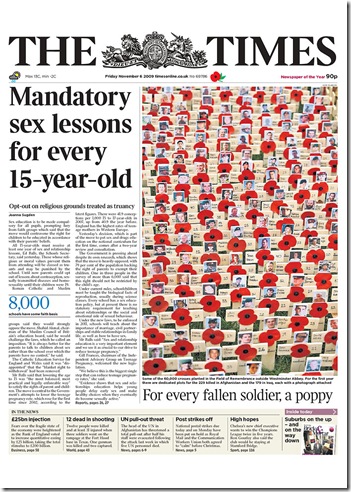
Sex education in the United Kingdom will soon be made mandatory for all 15-year-olds. In other words, these teenagers will be legally obliged to take one-year of sex and relationship lessons. Another common synonym for this word is compulsory.
This decision has prompted fury from religious groups who believe this contravenes parental rights. This means that if enacted, they believe the decision would violate parents’ rights to educate children according to their beliefs.
If students opt out on religious grounds, it will be considered as truancy and the students may be punished by the school. If you opt out of something, you decide to not participate or not take part in something. Opting out on religious grounds means to not participate because of religious reasons. Here’s another example of the phrase: In France it is illegal to discriminate against someone on the grounds of religion, race, sex, age or sexual orientation.
Students who decide to not attend these lessons on the grounds of religious beliefs will be punished for truancy which means they are absent from class without permission. Any student skipping class is said to be truant. In the UK, Canada and the US, there are police officers or other designated officials who are authorized to arrest truant students and take the child to school. These officers or officials are called truant officers.
Read the original article at : http://www.timesonline.co.uk/tol/life_and_style/education/article6905543.ece
Learn more about truancy at : http://en.wikipedia.org/wiki/Truancy
16 October 2009
Vocabulary In the News : 16 October 2009 – The Times (United Kingdom)

For a larger view of the front page, click on the image. To visit The Times webpage, go to: http://www.timesonline.co.uk
The Middle East peace process is on the brink of collapse due to a row over a United Nations report condemning Israel of war crimes. A brink is the point in time when something very good or very bad is about to happen. If nations or people are having a row about/over something, this means they have a very serious disagreement over an issue.
Unfortunately the UN report causing the row threatens to sink the peace plan. Normally, this verb describes a boat or other object that falls to the bottom of a body of water, but here it means to make worse.
In this dispute, the UK is refusing to back Israel over the Gaza offensive. If you back someone or something, you give your give support.
If the negotiations collapse, this could scupper President Obama’s Middle East plans. To scupper is a naval term meaning to deliberately sink a ship by letting water in. In informal British English, to scupper means to spoil someone’s plans or hopes of success.
http://www.timesonline.co.uk/tol/news/world/middle_east/article6877164.ece
01 October 2009
In the News : British Legal History Being Made

Here’s a video as well :
To learn more, go to : http://en.wikipedia.org/wiki/UK_Supreme_Court
25 September 2009
Vocabulary In the News : 24 September 2009 – The Guardian (London, England)


- If you snub someone, you insult them by ignoring or being impolite to them. Apparently, British Prime Minister Brown was snubbed in New York by President Obama. It has been revealed that the prime minister was given the cold shoulder by Obama when the president spurned five requests for bilateral meetings. In other words, Obama refused to meet with Brown and turned away his requests.
One of the reasons for the snub began several weeks ago when the Scottish government released the Lockerbie bomber. The White House disapproved of how No 10 handled the situation.
http://www.guardian.co.uk/politics/2009/sep/23/barack-obama-gordon-brown-talks
Brown Denies Reports Of Obama Rift
Gordon Brown has been forced to deny reports of a rift (un désaccord)with Barack Obama. It had been claimed that the US President had rejected five approaches for a meeting with the Prime Minister. Mr Brown has been speaking to Sky's Andy Bell.
Is the US distancing itself from Britain?
Repeated requests from Britain for a formal meeting with President Barack Obama fell on deaf ears (tomber dans l’oreille d’un sourd) in the US. Is the "special relationship" cooling?
Requests from Downing Street for official talks were turned down with both camps denying it amounts to a snub. Instead the US president had private meetings with leaders from Russia, China and Japan.
Gordon Brown was able to have a wide-ranging (ample, étendu) discussion with the president. However, it has emerged this was a conversation in a kitchen after a meal at the United Nations.
Has the special relationship changed following the release of the Lockerbie bomber Abdelbaset Ali al-Megrahi? Should Obama be focusing on developing relations with other leaders? Do you think this is just a storm in a teacup (une tempête dans un verre d’eau) ?


15 September 2009
Vocabulary In the News : 14 September 2009 – The Journal (Newcastle, UK)

A Newcastle MP (Member of Parliament) is calling for the resignation of city officers and councillors of a North East city after the mishandling of expenses concerning the renovation of an art gallery came to light. A councillor is an elected member of a city’s governing council. These councillors mishandled the public funds by allowing the bill for the arts centre to exceed the budget. This bad and careless use of responsibility is called a mishandling. This abuse of public trust has now been revealed and made know, or idiomatically, has come to light. http://www.journallive.co.uk/north-east-news/todays-news/2009/09/14/taxpayers-will-pay-for-gallery-failures-61634-24680603/
In another front page story, a taxi driver describes a terrifying experience when his passengers threw a rope around his neck and thrust in his face. To thrust means to push with force. It is an irregular verb like put and hit; it doesn’t change: thrust (simple past) and thrust (past participle). At one point during the taxi driver’s nightmare, he grappled with the three men who attacked him. This means he fought them. As a result of grappling with the men, he suffered some cracked ribs and a broken nose. The attackers fled taking the driver’s keys and £120. http://www.journallive.co.uk/north-east-news/todays-news/2009/09/14/gun-and-rope-used-in-attack-on-driver-61634-24680606/
Subscribe to:
Posts (Atom)