If you stab someone or something, you push a sharp object such as a knife into that person or thing. Thankfully, in the case of this Marine who was stabbed in the back, his wound wasn’t severe. The Marine was trying to stop a shoplifter, who had tried to shoplift a laptop computer. Shoplifting is the act of stealing from a shop. This comes from the verb ‘to lift,’ which also means to steal.
Other interesting expressions with ‘stab’:
Unpleasant feelings or emotions can stab you if you feel them very strongly. When my grandmother passed away, sadness stabbed my heart. If someone’s words stab you, you feel a strong sense of sadness or fear.
a stabbing – In the article, the Marine was a victim of a stabbing. This is the name for this type of attack.
a stabbing pain – This is very intense and sharp pain such as would be felt in a heart attack or severe injury.
to stab someone in the back – If someone trusts you and that person thinks you are loyal to them, but you do something bad that is disloyal and hurtful, you stab them in the back.
a stab in the dark – If you make a guess at a question or problem that is not based on any knowledge and which will probably be a wrong answer, we call this a stab in the dark. Sometimes while playing trivia games and I don’t know the answer, I’ll make a stab in the dark.
Click on the above image to access the article’s main page.
World War I – known at the time as “The Great War” - officially ended when the Treaty of Versailles was signed on June 28, 1919, in the Palace of Versailles outside the town of Versailles, France. However, fighting ceased seven months earlier when an armistice, or temporary cessation of hostilities, between the Allied nations and Germany went into effect on the eleventh hour of the eleventh day of the eleventh month. For that reason, November 11, 1918, is generally regarded as the end of “the war to end all wars.”
Soldiers of the 353rd Infantry near a church at Stenay, Meuse in France, wait for the end of hostilities. This photo was taken at 10:58 a.m., on November 11, 1918, two minutes before the armistice ending World War I went into effect
In November 1919, President Wilson proclaimed November 11 as the first commemoration of Armistice Day with the following words: "To us in America, the reflections of Armistice Day will be filled with solemn pride in the heroism of those who died in the country’s service and with gratitude for the victory, both because of the thing from which it has freed us and because of the opportunity it has given America to show her sympathy with peace and justice in the councils of the nations…"
The original concept for the celebration was for a day observed with parades and public meetings and a brief suspension of business beginning at 11:00 a.m.
The United States Congress officially recognized the end of World War I when it passed a concurrent resolution on June 4, 1926, with these words:
Whereas the 11th of November 1918, marked the cessation of the most destructive, sanguinary, and far reaching war in human annals and the resumption by the people of the United States of peaceful relations with other nations, which we hope may never again be severed, and
Whereas it is fitting that the recurring anniversary of this date should be commemorated with thanksgiving and prayer and exercises designed to perpetuate peace through good will and mutual understanding between nations; and
Whereas the legislatures of twenty-seven of our States have already declared November 11 to be a legal holiday: Therefore be it Resolved by the Senate (the House of Representatives concurring), that the President of the United States is requested to issue a proclamation calling upon the officials to display the flag of the United States on all Government buildings on November 11 and inviting the people of the United States to observe the day in schools and churches, or other suitable places, with appropriate ceremonies of friendly relations with all other peoples.
An Act (52 Stat. 351; 5 U. S. Code, Sec. 87a) approved May 13, 1938, made the 11th of November in each year a legal holiday—a day to be dedicated to the cause of world peace and to be thereafter celebrated and known as "Armistice Day." Armistice Day was primarily a day set aside to honor veterans of World War I, but in 1954, after World War II had required the greatest mobilization of soldiers, sailors, Marines and airmen in the Nation’s history; after American forces had fought aggression in Korea, the 83rd Congress, at the urging of the veterans service organizations, amended the Act of 1938 by striking out the word "Armistice" and inserting in its place the word "Veterans." With the approval of this legislation (Public Law 380) on June 1, 1954, November 11th became a day to honor American veterans of all wars.
Later that same year, on October 8th, President Dwight D. Eisenhower issued the first "Veterans Day Proclamation" which stated: "In order to insure proper and widespread observance of this anniversary, all veterans, all veterans' organizations, and the entire citizenry will wish to join hands in the common purpose. Toward this end, I am designating the Administrator of Veterans' Affairs as Chairman of a Veterans Day National Committee, which shall include such other persons as the Chairman may select, and which will coordinate at the national level necessary planning for the observance. I am also requesting the heads of all departments and agencies of the Executive branch of the Government to assist the National Committee in every way possible."
President Eisenhower signing HR7786, changing Armistice Day to Veterans Day. From left: Alvin J. King, Wayne Richards, Arthur J. Connell, John T. Nation, Edward Rees, Richard L. Trombla, Howard W. Watts
In 1958, the White House advised VA's General Counsel that the 1954 designation of the VA Administrator as Chairman of the Veterans Day National Committee applied to all subsequent VA Administrators. Since March 1989 when VA was elevated to a cabinet level department, the Secretary of Veterans Affairs has served as the committee's chairman.
The Uniform Holiday Bill (Public Law 90-363 (82 Stat. 250)) was signed on June 28, 1968, and was intended to ensure three-day weekends for Federal employees by celebrating four national holidays on Mondays: Washington's Birthday, Memorial Day, Veterans Day, and Columbus Day. It was thought that these extended weekends would encourage travel, recreational and cultural activities and stimulate greater industrial and commercial production. Many states did not agree with this decision and continued to celebrate the holidays on their original dates.
The first Veterans Day under the new law was observed with much confusion on October 25, 1971. It was quite apparent that the commemoration of this day was a matter of historic and patriotic significance to a great number of our citizens, and so on September 20th, 1975, President Gerald R. Ford signed Public Law 94-97 (89 Stat. 479), which returned the annual observance of Veterans Day to its original date of November 11, beginning in 1978. This action supported the desires of the overwhelming majority of state legislatures, all major veterans service organizations and the American people.
Veterans Day continues to be observed on November 11, regardless of what day of the week on which it falls. The restoration of the observance of Veterans Day to November 11 not only preserves the historical significance of the date, but helps focus attention on the important purpose of Veterans Day: A celebration to honor America's veterans for their patriotism, love of country, and willingness to serve and sacrifice for the common good.
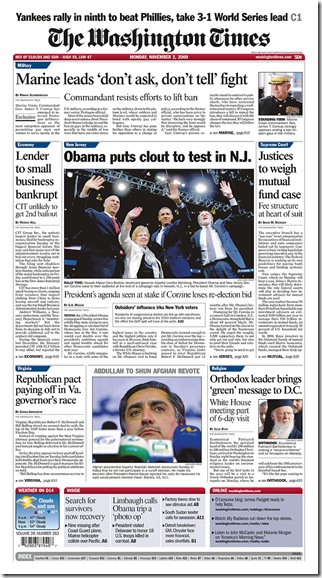
There is a some good vocabulary in this front page we can glean.
- US Marine Corps Commandant General James T. Conway is leading the fight against lifting the policy ‘don’t ask, don’t tell’ put in place in the 1990’s by President Clinton. ‘Don’t ask, don’t tell’ allows gays to serve in the US military but not openly. President Obama has promised to lift the ban and would permit gay men and women to serve openly. If Obama lifts the ban, he officially removes and ends a rule or law that stops someone from doing something. Read more at :
- The 3rd of November is seen as the first test of Obama’s presidency due to elections in 4 states where Republicans are expected to win. Virginians and New Jerseyites are voting for governor today. In Virginia, the Republican leads by double digits. In New Jersey, the race is close. President Obama is putting his clout to the test by campaigning for the incumbent Democratic governor running for re-election. Clout is the power of influence. Obama is hoping that his clout will help the incumbent Democrat in New Jersey. An incumbent is someone simply running for re-election hoping to keep his office. Obama’s agenda is seen to be at stake in these elections if Democrats lose their bid for re-electon. In other words, his policies are in danger because the elections are seen as a referendum on the Obama presidency and the Democrats in general. A bid is an attempt to do something. Read more at :