Showing posts with label Republican Party. Show all posts

03 November 2010

Vocabulary in the News : The Wall Street Journal (Front Page from 3 November 2010)

WSJ

Let’s look at some of the vocabulary found in the article titles. If you want to read each article on The Wall Street Journal webpage, click on the each title.

GOP Claims House in Huge Swing, Tea-Party Wave Creates New Dynamic in Washington and the States; Democrats to Retain Senate Despite Drubbing

    • A swing is seat that hangs from ropes or chains and moves back and forth which is usually used by children. So you can imagine the illusion here of a swing. In politics, we this word to describe when one ruling party has been replaced by a new one. The term can be used to describe any change in emotion, idea, condition, etc, to another. For example, Spain was a very conservative and Catholic country but there was a swing away from traditional family values when the country allowed same-sex marriage. In Amsterdam, there is a swing in the government position on legalized marijuana which may cause coffee shops to close down in the future.
  • A change in political parties in power at a national level can also be described as a wave or even a tidal wave. A wave of course is a raised line of water you find in the ocean or other body of water. Last night a Republican wave swept (past irregular form of ‘to sweep’ – balayer) across the country pushing Democrats out of power.
  • The Majority Leader Harry Reid, despite the drubbing the Democrats received by the Republicans last night, surprisingly won his reelection in Nevada. If you received a drubbing, this means that you were severely beaten. This word is believed to have been possibly derived from the Arabic word darb which means a beating, particularly by a stick.

Unaligned Voters Tilt Rightward In Droves

    • Voters who don’t identify themselves as Republicans or Democrats tilted rightward in this election. In other words, they favored the particular program or opinion of those running as Republicans. Literally, to tilt means to incline or to cause to slope to one side. For example, these slashes ‘///////’ all tilt to the right.  If these unaligned (or nonaligned) voters had favored the Democrats, we would have said that they tilted leftward. In any case, the election is over and the United States must now move forward and not backward.
    • The headline also said that these independent voters favored the political right in droves. If people do something in droves, it means they do it in very large numbers.

How the Rout Was Won : Careful Plans, Timely Wave

    • A rout is a term to describe the complete defeat of your opponent in a battle, competition or an election. The word is also a verb. For example, Spain won the FIFA World Cup after having routed the Netherlands.
    • If something happens in a timely manner, it happens at the most suitable or proper time.
       

02 November 2010

Cartoon : To Have a Leg Up On

Political Cartoon by Dave Granlund of Massachusetts and published on 31 October 2010.

The cartoonist is illustrating how the Republicans, represented by the elephant’s foot, are predicted to crush the Democrats in the midterm elections. The donkey states that the GOP (Grand Old Party, i.e. the Republicans) has a leg up on the midterms. If you have a leg up on somebody, this means that you have the advantage. For an example, if you have more experience than other candidates for a particular job, you probably have a leg up on the other applicants. This expression is American.

18 October 2010

Vocabulary In the News : US Midterm Elections

On 2 November, Americans will vote in national midterm elections to elect the entire House of Representatives and one-third of the Senate. National elections take place every two years in the United States. This year’s elections are called midterm elections because they fall fall in the middle of a president’s 4-year term in office. This Election Day, all 435 seats of the House of Representatives, whose members only have a 2-year term, are up for election. In the Senate, one-third of Senate seats out of 100 are up for election. Members of that body have 6-year terms.

Currently there are 253 Democrat seats, 178 Republican seats and 6 empty seats in the House of Representatives. The Representative from California’s 8th congressional district, Nancy Pelosi is the current Speaker of the House. She is the 60th and first female to preside over the chamber. The Speaker of the House is probably the closest thing that the United States has to a prime minister. The Speaker is the second in line to the presidency after the Vice President and is in a leadership position of the majority party. He or she also works to set the political agenda for their party giving the Speaker a great deal of power. It is the second most powerful position in the US Government.

All polls in the US project a Republican sweep in the elections. This means that the party will pick up seats in a very large number retaking control of that chamber. The polls currently predict that the Republicans will win 212 seats with Democrats maintaining 183 seats. Forty seats are considered tossups. If pollsters say a seat is a tossup, they are indicating that they can’t predict which candidate will win because poll numbers are too close. If Republicans are swept into office in November, the current Minority Leader John Boehner will probably become the 61st Speaker of the House. Mr. Boehner represents Ohio’s 8th congressional district. To be a member of the House, the Constitution requires that the representative to be a minimum of 25 years of age when he is sworn into office.

In the Senate, one-third of that body’s seats are up for election. There are currently 57 Democrats, 41 Republicans and 2 Independents who caucus with the Democrats. If a member caucuses with a certain party, this means they meet with and vote with that party. In effect, this gives the Democrats 59 seats but one vote short of an absolute majority of 60 votes. Sixty votes are need to stop a filibuster by the minority party and to proceed to a vote. In the Senate, there are no time limits to how long a senator may speak on the floor. To stop or delay a proposal known as a bill, a senator can filibuster till the end of debate. In other words, he talks the bill to death. The only way to stop a filibuster, is to have 60 senators willing to vote for cloture.

The Vice President of the United States is also the President of the Senate as written in the US Constitution. Vice President Joseph Biden is the current President. Today, modern vice presidents rarely preside over the Senate except for the swearing in of new members, joint sessions of Congress and to cast a tie-breaking (or “casting”) vote if there is a 50/50 vote. Other than this exception, the President of the Senate cannot vote nor participate in debate. In the absence of the vice president, the Senate chooses a president pro tempore to preside who is usually the highest-ranking senator. The President pro tempore is also third in line to the presidency after the Speaker of the House.

If polls hold true, Republicans will also gain seats in the Senate. The current projection is 49 Democrats, 46 Republican and 5 tossups. If the Senate is divided 50/50, then the President of the Senate’s party retains control. In this case, the Democrats would still have control but with neither party having a 60-seat, filibuster-proof majority. According to the Constitution, a senator must be a minimum of 30 years old when he takes office.

In these elections, Americans are not only voting for Congress, they are also going to the polls to vote for over a million different offices at the state and local level including governors, lieutenant governors, members of state assemblies, local and state judges, local education boards, sheriffs, etc…. Most states will also have referendums and state constitutional amendments on the ballot. Republicans are expected to hold the majority of governorships. Of the 50 states, polls predict 14 Democrat governors, 26 Republican and 10 seats are still a tossup.

This election has been described as an anti-incumbent election because many Americans are tired of the same old politics by what has come to be called the political establishment or the ruling class. This negative term is used to describe that elite group of politicians that have power or authority. In many cases, they have held elected position for a long time. An incumbent is the term used for any outgoing politician who is running for reelection. The anti-incumbent movement has not only targeted Democrats but has also targeted establishment Republicans, many of whom lost in state primaries to a more conservative Republican. If an incumbent is not running for reelection, then the candidates are running for an open seat.

For further election news and to track election poll numbers as they change, go to http://www.realclearpolitics.com/

13 October 2010

Cartoon : Democrat vs. Republican Debate

Political cartoon by Chuck Assay of The Colorado Springs Gazette published on 08 October 2010.

Updated: If you place your cursor over some of the words, the French translation will appear in a popup window. Not all the words with a translation are in bold so you’ll have to explore the text.

In this conservative cartoon by Chuck Assay, you see the two major political parties represented by the donkey and the elephant.

The Democratic donkey was first associated with President Andrew Jackson back in 1828 when his opponents called him a jackass. Jackson later decided to officially adopt the image for his presidential campaign because it represented a strong-willed animal. If you are strong-willed, you are determined to do something you want to do, even if others don’t want to do it. The donkey was made famous by political cartoonist Thomas Nast who used the donkey in his cartoons to represent the Democratic Party. If you ask a Democrat today why the donkey is their official symbol, they will say it represents intelligence and bravery.

The Republican elephant was also created by Nash when in one cartoon drawn in 1874, he drew an elephant running away from a donkey dressed in a lion’s skin. On the side of the elephant there was written “The Republican Vote.” Ever since, the elephant has become the symbol of the Republican party. If you ask a Republican today why the elephant is their official symbol, they will say it represents strength and dignity.

The above cartoon was drawn to represent the debate between the two warring parties in this election season. The Democratic donkey candidate states with pride that he voted for Obama-Care and the stimulus bill. The term Obama-Care refers to the healthcare reform that was voted on by the Congress and signed into law by Obama this year. It is very common in American politics to invent new words for the political reforms or agendas of presidents such as in the economic reforms of President Reagan which have ever since been called Reaganomics.

The Democratic donkey calls the Republican elephant a wacko which is what you call someone you think is crazy or very strange. It comes from the adjective wacky which is synonymous for funny or silly. He continues by accusing him of wanting to take away Social Security and Medicare. In the United States, Social Security has nothing to do with healthcare but with retirement and disability. To read more, go to: http://en.wikipedia.org/wiki/Social_Security_(United_States). Medicare is a social insurance program providing healthcare to people 65 years or older. To read more, go to: http://en.wikipedia.org/wiki/Medicare_(United_States).

He then accuses of him liking polluters and greedy businessmen. If you are greedy, you want more money, things, or power for yourself.

After that he calls him a heartless, skirt-chasing, money-grubbing warmonger who will do great harm to the planet. Someone is heartless, they don’t feel or show sympathy or kindness. In politics you have a lot of famous skirt-chasing politicians such as Bill Clinton. You’ll also find a lot of money-grubbing politicians who constantly want money and try to get as much as possible. President Bush was accused of being a warmonger which is a name given to someone who encourages or advocates aggression or warfare towards other nations. Whenever you cause injury, damage or other problems to something or someone, we say that you do them harm.

In the end, the moderator ask the Republican for his response who simply says, “I’m not him.” The Republican is then carried away in great support by the voters. This political cartoon describes the current political mood in the United States where Republicans are expected to retake control of the House of Representatives and possibly the Senate when Americans vote in national elections on 2 November. It’s not very popular to be a Democrat right now.

13 September 2010

Cartoon : The Tea Party vs. RINOs

Political cartoon by Henry Payne of The Detroit News in Michigan published on 17 September 2010.

RINO – This is an acronym for “Republican In Name Only.” This term is appearing a lot in the media in the United States and is being used by conservatives critical of Republicans who often support and vote for Democrat agenda. Many conservatives across the country believe it is time to throw out these RINOs and replace them with conservative Republicans. This movement is being led by the Tea Party.

Tea Party – The Tea Party, named after the famous Boston Tea Party of 1773, is a conservative grassroots movement that has become a major force in the current, political landscape in the United States. A grassroots movement is best described as movement by common, ordinary people who become politically involved at a local level in order to support a political idea or a politician. Usually, such a movement does not have a national political structure or leader. In this case, the Tea Party is a coalition of local and state Tea Parties united around a common cause: limited federal government. These activists believe that the federal government is violating the limits of its power and size as defined by the US Constitution. They are protesting out-of-control spending, high taxes and healthcare reform. They want a return to the founding principals as defined by the Founding Fathers.

Tea Party anger is not only aimed at President Obama and the Democrats in Congress, but it is also aimed at RINOs, also referred to as establishment Republicans because they have become part of the “ruling class.” In the primaries leading up to the national elections in November, many RINOs are loosing to more conservative Republicans who are endorsed by Tea Party activists.

An example of this can be found in Delaware, where in last week’s primary, Tea Party candidate Christine O’Donnell beat RINO Mike Castle to be her state's Republican nominee for Senate in November’s national elections. Ms. O’Donnell is the woman represented in the above cartoon.

19 November 2009

Culture Spot : On This Day . . . 19 November – Happy Birthday James A. Garfield, 20th President of the United States

American Presidents header

On this day in 1831, James Abram Garfield was born in Moreland Hills, Ohio. He would become the 20th President of the United States and would have the second shortest presidency in the history of the country with only 199 days in office.

James A. Garfield was a major general in the US Army during the Civil War and later became a member of the US House of Representatives. In fact, Garfield is the only sitting member of the House to have been elected President of the United States.

Garfield’s life was changed at the Republican National Convention of 1880. Just before, in January of that year, Garfield had been elected by the Ohio legislature to become US Senator for the state of Ohio starting in March of 1881. Senator-elect Garfield went to the convention supporting Secretary of the Treasury John Sherman for the Republican nomination. In all, there were 14 nominations for the party’s nomination (this predates the modern primary system). The top three candidates  were former President Ulysses S. Grant, James G. Blaine and John Sherman. Grant, who was president from 1869 to 1877 was seeking a third term in office.

After 35 ballots, none of the candidates obtained the required number of votes to capture the party’s nomination.  Sherman and Blaine along with their delegates decided to look elsewhere and threw their support to a ‘dark horse,’ James A. Garfield. In political terms, a dark horse is someone who is little known and rises to prominence, much like current President Barack Obama. On the 36 ballot, Garfield, who didn’t even go the Republican Convention seeking the nomination, was elected with 93 more votes than Grant. Finally, the convention chose Chester A. Arthur as Garfield’s vice presidential running mate ending the longest Republican Convention in history. Ironically, Sherman, whom Garfield went to the convention to support, was chosen to be the senator for Ohio in the place of Garfield.

In the general election of 1880, the Republican Garfield-Arthur ticket won 214 votes in the Electoral College against the Democratic Hancock-English ticket’s 155 votes. In the popular vote, Garfield and Arthur received only 1,898 more votes. The smallest popular vote majority in the history of US presidential elections. President Garfield and Vice President Arthur were sworn into office on March 4, 1881.

On July 2, 1881 Garfield was on his way to deliver a speech and was shot twice while walking through a train station in Washington D.C. by Charles J. Guiteau who was disgruntled for not being able to obtain a federal post. One bullet only grazed the President’s arm and the other was believed to have lodged itself in the spine. Garfield survived but was bedridden in the White House as he became increasingly ill from infection. The doctors were unable to locate the bullet and Alexander Graham Bell, the inventor of the telephone, devised a metal detector to locate the bullet. Unfortunately the metal-framed bed in which the President lay caused the detector to not function correctly. Such beds were so rare, they had no idea that it was the cause of the metal detector’s deviation.

President Garfield’s infection worsened which weakened his heart. He had constant fevers and severe pains. On September 9, he was moved to the New Jersey shore hoping that the fresh air would help aid the President in his recovery. Unfortunately, on September 19, President Garfield suffered either a massive heart attack or an aneurysm due to blood poisoning and pneumonia from infection. Garfield became the second American president to have been assassinated after President Lincoln. On the same day, Vice President Chester A. Arthur was sworn in as the 21st President of the United States.

Other interesting facts about the 20th President of the United States (taken from Wikipedia) :

    • Garfield was a minister and an elder for the Church of Christ (Christian Church), making him the first—and to date, only—member of the clergy to serve as President. He is also claimed as a member of the Disciples of Christ, as the different branches did not split until the 20th century. Garfield preached his first sermon in Poestenkill, New York.
    • Garfield is the only person in U.S. history to be a Representative, Senator-elect, and President-elect at the same time. To date, he is the only Representative to be directly elected President of the United States.
    • In 1876, Garfield discovered a novel proof of the Pythagorean Theorem using a trapezoid while serving as a member of the House of Representatives.
    • Garfield was the first ambidextrous president. It was said that one could ask him a question in English and he could simultaneously write the answer in Latin with one hand, and Ancient Greek with the other.
    • Garfield was a descendant of Mayflower passenger John Billington through his son Francis, another Mayflower passenger. John Billington was convicted of murder at Plymouth Mass. 1630.

Read more about President James A. Garfield at:

http://en.wikipedia.org/wiki/James_Garfield

http://jamesagarfield.com/

http://www.answers.com/topic/james-garfield

http://www.whitehouse.gov/about/presidents/jamesgarfield/

03 November 2009

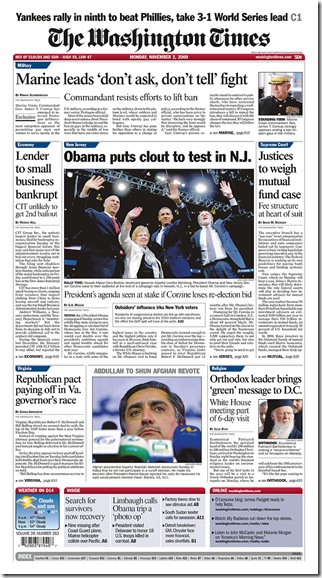
Vocabulary In the News : 2 November 2009 – The Washington Times

DC_WThttp://www.washingtontimes.com/

There is a some good vocabulary in this front page we can glean.

- US Marine Corps Commandant General James T. Conway is leading the fight against lifting the policy ‘don’t ask, don’t tell’ put in place in the 1990’s by President Clinton. ‘Don’t ask, don’t tell’ allows gays to serve in the US military but not openly. President Obama has promised to lift the ban and would permit gay men and women to serve openly. If Obama lifts the ban, he officially removes and ends a rule or law that stops someone from doing something. Read more at :

 http://www.washingtontimes.com/news/2009/nov/02/marine-leads-dont-ask-dont-tell-fight/

- The 3rd of November is seen as the first test of Obama’s presidency due to elections in 4 states where Republicans are expected to win. Virginians and New Jerseyites are voting for governor today. In Virginia, the Republican leads by double digits. In New Jersey, the race is close. President Obama is putting his clout to the test by campaigning for the incumbent Democratic governor running for re-election. Clout is the power of influence. Obama is hoping that his clout will help the incumbent Democrat in New Jersey. An incumbent is someone simply running for re-election hoping to keep his office. Obama’s agenda is seen to be at stake in these elections if Democrats lose their bid for re-electon. In other words, his policies are in danger because the elections are seen as a referendum on the Obama presidency and the Democrats in general. A bid is an attempt to do something. Read more at :

http://www.washingtontimes.com/news/2009/nov/02/obama-puts-clout-to-test-in-nj/

14 September 2009

Cartoon : Truther & Birther

Cartoon by Chip Bok of The Akron (Ohio) Beacon-Journal published 10 September 2009

Two new words have recently entered the American political vocabulary: a truther and a birther. Both words refer to conspiracy theorists.

- A truther is part of the 9/11 Truth Movement and is someone who believes that the attacks of September 11th were an inside job. In other words, he or she believes the US Government and President Bush were behind the terrorist attacks. Also called “9/11 deniers” and “9/11 skeptics,” the term “truther” has stuck. The movement was inspired by the documentary “Loose Change.” One of the reasons President Obama’s Green Jobs Czar, Anthony “Van'” Jones, had to resign was because he was accused of being part of this movement.

- A birther believes that Obama is ineligible to be President of the United States based on the claim that he wasn’t really born in the United States. The claim is based on the fact that Obama has never released his original birth certificate. According to the US Constitution, a president must be a natural-born citizen (born in the US) and not a naturalized citizen (obtained citizenship in country where he or she wasn’t born).

- A swap is when you exchange with someone one thing for something else. For example, imagine you are on the plane and you got a window seat and your neighbor has an aisle seat but you both don’t like your seats, so you both offer to swap seats. You take his aisle seat and he takes your window seat. In this case, the cartoonist shows the Democrat (represented by the donkey) proposing that the Republican (represented by the elephant) sacrifice one his birthers since the Democrats sacrificed a truther through the resignation of Mr. Van Jones.

Visit Chip Bok’s blog at : http://www.bokbluster.com/

20 June 2009

Cartoon: Painting oneself into a corner

The cartoonist, Jeff Parker, in this picture is criticizing the Republican opposition to President Obama’s nomination to the US Supreme Court, Sonia Sotomayor. Many on the left and in the media are asserting that any opposition on the part of the Republican Party will hurt them with Hispanic-American voters in future elections.

Mr. Parker drew a visual statement of the common idiomatic expression to paint oneself into a corner. What does this mean? According to Answers.com:

Get oneself into a difficulty from which one can't extricate oneself. For example, “By volunteering to do more work in the office and then taking a freelance job, George has painted himself into a corner.” This idiom uses the graphic image of painting all of the floor except for the corner one stands in, so that one cannot leave without stepping on wet paint.

Wikitionary defines to paint oneself into a corner as:

(idiomatic) To create a predicament or problem for oneself; to do something that leaves one with no good alternatives or solutions.

Other Terms:

1. GOP – The other common name for the Republican Party is the GOP or Grand Old Party. In  the picture, the party is represented by an elephant, the traditional mascot of the Republican Party. The Democratic Party’s mascot is the donkey.

2. Drat! – This simple non-vulgar slang interjection is used to express annoyance.