Showing posts with label front page. Show all posts

03 November 2010

Vocabulary in the News : The Wall Street Journal (Front Page from 3 November 2010)

WSJ

Let’s look at some of the vocabulary found in the article titles. If you want to read each article on The Wall Street Journal webpage, click on the each title.

GOP Claims House in Huge Swing, Tea-Party Wave Creates New Dynamic in Washington and the States; Democrats to Retain Senate Despite Drubbing

    • A swing is seat that hangs from ropes or chains and moves back and forth which is usually used by children. So you can imagine the illusion here of a swing. In politics, we this word to describe when one ruling party has been replaced by a new one. The term can be used to describe any change in emotion, idea, condition, etc, to another. For example, Spain was a very conservative and Catholic country but there was a swing away from traditional family values when the country allowed same-sex marriage. In Amsterdam, there is a swing in the government position on legalized marijuana which may cause coffee shops to close down in the future.
  • A change in political parties in power at a national level can also be described as a wave or even a tidal wave. A wave of course is a raised line of water you find in the ocean or other body of water. Last night a Republican wave swept (past irregular form of ‘to sweep’ – balayer) across the country pushing Democrats out of power.
  • The Majority Leader Harry Reid, despite the drubbing the Democrats received by the Republicans last night, surprisingly won his reelection in Nevada. If you received a drubbing, this means that you were severely beaten. This word is believed to have been possibly derived from the Arabic word darb which means a beating, particularly by a stick.

Unaligned Voters Tilt Rightward In Droves

    • Voters who don’t identify themselves as Republicans or Democrats tilted rightward in this election. In other words, they favored the particular program or opinion of those running as Republicans. Literally, to tilt means to incline or to cause to slope to one side. For example, these slashes ‘///////’ all tilt to the right.  If these unaligned (or nonaligned) voters had favored the Democrats, we would have said that they tilted leftward. In any case, the election is over and the United States must now move forward and not backward.
    • The headline also said that these independent voters favored the political right in droves. If people do something in droves, it means they do it in very large numbers.

How the Rout Was Won : Careful Plans, Timely Wave

    • A rout is a term to describe the complete defeat of your opponent in a battle, competition or an election. The word is also a verb. For example, Spain won the FIFA World Cup after having routed the Netherlands.
    • If something happens in a timely manner, it happens at the most suitable or proper time.
       

02 November 2010

Vocabulary In the News : The Washington Times (Front Page from 01 November 2010)

Washington Times 01 Nov 10

Let’s look at some of the vocabulary found in the article titles. If you want to read each article on The Washington Times webpage, click on the each title.

  • ‘Rhetoric heats up in homestretch, Partisans fire up troops for trench warfare’ – We often talk about political rhetoric during electoral campaigns or political debates. Rhetoric is the art of studying and the skill of using language effectively to persuade and convince the listener. It can also be used to describe language that is elaborate, pretentious and insincere. Now that we are in the homestretch, this rhetoric is becoming more intense. This expression is a sports term often used to describe racing. Well, political campaigns are referred to as races and thus such sports terms apply! If in a race you are in the homestretch, you are in the last turn of the racetrack heading towards the finish line.
  • Now that we are getting to the end of the race, the partisans are firing up the troops, i.e. the voters for trench warfare. In other words, they are trying to motivate and inflame with enthusiasm the voters to come out and vote for them. It’s a fight to the finish and it will be a difficult and dirty one, just like trench warfare. World War I is the best example of this type of war!
  • ‘GOP takeover would tighten gridlock on financial relief’ A takeover is the act of taking control, management or responsibility for something, particularly when talking about power in a nation or in a business. The article states that if the Republicans takeover Congress, Obama’s plan for financial relief would face gridlock. This term is used to describe traffic that cannot move on the motorways because of some sort of problem. In political terms, it means a complete lack of progress. With Republicans in control of the House of Representatives, they are expected to block Obama’s political agenda causing gridlock.

08 July 2010

Vocabulary In the News : Duluth News Tribune (Duluth, Minnesota) – 07 July 2010

MN_DNT
Drivers in Duluth, Minnesota are experiencing a new problem that they had not planned on due to work that began on a stretch of highway. When a problem seems to appear unexpectedly, we refer to this as a snag. In French you would refer to this as un pépin. Work on this segment of road, or stretch, is causing a traffic snarl. In other words, it complicates the movement of traffic making it difficult, if not impossible, to move.

When traffic moves slowly and you follow very closely the car in front of you and  there is also a car following you very closely in the rear, we call this bumper-to-bumper traffic. This is often experienced during  the morning and afternoon rush , when everyone is on the road going to and from work in the morning and evening. Your bumper is that long piece of metal or plastic attached to the front and back of your car to protect it if it hits or bumps anything.

Because of the road work, traffic has slowed down to a stop-and-go crawl. This of course describes the action of slowly moving forward in short movements while constantly having to brake in order to avoid hitting the car in front of you. During rush hour, traffic usually slows to a crawl.

When there are a lot of cars on the road due to the morning or evening rush,  we call this commuter traffic. A commuter is someone who travels to and from work by car, by train or by bus. Some American cities have tried to improve their traffic problems by putting in place HOV (high-occupancy vehicle) lanes. Usually this is the farthest lane on the left which is reserved for cars with 2 or more people in them. The HOV lane was designed to encourage carpooling, the act of sharing cars to get to and from work. If you are caught driving in this lane without passengers, you will get stopped and fined by the police. Some, however, have tried to trick the police by disguising a mannequin to appear as a sleeping passenger!


OTHER VOCABULARY FOUND IN THE TEXT

the interstatean American term for the motorway or highway because they cross state lines.


northbound, southbound, etc.. (adj.) – moving towards the north, south, etc..


a motoristsomeone who drives a car


an off-ramp – a road that leads off a huge highway (opposite = an on-ramp)


a blockan area of buildings in a city with roads on all four sides (un pâté)


pavement (American – uncountable) – the surface of the road (NOTE: in British English the pavement, now a countable noun, refers to the ‘le trottoir’)


an intersection – where two or more roads join or cross each other.


a curve – a bend in a road or river.


downtown – American English for the city centre

Read the complete article at http://www.duluthnewstribune.com/event/article/id/173144/

01 July 2010

Vocabulary In the News : The San Francisco Chronicle – 30 June 2O1O

In San Francisco, sting operations are being conducted to curb the rise in bicycle theft due to a rise in commuting by such vehicles. A sting is a trick prepared by the police in order to nab the wrongdoer. If you curb an action, behavior or a situation, you try to take control of it and limit it. Commuting is the act of traveling (by means of a vehicle such as a bike, train or car) back and forth between your home and place of work. When you commute, you’re called a commuter.
 
The police are working with cycling advocates, people who strongly support the use of bicycles, to nab these criminals. You don’t want to get nabbed by the police because this means you’ve been caught and arrested by them. To catch the criminal, they are placing a transponder in decoy bikes placed in various hot spots around the city. By doing this, they will be able to not only track the thief (pl. thieves), but also find the buyer and the seller. If you track something (or someone), you follow its course.
 
OTHER VOCABULARY ON THE FRONTPAGE
stock une action (titres d’une société)
a pill un comprimé, un cachet
to draw ire provoquer la colère
to bust a myth faire s’effondrer un mythe
to debunk déboulonner

16 March 2010

Vocabulary In the News : 15 March 2010 – The San Francisco Examiner

CA_SFE

A crackdown is a strong action taken by authorities to stop a particular action. The verbal expression is to crack down on. (Ex. San Francisco is cracking down on tax cheaters.)

A tax dodger is someone who illegally avoids paying taxes; in other words, he or she dodges taxes!

A variation of this term is a fare dodger, who is someone who tries to ride the bus, metro or tram for free without buying a ticket.

Besides meaning ‘rigid,’ stiff also means more severe or difficult than usual. Tax dodgers in San Francisco will face stiff fines; the city is making the penalty more expensive. In another example of the term, President Obama is facing stiff opposition to his health care reform.

09 March 2010

Vocabulary In the News : 08 March 2010 – The Arizona Republic (Phoenix, Arizona)

AZ_ARIn Paradise Valley, Arizona’s premiere tourist destination thanks to the 12 resorts located there, special room deals and freebies are the spring-season staples. These special prices are luring back sun-seekers and golfers in droves reversing the downward trend that is a result of the sluggish economy. Full story >>

to pay off

-

if something that you do pays off, it brings you some benefit or advantage

premiere (pronounced – Pre-MEERE)

-

first, principle, most important
a room deal

-

promotions offered by hotels
a freebie

-

something given to you that you don’t have pay for

a staple

-

a regular and important part or feature of something

to lure

-

to persuade someone to do something by making it look very attractive

in droves

-

large numbers of people
sluggish (adj.)

-

not performing or reacting as usual, not moving quickly

07 March 2010

Vocabulary In the News : 06 March 2010 – The Journal (Newcastle, UK)

UK_TJ

The main story from the front page concerns the tragic story of an ex-lawyer whose life was destroyed because he hit the bottle after the breakup of his marriage.

Jimmy Grogan descended into a downward spiral of alcoholism as his life careered out of control before hitting rock bottom. He lost his lucrative job as a lawyer and his alcohol addiction trapped him in a vicious circle of crime causing him to appear in courts but no longer as the lawyer but as the criminal.

Unfortunately, he is now crippled with pancreatitis and chronic liver disease and his doctors have given him only a few months to live. With his remaining days, Mr. Grogan has decided to speak out about his alcoholism and warn others about the devastating effects of turning to the bottle. Full story >>


to hit the bottle

-

to start drinking a lot of alcohol
to descend into a downward spiral

-

to deteriorate, to slowly be destroyed, to decline

to career out of control

-

to be in a situation in which you loose control because things are happening quickly

to hit rock bottom

-

to arrive at the lowest possible level
a vicious circle

-

a process in which the existence of a problem causes other problems, and this makes the original problem worse

crippled

-

physically disabled, severely damaged
to speak out

-

to state your opinion firmly and publicly about something, especially in order to protest against or defend something

to turn to the bottle

-

to start drinking alcohol in an attempt to help yourself when you are having difficulty dealing with a situation

Note: most definitions for vocabulary on this blog are taken or adapted from www.macmillandictionary.com

06 March 2010

Vocabulary In the News : 05 March 2010 – The Toronto Sun (Canada)

CAN_TSUNCanadian Finance Minister James Michael "Jim" Flaherty is the target of a very unflattering image on the front page of the Toronto Sun. They are calling him a tightwad due to a the fiscal restraints in his newly proposed federal budget. A tightwad is someone who always tries to avoid spending money. A good literary example of a tightwad would the be the protagonist of Ebenezer Scrooge in Charles Dickens's famous A Christmas Carol. In fact, this character is so famous that a scrooge is synonymous with tightwad.

Fiscal restraints is the term used to imply that limits or controls are being placed on the money being spent. The Harper government in Canada is trying to rein in current spending. To rein in means to limit or control something that has developed too much or has continued too long. The image is that of a horse which is controlled and directed by pulling on the reins.

In one of the front page’s headlines, it states, “Fiscal restraint the order of the day in Flaherty’s ‘stay-the-course’ budget.” When we say that something the order of the day, we are saying that it is usual or common at a particular time. During economic good times, it was the order of the day for the government to spend a lot of money on various projects and social programs. Now, because of the economic downturn, cutbacks in spending will be the order of the day. The new budget is being called the ‘stay-the-course’ budget. This comes from the verbal expression ‘to stay the course’ which means to continue doing something despite the difficulties. Former President Bush used to say the United States needed to stay the course in Iraq.

The budget will cut spending across the board. This term is both an adverb and an adjective (written across-the-board) and means that it involves everything or everyone affected by a particular situation. Full story >>

05 March 2010

Vocabulary In the News : 03 March 2010 – The Garden Island (Lihu’e, Hawaii)

HI_GI

The main headline tells the story of fire that started in a work shed partially attached to a home. The fire spread and scorched the home. If something is scorched by fire, it isn’t completely destroyed; it is burned enough to change the color and damage the surface. Full story >>

In another article, the state of Hawaii isn’t satisfied with a federal law that was designed to protect the state’s endangered species stating that the penalties aren’t serious enough. Hawaii’s state senate passed a bill that would make the intentional killing of a Hawaiian monk seal a felony with a penalty of 5 years in prison and a fine of up to $50,000. Under federal law, it is only a misdemeanor with a one-year prison term and a fine of up to $2,500. Under English common law on which the American legal system is based, a felony is a serious crime such as a murder or robbery, a misdemeanor is simply a less serious crime. Full story >>

Members of the Democratic Party on the Hawaiian island of Kaua’i caucused to choose delegates that would represent them in state and county conventions in April. “To caucus” is a political term simply meaning to meet in group to discuss plans. For example, in the US Senate, the two main political parties are Democrats and Republicans but there is one senator who is socialist and another who is independent. Because these two senators’ political beliefs lean to the left and they often vote with the Democrats, they caucus with the Democrats which gives the left control of 59 seats out of 100 in the Senate. The noun is the same as the verb. A caucus is a closed meeting of a group of persons from the same political party or faction that is designed to either select candidates or to decide policy. Full story >>

02 January 2010

Vocabulary In the News : 01 January 2010 - Atlanta Journal & Constitution

GA_AJC

Visit the AJC homepage at : http://www.ajc.com/

It’s the first front page for the AJC for 2010 and of course there is the obligatory article concerning the hopes and fears we have for the upcoming new year. The headline states that “Grins replace the grimaces.” A grin is a huge smile that shows your teeth. There is a good idiomatic expression to describe someone who smiles a lot because they are very happy which is “to grin (or smile) from ear to ear.”

Some people are saying that 2010 will be even a more difficult year than 2009 which means we may just have to grin and bear it. This means to accept a difficult situation without complaining or without showing how you really feel. Now there are some people who just annoy you and they seem to enjoy annoying because they have a smile on their face when they do it. Sometimes you just wish that you could somehow stop them from being so happy and pleased with themselves that you wish you could find a way to wipe the grin (or smile) off their face!

A grimace is a facial expression you make by twisting your face due to pain or because you don’t like something. If you fall and hurt your ankle, you might grimace with pain each time you walk. I tend to grimace with disgust when I get my gas bill in the winter for heating my apartment!

In any case I wish that for all of you, your grimaces of 2009 will be replaced by grins in 2010!

Read the full article at: http://www.ajc.com/news/a-new-year-brings-263703.html

28 November 2009

Vocabulary In the News : 27 November 2009 – Daily Record (Parsippany, New Jersey)

NJ_DRTo visit the homepage for the Daily Record, go to :

 http://www.dailyrecord.com/

Joann Tyler, president of Missionaries of God, a nonprofit charitable group that helps feed the homeless, risked receiving a summons from the city of Dover for feeding the homeless a Thanksgiving meal from the back of a truck. Dover has already served Ms. Tyler a dozen summons in the past for giving food to the homeless without a license. The city is concerned with public health and the handling of food. A summons is an official document that orders someone to appear in a court of law.

A helping is the amount of food served to one person during a meal. At a huge dinner after you have eaten what is on your plate, you may want to eat more. If so, you might help yourself to a second helping. Perhaps you wouldn’t have had that second helping if you first had had a heaping helping! Heaping here means a lot or very full especially when we talk about something that can be piled. For example, let’s say you like ice cream so much that when you serve yourself a helping of ice cream, you give yourself a very large portion of ice cream. We would say you served yourself a heaping portion of ice cream.

To learn more, read the article :

http://www.dailyrecord.com/article/20091127/COMMUNITIES/311270004/Thanksgiving-for-Dover-needy

08 November 2009

Vocabulary In the News : 8 November 2009 – Richmond-Times Dispatch (Richmond, Virginia)

VA_RTDVisit the Richmond-Times Dispatch

Sniper John Allen Muhammad is slated to be executed by injection Tuesday in the state of Virginia for the slaying of Dean Harold Meyers in October of 2002. If you say something is slated, this means it is arranged or scheduled to happen at a particular time or date. A slaying is the act of killing someone. It comes from the irregular verb ‘to slay’ (slay, slew, slain).

Muhammad unleashed terror in Virginia, Maryland and Washington D.C. in 2002. In other words he did something that had a very powerful and harmful effect on those regions! Here’s another example of this word’s use: “The passing of the health bill in the House of Representatives will unleash a storm of criticism by its opponents.”

He led a 2-man sniper team that claimed the lives of 10 people. To claim the life of someone means that something or someone causes the death of someone. For example, the H1N1 flu virus has claimed the lives of children in France and the United States. AIDS (SIDA) has claimed the lives of millions of people around the world and Hitler’s holocaust claimed the lives of millions of Jews during WWII.

Mr. Muhammad and his teenage partner in crime left a twisted trail of death behind them. To twist means to bend or turn into different shapes.  If a road is twisted, there are a lot of turns and thus is not a straight road. However, another meaning of twisted means behaving in a strange and and/or cruel way. We could say that Muhammad had a twisted mind. You might recognize this word from the American heavy metal band, Twisted Sister.

To read more, go to : http://www2.timesdispatch.com/rtd/news/local/crime/article/EXEC08_20091107-222006/304396/

07 November 2009

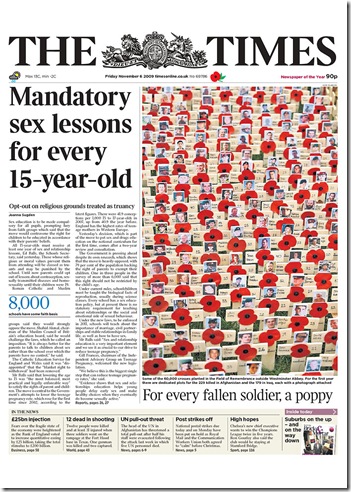
Vocabulary In the News : 6 November 2009 – The Times (UK)

UK_TThttp://www.timesonline.co.uk/tol/news/

Sex education in the United Kingdom will soon be made mandatory for all 15-year-olds. In other words, these teenagers will be legally obliged to take one-year of sex and relationship lessons. Another common synonym for this word is compulsory.

This decision has prompted fury from religious groups who believe this contravenes parental rights. This means that if enacted, they believe the  decision  would violate parents’ rights to educate children according to their beliefs.

If students opt out on religious grounds, it will be considered as truancy and the students may be punished by the school. If you opt out of something, you decide to not participate or not take part in something. Opting out on religious grounds means to not participate because of religious reasons. Here’s another example of the phrase: In France it is illegal to discriminate against someone on the grounds of religion, race, sex, age or sexual orientation.

Students who decide to not attend these lessons on the grounds of religious beliefs will be punished for truancy which means they are absent from class without permission. Any student skipping class is said to be truant. In the UK, Canada and the US, there are police officers or other designated officials who are authorized to arrest truant students and take the child to school. These officers or officials are called truant officers.

Read the original article at : http://www.timesonline.co.uk/tol/life_and_style/education/article6905543.ece

Learn more about truancy at :  http://en.wikipedia.org/wiki/Truancy

05 November 2009

Vocabulary In the News : 4 November 2009 – The Record (Hackensack, New Jersey)

NJ_TR

Visit the newspapers homepage at: http://www.northjersey.com

The top headline of Wednesday’s front page from concerned Tuesday’s election results for the state of New Jersey. New Jerseyans went to the polls on Tuesday to elect a governor as well as other state positions. If you go to the polls, you go vote at polling station you are registered at.

The race between incumbent Governor Corzine and Republican candidate Chris Christie was very close but in the end, Christie managed to sway the majority of voters in his favor. To sway literally means to swing move gently from side to side but it can also mean, as in the front page headline, to influence or change someone’s opinion. You could also say that Christie’s campaign and program for New Jersey held sway (to hold sway – irregular verb) over the voters of New Jersey. Another way of saying this is that the voters fell under Christie’s sway and elected him governor.

Read more at: http://www.northjersey.com/news/governorsrace2009.html

In an opinion article also found on the front page, the author states that the GOP (Grand Old Party – the other name for the Republican Party) is rudderless no more. A rudder is a flat piece of wood or other material in the back of a boat that is moved to change the direction the boat travels. Idiomatically, if we say a group or organization is rudderless, we say that they lack a clear aim, purpose or direction. The GOP in New Jersey now has the governorship in a state that is traditionally a Democratic bastion and is no longer rudderless.

Read more at : http://www.northjersey.com/news/opinions/political_stile/State_GOP_is_rudderless_no_more.html

03 November 2009

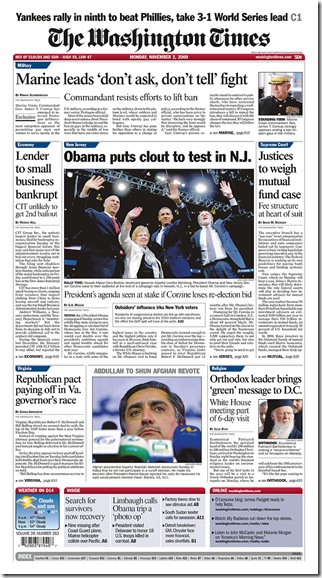
Vocabulary In the News : 2 November 2009 – The Washington Times

DC_WThttp://www.washingtontimes.com/

There is a some good vocabulary in this front page we can glean.

- US Marine Corps Commandant General James T. Conway is leading the fight against lifting the policy ‘don’t ask, don’t tell’ put in place in the 1990’s by President Clinton. ‘Don’t ask, don’t tell’ allows gays to serve in the US military but not openly. President Obama has promised to lift the ban and would permit gay men and women to serve openly. If Obama lifts the ban, he officially removes and ends a rule or law that stops someone from doing something. Read more at :

 http://www.washingtontimes.com/news/2009/nov/02/marine-leads-dont-ask-dont-tell-fight/

- The 3rd of November is seen as the first test of Obama’s presidency due to elections in 4 states where Republicans are expected to win. Virginians and New Jerseyites are voting for governor today. In Virginia, the Republican leads by double digits. In New Jersey, the race is close. President Obama is putting his clout to the test by campaigning for the incumbent Democratic governor running for re-election. Clout is the power of influence. Obama is hoping that his clout will help the incumbent Democrat in New Jersey. An incumbent is someone simply running for re-election hoping to keep his office. Obama’s agenda is seen to be at stake in these elections if Democrats lose their bid for re-electon. In other words, his policies are in danger because the elections are seen as a referendum on the Obama presidency and the Democrats in general. A bid is an attempt to do something. Read more at :

http://www.washingtontimes.com/news/2009/nov/02/obama-puts-clout-to-test-in-nj/

02 November 2009

Vocabulary In the News : 1 November 2009 – The Southtown Star (Tinley Park, Illinois)

IL_SS http://www.southtownstar.com

This unfortunate lady was robbed while mourning at her father’s gravesite. When you mourn, you feel extremely sad because someone has died.

Mrs. Koenig was another victim in a string of robberies by thieves who have the gall to steal from mourners who are paying their respects to loved ones. When we say that someone has the gall to do something, we say they have an attitude towards other people that shows a lack of respect or care for their needs.

Speaking of respect, to pay your respects means you honor someone by going to their funeral or visiting their grave. On All Saints’ Day on the 1st of November, many French pay their respects to deceased family members by visiting their graves. Unfortunately while paying her respects, Mrs. Koenig’s purse was snatched out of her vehicle in which her elderly mother was waiting. To snatch means to quickly steal something from someone.

To read more, go to http://www.southtownstar.com/news/1856344,110109cemetery.article

16 October 2009

Vocabulary In the News : 16 October 2009 – The Times (United Kingdom)

UK_TT

For a larger view of the front page, click on the image. To visit The Times webpage, go to: http://www.timesonline.co.uk

The Middle East peace process is on the brink of collapse due to a row over a United Nations report condemning Israel of war crimes. A brink is the point in time when something very good or very bad is about to happen. If nations or people are having a row about/over something, this means they have a very serious disagreement over an issue.

Unfortunately the UN report causing the row threatens to sink the peace plan. Normally, this verb describes a boat or other object that falls to the bottom of a body of water, but here it means to make worse.

In this dispute, the UK is refusing to back Israel over the Gaza offensive. If you back someone or something, you give your give support.

If the negotiations collapse, this could scupper President Obama’s Middle East plans. To scupper is a naval term meaning to deliberately sink a ship by letting water in. In informal British English, to scupper means to spoil someone’s plans or hopes of success.

http://www.timesonline.co.uk/tol/news/world/middle_east/article6877164.ece

14 October 2009

Vocabulary In the News : 14 October 2009 – Boston Herald

MA_BH

Former Speaker of the House of Representatives (Président de l’Assemblée) of the state of Massachusetts, Salvatore F. DiMasi, resigned in January of this year after having been charged with taking large financial kickbacks for giving lucrative state contracts to a software company. A kickback is money illegally paid to someone in exchange for something they have done for you. Due to being federally indicted for this illegal activity, the speaker resigned his position. If you are indicted for a crime, this means you have been formally accused or charged.

He has also been indicted on other charges and the latest bombshell is extortion! It is a bombshell because the latest news is unexpected and shocking. The news is dropped like a bomb. Extortion is a crime in which someone gets money or information from someone else by using force or threats.

If convicted (proven guilty by a court of law) on all the federal charges, DiMasi could serve hard time in the slammer for 185 years! Hard time is urban street English for the time spent in prison. You often hear the expression, “He’s serving hard time” or simply “He’s serving time.” The slammer is a very informal name for a prison. It is called the slammer because when you are prisoner, the guards slam (claquer) closed the door behind you.

http://www.bostonherald.com/news/politics/view/20091014new_sal_dimasi_shocker_ex-pol_slapped_with_extortion_rap/srvc=home&position=0

06 October 2009

Vocabulary In the News : 05 October 2009 – The Huntsville Times (Alabama)

AL_HTClick on the image to see a larger version of the front page. To visit the homepage of The Huntsville Times, go to :  http://www.al.com/huntsvilletimes/

1.  In the top story originally found in The Orlando Sentinel, we learn that NASA is strapped. Usually the word appears in the expression ‘strapped for cash.’ Simply, it means that you do not have enough money.  If NASA is unable to obtain a massive increase in their budget, they will not be able to send astronauts to the moon. To do so, they will have to look for a partner in Europe or Asia, turning space exploration into a global effort.

http://www.stltoday.com/stltoday/news/stories.nsf/sciencemedicine/story/19EA207DBC07E6E386257645007C90FB?OpenDocument

2.  In second story very loosely related to NASA, one of its employees, Mrs. Bennie Jacks, was diagnosed in 2002 with breast cancer and immediately had her right breast surgically removed. Over the next few years she took Arimidex, a drug which is used to treat breast cancer after surgery and prevent its spread to other organs. During this time, Mrs. Jacks was very active in various breast cancer organizations and support groups where she met other cancer victims and survivors. These cancer patients were an inspiration to Jacks because she realized that she too can survive breast cancer; they filled her with hope and encouragement which tapped her can-do spirit. Today, she is proud to say that she has been cancer-free for seven years.

If you tap or tap into an ability you use it or get some benefit from it. A boss hires good staff so he can tap their potential. In the case of Mrs. Jacks, the encouragement and hope she found in breast cancer support groups gave her a can-do attitude or spirit into which she was able to tap into to help her survive.

If you have a can-do attitude or a can-do spirit, this simply means that you know you can do something and be successful, particularly if the task or job is very difficult.

http://www.al.com/news/huntsvilletimes/local.ssf?/base/news/125473415699390.xml&coll=1

check-mark-graphic Explore other meanings of the word ‘tap’ by going to : http://www.macmillandictionary.com/search/american/?q=tap

30 September 2009

Vocabulary In the News : 29 September 2009 – Daily Press (Hampton Roads, Virginia USA)

VA_DPRESSClick on the image for a larger view of the front page. To visit the homepage of the Daily Press, go to : http://www.dailypress.com/

- A dead, 25-foot humpback whale recently beached near Gloucester Point in the York River in Virginia. A lot of onlookers (des spectateurs) are braving the stench to take look at the dead whale. The headline uses a play on words with ‘whale.’ Because the odor is very bad, they say that there’s a whale of a stench. Because the whale is the largest creature on earth, we sometime idiomatically use the word in the expression ‘a whale of’ to mean large, big, a lot of or great. So, when it says there’s one whale of a stench, it means it smells very, very bad! Take a look at other example sentences using this expression :

- It was a wonderful party! We had a whale of a time this weekend!

- That was a whale of test; it was very difficult.

- Chicago will take on a whale of a project if they are accepted as host city for the 2016 Olympic Games.

http://www.dailypress.com/news/gloucester-county/dp-local_whale_0929sep29,0,6242341.story