Showing posts with label money. Show all posts

29 December 2010

Funny Video: Esurance TV Commercial – $522 Bucks (and other slang terms for money!)

Here’s another TV commercial I saw airing on American television while I’m home this Christmas.

Unlike the French, Americans like to talk about money so it’s no surprise we have a lot of slang and idiomatic terms for it!

http://www.esurance.com/Welcome/home/home/ErinsWorld.aspx
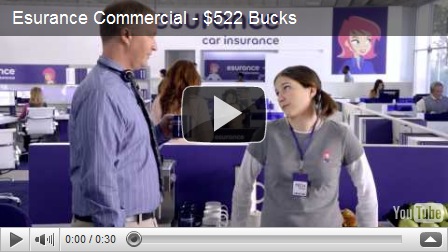
  • THE SAVER: 522 bucks (= dollars. Derived from the word ‘buckskin.’ In colonial America, the English wanted fur and they traded goods with the Native Americans for buckskin.) -- that's what people save, on average, when they call me to switch to Esurance.
  • FIRST GIRL: If they switch to Esurance online, they could save 522 clams (= dollars. Native Americans on the west coast of North America strung clamshells [des coquilles de palourde] into strings of money).
  • THE SAVER: I could save 'em 522 smackers. (= dollars. Sometimes said ‘smackeroo.’ Dates back to the beginning of the 20th century and comes from the notion of something being ‘smacked’ into the palm of the hand; the sound made as the dollar is slapped into the hand.)
  • FIRST GIRL:You talkin' dough? (= money. Bread is a necessity of life and we earn money to be able to buy it. Dough, pronounced ‘doh,’ is what bread is before it is baked. A breadwinner is the individual who earns the money to support a family.)
  • THE SAVER: Bread. (see above note)
  • FIRST GIRL: Benjamins? (= $100 banknote. Benjamin Franklin is on the $100 bill. Sometimes called in street talk as a ‘Benji’)
  • THE SAVER: Scratch (= money. Dates to beginning of the 20th century though its origins are unknown. Probably from the term ‘to scratch/scrape a living’ which means to earn just enough money to live). Greenbacks (= dollar. Since the Civil War, the back of US banknotes were printed in green ink). Moolah (= money. The origins are a mystery. Some say it comes from the Fijian language others say it comes from the French word ‘le moulin’ since mills were a primary source of wealth.) . Cheddar. (= money. This is a street term for money used often in African-American slang and rap music. I’m guessing that cheddar cheese probably was at some point in history an expensive item to buy and came to represent wealth or riches.) Simoleons. (= dollar. US slang term that is probably a blend of the 18th century British six pence coin called a ‘simon’ and the French gold ‘Napoleon’ coins.) Don't try to out-save me.
  • SECOND GIRL: He’s the Saver.
  • FIRST GIRL: (SAID WITH FRUSTRATION) I know he’s the Saver.
  • VOICEOVER : You could save 522 bucks. See for yourself at Esurance. Technology when you want it. People when you don’t.
     

22 October 2009

Featured Podcast : Words and Their Stories - More Terms About Money (VOA News)

Working hard to bring home the bacon. Transcript of radio broadcast:
15 October 2009

MP3  - (Tip: Left-click, or right-click and choose "Save...") Download (MP3)

Now, the VOA Special English program WORDS AND THEIR STORIES.

(MUSIC)

Most people enjoy working for several reasons. Their job might be fun, or they like their employer and the other people at work. Most people I know, however, work for the money. I do not know anyone who is loaded, or extremely rich.  Most of my friends work to earn enough money to live. They have to make ends meet. They have to earn enough money to pay for the things they need. Some even live from hand to mouth. They only have enough money for the most important things.

They struggle to earn enough money to bring home the bacon. It can be difficult to earn enough money for a family to survive. Sometimes, poor people even get caught short. They do not have enough money to pay for what they need.

Or they have to spend or lay out more money than they want for something. When this happens, poor people have to tighten their belts and live on less money than usual. I hate when I have to live on less money. It takes me longer to get back on my feet, or return to good financial health.

However, other people are on the gravy train. They get paid more money than their job is worth. These people make a bundle. They really rake in the cash. In fact, they make so much money that they can live high off the hog. They own the best of everything and live in great ease. Sometimes they pay an arm and a leg for something.

Because money is no object to wealthy people, they will pay high prices for whatever they want. Sometimes, they even pay through the nose. They pay too much for things.

I am not rich. I did not make a killing in the stock market when my stocks increased in value. Yet, I am not poor either. When I go out with friends, I do not want to shell out or pay a lot of money. Often, my friends and I will chip in or pay jointly for a fun night out. When we go to restaurants the meal is Dutch treat.  Each person pays his or her own share.

Once, the owner of a restaurant gave us a dinner on the house. We did not have to pay for our meals. However, I admit that we had to grease someone’s palm. We had to pay money to the employee who led us to our table. The money was for a special request. Yes, it was a buy off. The employee put us at the top of the list for a table instead of making us wait like everyone else. We had a great time that night and the meal did not set me back at all. I did not have to pay anything.

Because of that experience, I will always remember that nice things still happen in a world that is driven by money. But, that is just my two cents worth. It is just my opinion.

(MUSIC)       

WORDS AND THEIR STORIES, in VOA Special English, was written by Jill Moss. I’m Faith Lapidus.

VOA News - Words and Their Stories: More Terms About Money

08 October 2009

Featured Podcast : Words and Their Stories – Money, Part 1 (VOA News)

What does it take to have a rich life? Transcript of radio broadcast: 01 October 2009

MP3  - (Tip: Left-click, or right-click and choose "Save...") Download (MP3)

Now, the VOA Special English program, WORDS AND THEIR STORIES.

(MUSIC)

I think people everywhere dream about having lots of money. I know I do. I would give anything to make money hand over fist. I would like to earn large amounts of money. You could win a large amount of money in the United States through lotteries. People pay money for tickets with numbers. If your combination of numbers is chosen, you win a huge amount of money – often in the millions. Winning the lottery is a windfall.

A few years ago, my friend Al won the lottery. It changed his life. He did not have a rich family. He was not born with a silver spoon in his mouth. Instead, my friend was always hard up for cash. He did not have much money. And the money he did earn was chicken feed – very little.

Sometimes Al even had to accept hand-outs, gifts from his family and friends. But do not get me wrong. My friend was not a deadbeat. He was not the kind of person who never paid the money he owed. He simply pinched pennies. He was always very careful with the money he spent. In fact, he was often a cheapskate. He did not like to spend money. The worst times were when he was flat broke and had no money at all. 

One day, Al scraped together a few dollars for a lottery ticket. He thought he would never strike it rich or gain lots of money unexpectedly. But his combination of numbers was chosen and he won the lottery. He hit the jackpot. He won a great deal of money.

Al was so excited. The first thing he did was buy a costly new car. He splurged on the one thing that he normally would not buy. Then he started spending money on unnecessary things. He started to waste it. It was like he had money to burn. He had more money than he needed and it was burning a hole in his pocket so he spent it quickly.

When we got together for a meal at a restaurant, Al paid every time. He would always foot the bill, and pick up the tab. He told me the money made him feel like a million dollars. He was very happy.

But, Al spent too much money. Soon my friend was down and out again. He had no money left. He was back to being strapped for cash. He had spent his bottom dollar, his very last amount. He did not even build up a nest egg. He had not saved any of the money.

I admit I do feel sorry for my friend. He had enough money to live like a king. Instead, he is back to living on a shoestring -- a very low budget. Some might say he is penny wise and pound foolish. He was wise about small things, but not about important things.

(MUSIC)     

WORDS AND THEIR STORIES, in VOA Special English, was written by Jill Moss. I’m Faith Lapidus.

http://www.voanews.com/specialenglish/2009-10-01-voa2.cfm?renderforprint=1

06 October 2009

Vocabulary In the News : 05 October 2009 – The Huntsville Times (Alabama)

AL_HTClick on the image to see a larger version of the front page. To visit the homepage of The Huntsville Times, go to :  http://www.al.com/huntsvilletimes/

1.  In the top story originally found in The Orlando Sentinel, we learn that NASA is strapped. Usually the word appears in the expression ‘strapped for cash.’ Simply, it means that you do not have enough money.  If NASA is unable to obtain a massive increase in their budget, they will not be able to send astronauts to the moon. To do so, they will have to look for a partner in Europe or Asia, turning space exploration into a global effort.

http://www.stltoday.com/stltoday/news/stories.nsf/sciencemedicine/story/19EA207DBC07E6E386257645007C90FB?OpenDocument

2.  In second story very loosely related to NASA, one of its employees, Mrs. Bennie Jacks, was diagnosed in 2002 with breast cancer and immediately had her right breast surgically removed. Over the next few years she took Arimidex, a drug which is used to treat breast cancer after surgery and prevent its spread to other organs. During this time, Mrs. Jacks was very active in various breast cancer organizations and support groups where she met other cancer victims and survivors. These cancer patients were an inspiration to Jacks because she realized that she too can survive breast cancer; they filled her with hope and encouragement which tapped her can-do spirit. Today, she is proud to say that she has been cancer-free for seven years.

If you tap or tap into an ability you use it or get some benefit from it. A boss hires good staff so he can tap their potential. In the case of Mrs. Jacks, the encouragement and hope she found in breast cancer support groups gave her a can-do attitude or spirit into which she was able to tap into to help her survive.

If you have a can-do attitude or a can-do spirit, this simply means that you know you can do something and be successful, particularly if the task or job is very difficult.

http://www.al.com/news/huntsvilletimes/local.ssf?/base/news/125473415699390.xml&coll=1

check-mark-graphic Explore other meanings of the word ‘tap’ by going to : http://www.macmillandictionary.com/search/american/?q=tap

Cartoon : A Time-Honored Maxim

Momma

- If something is time-honored such as a maxim or a tradition, it is respected or adhered to because of its age or long-usage.

- A lender is someone you lends you money. In other words, he or she gives you money that you have to pay back, sometimes with interest. A bank is often such a lender. The money that a friend or a bank lends you is called a loan.

- If you ask someone to lend you money that you promise to pay back, then you are called the borrower because you borrow money.

- ‘Plain old’ is common adjective combination to describe something that is not unusual or special. For example, you walk in a coffee shop that proposes all sorts of strange and flavored coffee combinations but you don’t want any of these new and strange flavors; you just want a simple coffee, so you could say, “I just want a plain old coffee, please.” In the maxim used in the cartoon, you could say that it’s just plain old common sense.

- If you describe someone as being cagey, you are saying that they are clever and cannot be deceived or trapped. They don’t want to commit themselves to something. In the cartoon, Momma tries to teach the boy an age old lesson about money, but he replies with a cagey answer completely avoiding it. Sometimes public officials are cagey when they talk to journalists so as not to get trapped into giving answers or details that are too specific. As consumers, we have to sometimes be cagey so as not to be trapped into buying something we only think we need.