Showing posts with label legal terms. Show all posts

27 December 2010

Vocabulary In the News : CBS News (Online Article from 22 December 2010)

tryst

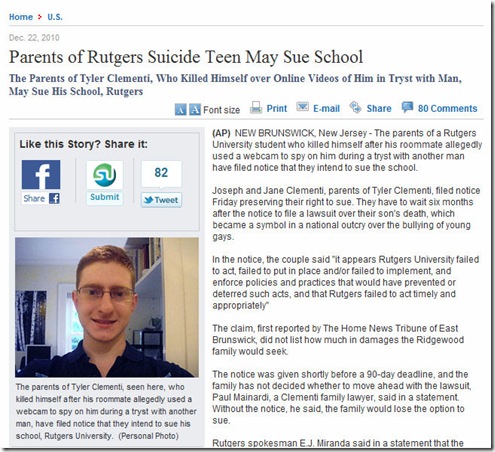
In this sad story, a student of Rutgers University, Tyler Clementi, was outed by his roommate who spied on him with a webcam during a tryst. The roommate then put the video online publically humiliating him. As a result, a humiliated Tyler committed suicide.

If someone is outed, this means it is made publically known that he or she is gay. Tyler Clementi, who was publically still in the closet, was caught in a tryst (pronounced ‘trist’) with another man.  A tryst means any secret meaning between two people who are having a romantic relationship.

The act caused national outcry in the United States. This is an angry expression of protest or shock!

Tyler’s parents believe that Rutgers University failed to enforce policies that would have prevented the act. His parents are now considering whether or not to sue the university. If you sue someone, you are making a legal claim against them, usually for money, because they have done something bad against you. To formally ask a court to look at your case against someone, you file a lawsuit.

To read more about this story, click on the image above.

I had just finished writing the blog post above when I noticed that Newsy had just posted video on this story:

pp

For the transcript, go to : http://www.newsy.com/videos/rutgers-facing-lawsuit-over-clementi-suicide

15 March 2010

Cartoon : Cover Your Keister

Cartoon by Randy Bish of The Pittsburg Tribune-Review published on 10 March 2010.

This political cartoon concerns a local corruption scandal in the Pennsylvania House of Representatives. Bill Deweese, a member of this governing body, was questioned by a judge in connection with a corruption trial of a former legislative colleague. During this questioning, Mr. Deweese took the Fifth (can also say plead the Fifth).

This is a common American expression that refers to the Fifth Amendment of the US Bill of Rights which protects against abuse of government authority in a legal procedure. One part of this amendment states that no person shall be compelled to witness against himself. It protects against self-incrimination. During any sort of legal proceedings, if any person feels that the testimony he is about to give could cause him or her personal trouble with the law, he simply has to say “I plead the Fifth” or “I take the Fifth.”

According to the cartoon, Deweese took the Fifth, to cover his keister (sometimes written keester as it is pronounced). Your keister is an American slang term for your buttocks; that part of the body you sit on! The slang term probably dates back to the first part of the 20th century and is believed to come from a Yiddish word for a box or chest. To cover your keister means to take precautions to protect yourself so that you aren’t accused or punished for something.

Other variations of this expression are to cover your butt and to cover your ass. The word “ass” is considered to be impolite by most people so you might hear someone simply say in English “CYA!”

Well, I’m finished writing this blog post so I can now go sit on my keister in front of the television. Bye!

External links:

DeWeese invokes Fifth Amendment rights (9 March article from www.philly.com)

Pleading the Fifth (Wikipedia)

05 March 2010

Vocabulary In the News : 03 March 2010 – The Garden Island (Lihu’e, Hawaii)

HI_GI

The main headline tells the story of fire that started in a work shed partially attached to a home. The fire spread and scorched the home. If something is scorched by fire, it isn’t completely destroyed; it is burned enough to change the color and damage the surface. Full story >>

In another article, the state of Hawaii isn’t satisfied with a federal law that was designed to protect the state’s endangered species stating that the penalties aren’t serious enough. Hawaii’s state senate passed a bill that would make the intentional killing of a Hawaiian monk seal a felony with a penalty of 5 years in prison and a fine of up to $50,000. Under federal law, it is only a misdemeanor with a one-year prison term and a fine of up to $2,500. Under English common law on which the American legal system is based, a felony is a serious crime such as a murder or robbery, a misdemeanor is simply a less serious crime. Full story >>

Members of the Democratic Party on the Hawaiian island of Kaua’i caucused to choose delegates that would represent them in state and county conventions in April. “To caucus” is a political term simply meaning to meet in group to discuss plans. For example, in the US Senate, the two main political parties are Democrats and Republicans but there is one senator who is socialist and another who is independent. Because these two senators’ political beliefs lean to the left and they often vote with the Democrats, they caucus with the Democrats which gives the left control of 59 seats out of 100 in the Senate. The noun is the same as the verb. A caucus is a closed meeting of a group of persons from the same political party or faction that is designed to either select candidates or to decide policy. Full story >>

19 February 2009

Vocabulary in the News: Man charged over Australian bush fires named

http://edition.cnn.com/2009/WORLD/asiapcf/02/16/australia.bushfire.accused.court/index.html

header_cnn_com_logo_intA court has lifted a ban on identifying a man charged with one of a number of deadly wildfires that scorched southwestern Australia this month.

The man, 39-year-old Brendan Sokaluk, did not appear in Monday's hearing in Melbourne Magistrates' Court, the Australian Associated Press reported. An order banning the publishing of Sokaluk's street address or his image remains in place.

Public passions are running high in the aftermath of the fires that have killed scores of people. One T-shirt says, "The bastards who lit Victoria's fires should: Burn in hell."

Sokaluk is suspected of lighting a fire on February 7. He was charged with arson causing death, intentionally or recklessly lighting a bush fire, and possessing child pornography, Victoria state police said last week. The fire Sokaluk is accused of setting killed at least 21 people in Gippsland.

The death toll in a string of fires across Victoria climbed to 189 on Monday, police reported. The number of fires burning had dropped to six, from about a peak of about three dozen, the Country Fire Authority said.

Meanwhile, more than 150 detectives were working on the arson investigation, authorities said. The fires have destroyed more than 1,800 homes and displaced about 7,000 people.

to charge someone with

  to assert that someone is guilty of a particular crime (official crime mentioned – e.g. arson, first degree murder, armed robbery, assault, etc...)
EX. The police are charging him with armed robbery.

to charge someone over

  to assert that an activity may be the result of a crime committed (activity or event where a possible crime took place – death of husband, protest event, car accident, etc..)
EX. Authorities may charge Phelps over his bong use.

to lift a ban

  to put an end to something that has been forbidden or restricted
EX. Turkey’s prime minister’s attempt to lift the ban on headscarves was anti-secular.

to scorch

  to burn and destroy
EX. The lava flow from Mount St. Helens completely scorched the forests around the mountain.

a hearing

  a) a court appearance before a judge other than a formal trial; b) a formal meeting of an investigative body or legislative committee where evidence or testimony are given
EX. State Real Estate Commissions hold hearings to investigate complaints filed against licensed salespersons.

passions are running high

  An expression to mean that people are experiencing strong emotions.
EX. Due to the sensitive nature of the incident, passions are running high on both sides of the controversy.

the aftermath (uncount noun)

  the consequences or state of affairs resulting from something
EX. In the Maldives, there are severe problems in the aftermath of the tsunami.

scores (in the plural)

  large numbers
EX. Scores of people attended the Obama presidential campaign rallies.

to light (irregular verblit, lit)

  to set on fire or ignite
EX. To create a romantic mood at dinner, he lit the candles on the table.

suspected of

  to be thought guilty without proof
EX. Because of her connection to the victim, she was suspected of murdering him.

arson (uncount noun)

  the crime of purposely setting fire to a building or property
EX. Vehicle arson is unfortunately an annual event in Strasbourg on New Year’s Eve.

recklessly (adv.)

  not regarding the circumstances, irresponsibly, dangerously
EX. His driving at 160 kilometers an hour on the motorway in the rain recklessly endangered his life and of those around him.

a bush fire or a bushfire

  a fire that occurs in the bush (collective term for the countryside in Australia, New Zealand and New Caledonia)
EX. In south east Australia, bushfires tend to be most common and most severe during summer and autumn.

accused of

  to have legal action brought against
EX. He was accused of murdering his ex-wife because his fingerprints were found at the crime scene.

death toll

  the number of dead
EX. The death toll in Africa due to AIDS may hit 100 million by the year 2025.

a string of

  any series of things in close or uninterrupted succession
EX. Obama’s string of victories in the presidential primaries gave him enough delegate votes to win his party’s nomination.

a peak

  the highest or utmost point of anything; height; maximum
EX. In December, the flu season was at its peak.

http://edition.cnn.com/2009/WORLD/asiapcf/02/16/australia.bushfire.accused.court/index.html