
To read the article go to: http://www.boston.com/bostonglobe/ideas/articles/2010/12/26/the_belsnickler_cometh/?page=1
To read the article go to: http://www.boston.com/bostonglobe/ideas/articles/2010/12/26/the_belsnickler_cometh/?page=1
Black Friday is the day following Thanksgiving Day in the United States, traditionally the beginning of the Christmas shopping season. On this day many U.S. retailers open very early, often at 5 a.m., and offer promotional sales to kick off the shopping season. Because Thanksgiving always falls on the fourth Thursday in November in the United States, the day after occurs between the 23rd and the 29th of November.
The day's name originated in Philadelphia, where it originally was used to describe the heavy and disruptive pedestrian and vehicle traffic which would occur on the day after Thanksgiving. Use of the term began by 1966 and began to see broader use outside Philadelphia around 1975. Later an alternative explanation began to be offered: that "Black Friday" indicates the period during which retailers are turning a profit, or "in the black." (Wikipedia)
Political cartoon by Dave Granlund of Massachusetts and published on 25 November 2010.
If you are black and blue, you are covered in bruises due to injury from being hit, falling, etc…
Political cartoon by Joe Heller of The Green Bay Press-Gazette in Wisconsin and published on 25 November 2010.
The Christmas shopping season has officially begun and millions of Americans find themselves fighting the throngs of people wanting to get those great after Thanksgiving sales. The principal shopper in the cartoon just happens to get the last item on sale but other shoppers also want it and are fighting him for it! He states that just the other day he was worried about strangers touching his junk at the airport. Now they have his hands on him everywhere!!
You’ve probably seen the word ‘junk’ in expressions such as junk food or junk mail however this word has another pop culture meaning that has become more popularized due to current security measures at airports. Junk is an American slang term for your genital organs that seems to have gotten its start in pop songs though I’m unsure of its origins.** It refers more specifically to male genitals but has crossed over to indicate the female’s as well. Use this term with great caution because it may be considered quite vulgar by some speakers!
“Don’t touch my junk” was made popular in the press by a traveller at the airport who didn’t want the TSA (Transportation Security Administration) agent touching his genital area during a pat-down. This is the act of passing the hands over the clothed body of someone else in order to detect concealed contraband such as weapons, drugs, etc.. These pat-downs have become very invasive with agents actually touching the genitals of passengers, the breasts of women, placing hands in underwear and in some cases, strip searching travellers including small children! Justifiably, many Americans are very angry with these new measures and view them as actions of a police state. This provoked one airline passenger to warn the TSA agent, “Don’t touch my junk!”
**If any of my blog followers know the origins of the term ‘junk’ in referring to the sexual genitals, please share them by leaving a comment!!
I found this on the ESL Podcast Blog : http://www.eslpod.com/eslpod_blog/2010/11/24/happy-thanksgiving-2/
The song below is a parody (funny song based on another song) of the popular 1970′s Gloria Gaynor hit song “I Will Survive.” Happy Thanksgiving!
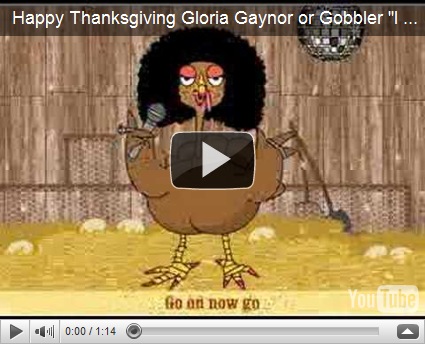
“I Will Survive” – Thanksgiving Version
At first I was an egg, I was petrified* (very scared; very frightened)
Kept thinking I’d be lost or I’d get cracked (for something hard to be broken so that a line appears on the surface) and fried
But you took me to your nest (bird’s home) before it was too late
and kept me warm and you helped me incubate (for an egg to be kept warm until a bird is hatched or born).
And now you’re back, think you’re the boss
Wanna put me on a plate next to your wife’s cranberry sauce (a sweet jelly sauce made from cranberries, eaten at Thanksgiving)
I should have known this day would come
I should have known not to relax
If I thought for just a second that you’d come in here with an ax (tool for cutting wood).
Go on now go, walk out the door
Just turn around now
Ain’t chopping (using a sharp tool to cut) my head to the floor.
Weren’t you the one who prized (highly valued) this dark meat on my thighs (upper part of a leg)?
Do you think I’d gobble (make the noise that a turkey makes)?
Did you think I’d lay down and die?
Oh on, not I.
I will survive.
Oh as long as I know how to peck (for a bird to use its hard mouth (beak) to hit or bite), I know I’ll stay alive.
Got my wings so I won’t fall,
Ain’t selling me to Butterball (popular U.S. company that sells turkeys).
I will survive.
I will survive.
…
* “Petrified” can also mean for a living thing to turn into something very, very hard because it is very old, like a fossil.
 HAPPY THANKSGIVING!!
 "Whereas it is the duty of all Nations to acknowledge the providence of Almighty God, to obey his will, to be grateful for his benefits, and humbly to implore his protection and favor, and whereas both Houses of Congress have by their joint Committee requested me "to recommend to the People of the United States a day of public thanksgiving and prayer to be observed by acknowledging with grateful hearts the many signal favors of Almighty God especially by affording them an opportunity peaceably to establish a form of government for their safety and happiness. Now therefore I do recommend and assign Thursday the 26th day of November next to be devoted by the People of these States to the service of that great and glorious Being, who is the beneficent Author of all the good that was, that is, or that will be. That we may then all unite in rendering unto him our sincere and humble thanks, for his kind care and protection of the People of this Country previous to their becoming a Nation, for the signal and manifold mercies, and the favorable interpositions of his providence, which we experienced in the course and conclusion of the late war, for the great degree of tranquility, union, and plenty, which we have since enjoyed, for the peaceable and rational manner, in which we have been enabled to establish constitutions of government for our safety and happiness, and particularly the national One now lately instituted, for the civil and religious liberty with which we are blessed; and the means we have of acquiring and diffusing useful knowledge; and in general for all the great and various favors which he hath been pleased to confer upon us. And also that we may then unite in most humbly offering our prayers and supplications to the great Lord and Ruler of Nations and beseech him to pardon our national and other transgressions, to enable us all, whether in public or private stations, to perform our several and relative duties properly and punctually, to render our national government a blessing to all the people, by constantly being a Government of wise, just, and constitutional laws, discreetly and faithfully executed and obeyed, to protect and guide all Sovereigns and Nations (especially such as have shown kindness unto us) and to bless them with good government, peace, and concord. To promote the knowledge and practice of true religion and virtue, and the encrease* of science among them and Us, and generally to grant unto all Mankind such a degree of temporal prosperity as he alone knows to be best. Given under my hand at the City of New York the third day of October in the year of our Lord 1789."
*an older spelling of “increase”
Other Links and Articles:
Presidential Proclamation – Thanksgiving Day (released on November 24, 2010 by President Obama)
Thanksgiving Features Native American Foods (VOA News article) & Video
President Obama Pardons Thanksgiving Turkey (VOA News article) & Audio
Watch video of President Obama pardoning the 2010 White House turkey in this unusual White House tradition! Download Video : MP4 (66 MB)


See also President Bush’s 2008 Thanksgiving Proclamation
Political cartoon by Rick McKee of the The Augusta Chronicle in Georgia and published on 21 November 2010.
Clear-cutting is the act of cutting down all the trees in an area. The deforestation of the Brazilian rain jungle is caused by clear-cutting.
If you set up a new business, you start and put it in place. The cartoonist is criticizing how the government set up by the Founding Fathers has been turned into a massive, oversized one.
The government, as most of our Western governments, have run up massive debts! If you run up a bill or a debt, you owe someone a lot of money. With the arrival of winter, we run up our gas bills as we heat our homes more and more.
The cartoonist also criticizes the moral state of the country. He believes that Americans have embraced immorality of every kind. If you embrace a new belief, an idea or a new way of life, you accept it completely.
According to the cartoonist, the embrace of immorality has led the country to devolve into godless socialism. Devolve is the opposite of evolve and has the meaning of deteriorating and degenerating. The cartoonist also expresses the global opinion of Americans concerning socialism as being godless. A form of governance that is considered to be immoral and atheistical by a large part of the American citizenry.
After a harsh winter, the Pilgrims had their first formal contact with the indigenous when on March 16, 1621 an Native American walked boldly into the middle of Plymouth Colony and declared in English, "Welcome, Englishmen!" He also asked if they had any beer! His name was Samoset, a subordinate chief of the Abenaki tribe in Maine, and he was was visiting Chief Massasoit of the Wampanoags. Samoset had learned English from English fishermen that came to fish off the coast of Maine. From Samoset, the colonists learned about the plague that had wiped out the Indians where they had established Plymouth Colony. After spending the night in the settlement, he came back two days later with Tisquantum, better known today as Squanto.
 For the Pilgrims, Tisquantum (or Squanto) was a Godsend. He helped them to recover from the harsh winter teaching them how to plant crops in the New World and where to best catch fish and eels. Around October of 1621 after a fruitful harvest thanks to the help of the Wampanoags, they held "The First Thanksgiving." The colonists didn't refer to this celebration as Thanksgiving because it was more of a harvest festival. For Puritans, thanksgiving was a day of prayer and worship, not revelry. The first real thankgiving was in 1623 with the arrival of new supplies and colonists from England. What Americans really celebrate today is rooted in the European harvest festival tradition.
  The Pilgrims had brought with them a shallop they had dismantled to fit onboard the Mayflower. It had also been damaged during the crossing and so its reparation and reassembling delayed exploration of the coast for two weeks. Finally exploration began under the leadership of Myles Standish, a soldier the Pilgrims met in Leiden and hired to assist them, and Christopher Jones, the Mayflower's master. They found an area of land deserted of all human life with vestiges of old buildings and recently cultivated fields. Artificial mounds which turned out to be Native American graves were discovered and in which they found baskets of maize which they took intending it for planting.
 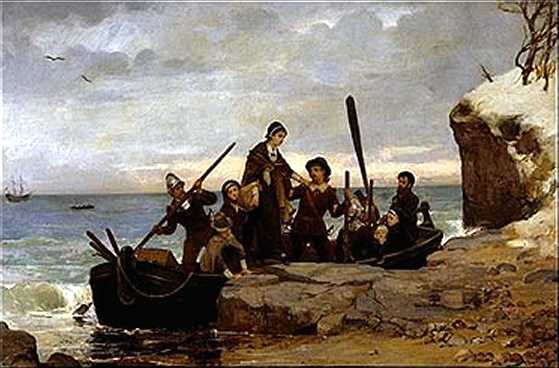 arrived in the area which would become the settlement of Plymouth. They cleared the remains of the village Patuxet which had belonged to the Wampanoag people and whose residents were wiped out by a plague three years earlier. Construction began immediately and the first common house of the Pilgrims was completed on January 19th.
  Finally in September of 1620, the Mayflower set sail for the New World. At first, the sailing was smooth but they encountered rough seas. The crossing was very difficult for the passengers. The ship had to be repaired using some of the Pilgrims' construction supplies. During the passage, one passenger and one crew member died, however one baby was born.
The cornucopia, also called the horn of plenty, has become one of traditional images associated with Thanksgiving in the United States. Historically the symbol dates back to the 5th century and represents food and abundance.
Slide your cursor over the words in bold to learn their definition.
 I am personally not a fan of Halloween though it is much celebrated in the United States. One of the big traditions for this night is a pumpkin carving known as the Jack O’ Lantern.
People are becoming more and more creative when they carve their pumpkin. When you carve a pumpkin, you cut off the top and scoop out the flesh. On the side of the pumpkin, a monstrous or humorous face is carved. Usually the pumpkin sits next to the front door of the house. A candle is lit to illuminate the carving and placed inside. The cut off top replaced as a lid.
The tradition was brought over to the United States with the Irish immigrants. In Ireland and Britain, it was commonplace to carve lanterns out of vegetables such as turnips, potatoes, beets, etc.. These lanterns were carved and placed on the door step on All Hallows’ Eve to ward off evil spirits.
The origins are based in Irish folktales and there are several different versions. Here’s a version I found on the net:
“The Irish brought the tradition of the Jack O' Lantern to America. But, the original Jack O' Lantern was not a pumpkin.The Jack O' Lantern legend goes back hundreds of years in Irish History. As the story goes, Stingy Jack was a miserable, old drunk who liked to play tricks on everyone: family, friends, his mother and even the Devil himself. One day, he tricked the Devil into climbing up an apple tree. Once the Devil climbed up the apple tree, Stingy Jack hurriedly placed crosses around the trunk of the tree. The Devil was then unable to get down the tree. Stingy Jack made the Devil promise him not to take his soul when he died. Once the devil promised not to take his soul, Stingy Jack removed the crosses and let the Devil down.
Many years later, when Jack finally died, he went to the pearly gates of Heaven and was told by Saint Peter that he was too mean and too cruel, and had led a miserable and worthless life on earth. He was not allowed to enter heaven. He then went down to Hell and the Devil. The Devil kept his promise and would not allow him to enter Hell. Now Jack was scared and had nowhere to go but to wander about forever in the darkness between heaven and hell. He asked the Devil how he could leave as there was no light. The Devil tossed him an ember from the flames of Hell to help him light his way. Jack placed the ember in a hollowed out turnip, one of his favorite foods which he always carried around with him whenever he could steal one. From that day onward, Stingy Jack roamed the earth without a resting place, lighting his way as he went with his "Jack O' Lantern". (The Pumpkin Nook)
Here’s a second version:
“Another version of the myth says that Jack was getting chased by some villagers from whom he had stolen, when he met the Devil, who claimed it was time for him to die. However, the thief stalled his death by tempting the Devil with a chance to bedevil the church-going villagers chasing him. Jack told the Devil to turn into a coin with which he would pay for the stolen goods (the Devil could take on any shape he wanted); later, when the coin/Devil disappeared, the Christian villagers would fight over who had stolen it. The Devil agreed to this plan. He turned himself into a silver coin and jumped into Jack's wallet, only to find himself next to a cross Jack had also picked up in the village. Jack had closed the wallet tight, and the cross stripped the Devil of his powers; and so he was trapped.
Jack only lets the Devil go when he agrees never to take his soul. After a while the thief died, as all living things do. Of course, his life had been too sinful for Jack to go to heaven; however, the Devil had promised not to take his soul, and so he was barred from hell as well. Jack now had nowhere to go. He asked how he would see where to go, as he had no light, and the Devil mockingly tossed him an ember that would never burn out from the flames of hell. Jack carved out one of his turnips (which was his favorite food), put the ember inside it, and began endlessly wandering the Earth for a resting place. He became known as ‘Jack of the Lantern’, or Jack-o'-Lantern.” (Wikipedia)
Here are a few more creative Jack O’ Lanterns:


More of these pumpkin carvings can be seen at : http://www.coolpicturegallery.us/2010/10/cool-halloween-pumpkin-jack-o-lanterns.html
http://www1.voanews.com/learningenglish/home/american-life/people/Independence-Day-97620419.html

Or download MP3 (Right-click or option-click and save link)
DOUG JOHNSON: Welcome to American Mosaic in VOA Special English.
(MUSIC)
I’m Doug Johnson.
Today we tell about Independence Day in the United States. This Fourth of July will mark America’s two hundred and thirty-fourth birthday.
We also answer a listener question about a famous American general.
And we hear a poem about the American flag by country singer Johnny Cash.
(MUSIC)
Independence Day
DOUG JOHNSON: The Fourth of July marks the anniversary of America’s Declaration of Independence from Britain. During the summer of seventeen seventy-six, American colonists were deeply divided. Almost one in three was loyal to Britain. Yet most were increasingly angry about what they considered unfair treatment by the British government. By June, fighting had already taken place between colonial forces and Britain. The idea of independence was spreading.
Delegates from the thirteen colonies gathered in Philadelphia, Pennsylvania. The Continental Congress decided that a document declaring separation from Britain should be declared. Thomas Jefferson led a committee chosen to write it.
**(TO READ MORE, CLICK ON THE LINK ABOVE)**
http://www.voanews.com/specialenglish/2009-11-22-voa2.cfm
Sharing some favorite memories, mixed with cold reality about the effects of the economic downturn.
Download MP3 HERE
Transcript of radio broadcast: 22 November 2009
VOICE ONE:
Welcome to THIS IS AMERICA. I'm Faith Lapidus. This Thursday is a day for families and friends to share a special holiday meal and think about what they are thankful for. This week on our program, we ask some people to share their favorite memories of Thanksgiving Day.
(MUSIC)
VOICE ONE:
Special English reporters June Simms and Dana Demange talked to people about the holiday.
JIM OLDHAM: "My name is Jim Oldham and I'm from Nashville, Tennessee. I remember my father drove a bus and my mother was a waitress, and so we often didn't get to have Thanksgiving together. And I remember when I was about twelve, her work and his work permitted us all to do that. And we had brothers and sisters, and the traditional turkey and all the trimmings. We always had pumpkin pie, and if we were really lucky, a little bit of whipped cream on top. And it was just a wonderful day."
ANN GEIGER: "I'm Ann Geiger from Tucson, Arizona. Thanksgiving is special for our family because like so many families our adult children live around the country. And we usually get at least part of them together for Thanksgiving."
REPORTER: "And what is one of your fondest Thanksgiving Day memories?"
ANN GEIGER: "Oh, I think a recent Thanksgiving when my son and I had a turkey cook-off. He brined his turkey and I didn't brine mine. And we decided which one was the best."
REPORTER: "Who won?"
ANN GEIGER: "He did."
VOICE ONE:
Brining is a way to prepare meat in a salt solution, whether for a competitive "cook-off" or just any meal. Traditionally the meat served on Thanksgiving is turkey. The bird is usually served with side dishes including a mixture known either as stuffing or dressing.
Many families also bring out their finest table settings -- the "good china" -- for Thanksgiving.
JOEL UPTON: "My name is Joel Upton. I'm from Livingston, Tennessee. Thanksgiving at my family was always a time when brothers and sisters, aunts and uncles, cousins, we all got together. And someone would bring different dishes. Someone would bring the sweet potatoes. Someone would bring the meat. Someone would bring the dressing. And we would all sort of combine the efforts to have a family Thanksgiving dinner and bring out the good china for that particular event.
And Thanksgiving also, in my early days when I was a child, the kids would all get to play, maybe we hadn't seen each other for a while. The men would always watch a football game on TV. And Thanksgiving was just a really, really special time. And, of course, we had in mind the Pilgrims and what it was all about too. But it was a family time."
VOICE ONE:
The Pilgrims first arrived in America in sixteen twenty. They were separatists from the Church of England and other settlers. The ship that brought the first group was the Mayflower.
An exploring party landed at Plymouth, in what became the Commonwealth of Massachusetts. The state is named after an American Indian tribe -- a recognition of the groups that came long before the Pilgrims.
The first Pilgrims established a village. Those who survived the first difficult years held harvest festivals and religious celebrations of thanksgiving. These events formed the basis of the holiday that Americans now celebrate.
But there are no official "rules" for a Thanksgiving meal. Some people like to find ways to do things a little differently.
BUTCH HUNSINGER: "Butch Hunsinger from Williamsport, Pennsylvania."
REPORTER: "The bird. What are you going to do differently this year?"
BUTCH HUNSINGER: "Try to shoot it myself, instead of go to the store to buy it. Go to the family cabin, and hunt on the family land and try to call in a turkey and fire away."
REPORTER: "And who's the better shot in the family?"
BUTCH: "Oh my son, by far."
REPORTER: "What about your worst Thanksgiving memory?"
BUTCH: "Worst…[Laughter] The worst was also the funnest, 'cause I got up early Thanksgiving day and we went to the Burwick Marathon, but it's a nine-mile road race. Just a crusher." [Laughter]
HUGUETTE MBELLA: "Hi, my name is Huguette Mbella. And I was born in Cameroon and grew up in France. And I live now in the United States in Washington, D.C. The whole concept of Thanksgiving was a little bit bizarre. In France, the main celebration is Christmas, not Thanksgiving."
REPORTER: "Can you think of one of your most fond Thanksgiving memories?"
HUGUETTE MBELLA: "I would say my first one. It was in New York. Suddenly the turkey comes on the table, and I was amazed by the size. It was huge! The first thing that came to my mind was actually that's a lot of food!"
ELIZABETH BRINKMAN: "My name is Elizabeth Brinkman and I'm from Cleveland, Ohio. It was always a day that my mother did all the cooking. And we had turkey and I got to chop the vegetables for the dressing. And we got out the good china."
GORDON GEIGER: "Gordon Geiger from Tucson, Arizona. We used to get together at my parents' house and all of my relatives would come over and we'd have a big dinner. And after dinner we would watch football games on the television.
I think it's probably really the most important holiday in the United States because it is a day that is not tied to a particular religion. It is not tied as much to commercial activities. It's more a reflection of the fact that we've had a good life and we appreciate it."
(MUSIC)
VOICE ONE:
This Thanksgiving, Americans can be thankful that the Great Recession may be over. But the job market faces a long recovery. Unemployment is now above ten percent. And if the underemployed are added, the rate is seventeen and a half percent. The underemployed are people no longer searching for work or only able to find part time jobs.
Last week, the United States Department of Agriculture released its "household food security" report for two thousand eight. The study found that families in seventeen million households had difficulty getting enough food at times during the year. That was almost fifteen percent -- up from eleven percent in two thousand seven. It was the highest level since the current surveys began in nineteen ninety-five.
The Agriculture Department says poverty is the main cause of food insecurity and hunger in the United States.
President Obama, in a statement, called the report unsettling. Especially troubling, he said, is that there were more than five hundred thousand families in which a child experienced hunger multiple times during the year.
He said the first task is to renew job growth, but added that his administration is taking other steps to prevent hunger. These include an increase in aid for people in the government's nutrition assistance program, commonly known as food stamps.
(MUSIC)
VOICE ONE:
The Continental Congress wrote the first national Thanksgiving proclamation in seventeen seventy-seven, during the Revolutionary War. George Washington issued the first presidential Thanksgiving proclamation in seventeen eighty-nine. Here is part of what he wrote.
READER:
Whereas it is the duty of all nations to acknowledge the providence of almighty God, to obey his will, to be grateful for his benefits, and humbly to implore his protection and favor -- and whereas both houses of Congress have by their joint committee requested me "to recommend to the people of the United States a day of public thanksgiving and prayer to be observed by acknowledging with grateful hearts the many signal favors of Almighty God, especially by affording them an opportunity peaceably to establish a form of government for their safety and happiness."
Now therefore I do recommend and assign Thursday the twenty-sixth day of November next to be devoted by the people of these states to the service of that great and glorious being, who is the beneficent author of all the good that was, that is, or that will be ...
VOICE ONE:
Sarah Josepha Hale was a magazine editor and writer who campaigned for a Thanksgiving holiday. That way, there would be "two great American national festivals," she said, the other being Independence Day on the Fourth of July.
In September of eighteen sixty-three, Sarah Josepha Hale appealed to President Abraham Lincoln. Lincoln had made proclamations in the spring of eighteen sixty-two and sixty-three. But these gave thanks for victories in battle during the Civil War.
Then came another proclamation on October third, eighteen sixty-three. It gave more general thanks for the blessings of the year. This is part of what it said:
READER:
In the midst of a civil war of unequaled magnitude and severity, which has sometimes seemed to foreign states to invite and to provoke their aggression, peace has been preserved with all nations, order has been maintained, the laws have been respected and obeyed, and harmony has prevailed everywhere, except in the theater of military conflict, while that theater has been greatly contracted by the advancing armies and navies of the Union.
Needful diversions of wealth and of strength from the fields of peaceful industry to the national defense have not arrested the plow, the shuttle, or the ship; the ax has enlarged the borders of our settlements, and the mines, as well of iron and coal as of the precious metals, have yielded even more abundantly than heretofore. ...
I do therefore invite my fellow-citizens in every part of the United States, and also those who are at sea and those who are sojourning in foreign lands, to set apart and observe the last Thursday of November next as a day of thanksgiving and praise to our beneficent Father who dwelleth in the heavens.
VOICE ONE:
Lincoln's proclamation began a tradition. Presidents have issued Thanksgiving proclamations every year since eighteen sixty-three. All can be found on the Web site of the Pilgrim Hall Museum in Plymouth.
In nineteen forty-one, Franklin Roosevelt was president. Roosevelt approved a resolution by Congress. It established, by law, the fourth Thursday in November as Thanksgiving Day.
(MUSIC)
Our program was produced by Caty Weaver. I'm Faith Lapidus. Join us again next week for THIS IS AMERICA in VOA Special English.

to beg - to ask for help, an opportunity, etc. in a way that shows you want it very much
seldom – rarely, not often

“As we express our gratitude, we must never forget that the highest appreciation is not to utter words, but to live by them.” John Fitzgerald Kennedy, 35th President of the United States
| to express – exprimer |
| gratitude – la reconnaissance |
| to utter – prononcer |

| to set aside – réserver pour |
| to diet – faire régime |

| unchallengeable – incontestable |
| goo – une substance gluante |
| overtone – une connotation |
| delectable – délicieux |
| board – le repas, le couvert |
| uneatable – non comestible |
To renege on something, you decide not to do something that you promised to do. In the cartoon, Babs states that we reneged on every single treaty. In other words, she’s accusing earlier Americans of not honoring the treaties they signed with the native peoples.
As a result, Babs states that Native American culture was decimated and that they were forced into poverty onto squalid reservations. If something is squalid, we say that it is dirty and unpleasant. It can also imply unpleasant conditions because it involves dishonest, illegal or immoral behavior. Many people who live in government housing projects (les cités) live in squalid living conditions.
Even though the official name of this holiday is still “Washington’s Birthday,” it has commonly been called by many Americans as Presidents’ Day. Many schools around the country use the days preceding this holiday to educate students about all US presidents with emphasize on Washington and Lincoln.
To learn more about this US federal holiday, read the Wikipedia article Washington’s Birthday.
See also, Presidents’ Day or Washington’s Birthday?
Celebrate! Holidays in the USA (from the US embassy site in Sweden): George Washington’s Birthday
George Washington’s Birthday from the National Archives
Biography of George Washington at the White House website
George Washington’s Mount Vernon Estate and Gardens
Below is a video from the recent television miniseries, ‘John Adams,’ with an accurate representation of George Washington taking the oath of office as the first US President!
Also check out the History Channel’s video ‘Searching for George Washington’.
Celestial choir! enthron'd in realms of light,
Columbia's scenes of glorious toils I write.
While freedom's cause her anxious breast alarms,
She flashes dreadful in refulgent arms.
See mother earth her offspring's fate bemoan,
And nations gaze at scenes before unknown!
See the bright beams of heaven's revolving light
Involved in sorrows and veil of night!
The goddess comes, she moves divinely fair,
Olive and laurel bind her golden hair:
Wherever shines this native of the skies,
Unnumber'd charms and recent graces rise.
Muse! bow propitious while my pen relates
How pour her armies through a thousand gates,
As when Eolus heaven's fair face deforms,
Enwrapp'd in tempest and a night of storms;
Astonish'd ocean feels the wild uproar,
The refluent surges beat the sounding shore;
Or thick as leaves in Autumn's golden reign,
Such, and so many, moves the warrior's train.
In bright array they seek the work of war,
Where high unfurl'd the ensign waves in air.
Shall I to Washington their praise recite?
Enough thou know'st them in the fields of fight.
Thee, first in peace and honours,—we demand
The grace and glory of thy martial band.
Fam'd for thy valour, for thy virtues more,
Hear every tongue thy guardian aid implore!
One century scarce perform'd its destined round,
When Gallic powers Columbia's fury found;
And so may you, whoever dares disgrace
The land of freedom's heaven-defended race!
Fix'd are the eyes of the nations on the scales,
For in their hopes Columbia's arm prevails.
Anon Britannia droops the pensive head,
While round increase the rising hills of dead.
Ah! cruel blindness to Columbia's state!
Lament thy thirst of boundless power too late.
Proceed, great chief, with virtue on thy side,40
Thy ev'ry action let the goddess guide.
A crown, a mansion, and a throne that shine,
With gold unfading, WASHINGTON! be thine.
This poem was written by a young slave girl from Boston, Phyllis Wheatley. You can learn more about her on Wednesday when there will be a post dedicated to the great African-American poet.
Phillis Wheatley’s poem “To His Excellency General Washington” is as unique as the poet herself. The poem was sent to George Washington, the newly appointed Commander-in-Chief of the Armies of North America, in October of 1775, well before American Independence was declared in 1776. Washington, as busy as he was with organizing the colonies to take on the British, sent a letter back to Wheatley thanking her for the poem and inviting her to visit him if she ever came to Cambridge, Massachusetts. The two did meet in March of 1776, seven years before the war was finished and true independence was declared. Washington was roundly lauded in poems and prose after the successful conclusion of the Revolutionary War in 1783, but Wheatley’s poem was written when the war’s outcome was very uncertain, the British being the obvious favorites to win. It can be said that Wheatley was the groundbreaker in beginning the Washington legend as the “father of our country,” yet she stands as a groundbreaker in even more important ways. In 1773, two years before this poem was written, Phillis Wheatley, a twenty-year-old slave, published her collection of poems entitled Poems on Various Subjects, Religious and Moral, the first book of poetry published by an African American, and only the second book by a woman in what would become the United States. Considering that Ms. Wheatley was bought at a slave auction in 1761, not able to read or write and incapable of speaking English, her book of poems is truly astounding. She was revered in many countries. Benjamin Franklin offered his services to her, as did many other high-ranking men in America. In April of 1776, the author and political philosopher Thomas Paine published Wheatley’s poem to Washington in The Pennsylvania Magazine. The central theme of this poem is “freedom’s cause,” the colonies’ struggle for freedom from England, which General Washington was assigned to lead. Like many other residents of Boston, Wheatley’s feelings for the British regime turned from obedient admiration to mild admonition, and finally, to support of the revolution. The poem anticipates the future for the new republic, and praises the efforts of its military leader and first president.
To learn more about his poem, go to the Study Guide.
February 13, 2009—Archaeologists digging at the site of George Washington's early home have discovered clues about the boyhood of the first U.S. President. (http://news.nationalgeographic.com/news/2009/02/090213-washington-missions-video-wc.html)
| to chop down | - | abattre |
| greatness | - | l’importance, la grandeur |
| to uncover | - | dévoiler, découvrir |
| well-crafted | - | bien fait |
| boyhood | - | l’enfance |
| landscape | - | le panorama |
| outbuilding | - | une dépendance, une annexe |
| tricky | - | délicat |
| trench | - | une tranchée |
| clay pipe | - | une pipe en argile |
| to store | - | conserver |
| to hurl | - | lancer |
 Taken from the official White House website.
 A Proclamation by the President of the United States of AmericaThanksgiving is a time for families and friends to gather together and express gratitude for all that we have been given, the freedoms we enjoy, and the loved ones who enrich our lives. We recognize that all of these blessings, and life itself, come not from the hand of man but from Almighty God.Every Thanksgiving, we remember the story of the Pilgrims who came to America in search of religious freedom and a better life. Having arrived in the New World, these early settlers gave thanks to the Author of Life for granting them safe passage to this abundant land and protecting them through a bitter winter. Our Nation's first President, George Washington, stated in the first Thanksgiving proclamation that "It is the duty of all nations to acknowledge the providence of Almighty God, to obey His will, to be grateful for His benefits, and humbly to implore His protection and favor." While in the midst of the Civil War, President Abraham Lincoln revived the tradition of proclaiming a day of thanksgiving, asking God to heal our wounds and restore our country.Today, as we look back on the beginnings of our democracy, Americans recall that we live in a land of many blessings where every person has the right to live, work, and worship in freedom. Our Nation is especially thankful for the brave men and women of our Armed Forces who protect these rights while setting aside their own comfort and safety. Their courage keeps us free, their sacrifice makes us grateful, and their character makes us proud. Especially during the holidays, our whole country keeps them and their families in our thoughts and prayers. Americans are also mindful of the need to share our gifts with others, and our Nation is moved to compassionate action. We pay tribute to all caring citizens who reach out a helping hand and serve a cause larger than themselves.On this day, let us all give thanks to God who blessed our Nation's first days and who blesses us today. May He continue to guide and watch over our families and our country always.NOW, THEREFORE, I, GEORGE W. BUSH, President of the United States of America, by virtue of the authority vested in me by the Constitution and laws of the United States, do hereby proclaim November 27, 2008, as a National Day of Thanksgiving. I encourage all Americans to gather together in their homes and places of worship with family, friends, and loved ones to strengthen the ties that bind us and give thanks for the freedoms and many blessings we enjoy.IN WITNESS WHEREOF, I have hereunto set my hand this twenty-first day of November, in the year of our Lord two thousand eight, and of the Independence of the United States of America the two hundred and thirty-third.GEORGE W. BUSH


